Of the 1,800+ US mass transit systems ~2% reported that fare revenue exceeded operating costs bit.ly/1EoQyqD http://t.co/Q6t9pB7q8a—
The Hamilton Project (@hamiltonproj) May 14, 2015
1,800 mass transit systems in the US — 2% report fare revenues exceeding operating expenses
11 Jun 2015 Leave a comment
in politics - USA, transport economics Tags: buses, green rent seeking, public transport, public transport deficits, trains
Have the mass kidnappings extended to Oxfam and other principled ODA activists?
11 Jun 2015 Leave a comment
in applied welfare economics, development economics, economic history, growth disasters, growth miracles, politics - Australia, politics - New Zealand, politics - USA Tags: extreme poverty, global poverty, Left-wing hypocrisy, The Great Enrichment, The Great Escape, The Great Fact
Oxfam and other ODA activists should be dancing in the streets to celebrate the doubling of global median income in the last 10 years.
This is awesome news!!
Global median income has doubled(!) over the last 10 yearsNew paper: bit.ly/1JRwv90 http://t.co/4cq6x5pXpu—
Max Roser (@MaxCRoser) May 17, 2015
The only reason for them not doing this as they must have been kidnapped en mass.
Staggering #inequality: Top 1% will own 50% of world's wealth by 2016. Help us to #EvenItUp! http://t.co/NcNOqVcTgS—
Oxfam International (@Oxfam) March 20, 2015
We can only hope for their safe release.
Securing a just world means challenging the power of the 1% say civil society groups #WSF2015 oxf.am/ZfkL http://t.co/r2S0lkBoC2—
Oxfam New Zealand (@oxfamnz) March 23, 2015
Lower prices for oil/other commodities have intensified the slowdown in dev'ing countries wrld.bg/O9hq8 #GEP http://t.co/2IsmedNmgW—
World Bank Pubs (@WBPubs) June 11, 2015
Composition of the bottom 40% of the population in #LAC countries: wrld.bg/NkKZP #sharedprosperity http://t.co/MdublHSp59—
World Bank Pubs (@WBPubs) June 09, 2015
The extreme poor live in conflict & rural areas: wrld.bg/Nynge #endpoverty http://t.co/43HDDI11JR—
World Bank (@WorldBank) May 31, 2015
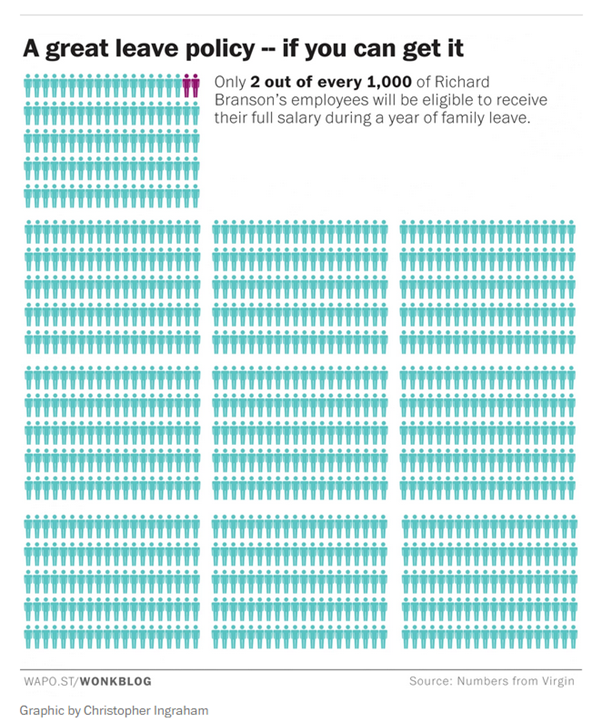
Richard Branson has announced a great paid leave policy for .2 percent of his workers
11 Jun 2015 Leave a comment
in discrimination, entrepreneurship, gender, labour economics, labour supply, occupational choice, politics - Australia, politics - New Zealand, politics - USA Tags: entrepreneurial alertness, maternity leave, paternity leave, Richard Branson
Trends in what drives single motherhood
11 Jun 2015 Leave a comment
Divorce used to be biggest engine of single parenthood in America. No more. It's nonmarital childbearing cc@davidfrum http://t.co/J5yZtUukNW—
W Bradford Wilcox (@WilcoxNMP) June 10, 2015
What it would take for the US to run on 100% renewable energy
10 Jun 2015 Leave a comment
in energy economics, environmental economics, global warming, politics - USA Tags: expressive voting, geothermal power, hydroelectric power, rational ignorance, rational irrationality, renewable energy, solar power, tidal power, wind power
/cdn0.vox-cdn.com/uploads/chorus_asset/file/3768834/jacobson-us-renewables-2015.png)
How do presidential candidates spend $1 billion?
10 Jun 2015 Leave a comment
in politics - USA, Public Choice Tags: campaign finance regulation, expressive voting, rational ignorance, rational irrationality

New Zealand primary school teachers have experienced rapid wages growth by international standards
10 Jun 2015 Leave a comment
in economics of education, human capital, labour economics, labour supply, occupational choice, politics - Australia, politics - New Zealand, politics - USA Tags: teachers pay
Should the New Zealand superannuation fund try to beat the market?
09 Jun 2015 Leave a comment
in entrepreneurship, financial economics, politics - New Zealand Tags: active investing, ageing society, demographic crisis, efficient markets hypothesis, entrepreneurial alertness, New Zealand superannuation fund, old age pensions, passive investing, retirement savings
Most mutual funds still can't beat their benchmark read.bi/1GkTig1 http://t.co/r7ezoDGJbV—
BI Chart of the Day (@chartoftheday) June 03, 2015
Household energy price inflation in New Zealand
09 Jun 2015 Leave a comment
in energy economics, politics - New Zealand Tags: child poverty, consumer price index, CPI inflation, energy prices, family poverty, fuel poverty, power prices
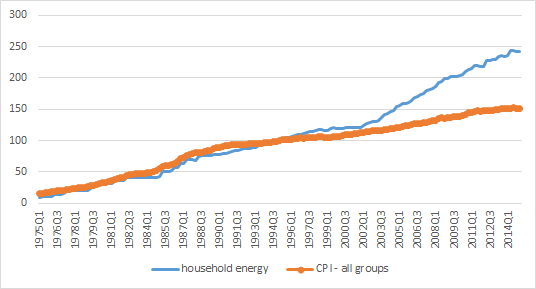
Energy prices seem to have been roaring ahead of consumer prices since the first quarter of 2001. Maybe that is a major contributor to fuel poverty in New Zealand and material deprivation among more poor households in the winter. What gives?
Figure 1: ratio of household energy price index to consumer price index – all groups, March quarter 1995 – March quarter 2015, base = 1995

Source: Statistics New Zealand Infoshare.
Figure 2: Household energy price index and consumer price index – all groups, March quarter 1975 – March quarter 2015, base = 1995
Source: Statistics New Zealand Infoshare.
What It’s Like to Be Declared Dead by the US Government
09 Jun 2015 Leave a comment
in economics of bureaucracy, economics of regulation, politics - USA Tags: government failure, Social Security numbers
In 2011, the Office of the Inspector General conducted an audit of the Death Master File, and found that, from May 2007 to April 2010, 36,657 living people (12,219 per year) had been prematurely added, nulling them legally dead. After probing deeper, officials estimated that between 700 and 2,800 people were erroneously declared dead every month since the list’s inception. Over the file’s 35-year history, the Inspector General suspects that more than 500,000 Americans have been affected.

Corporate welfare in New Zealand – 2015 budget update
09 Jun 2015 2 Comments
in applied price theory, applied welfare economics, comparative institutional analysis, economics of bureaucracy, industrial organisation, politics - New Zealand, rentseeking, survivor principle Tags: corporate welfare
I have updated my 2014 report on corporate welfare for the 2015 budget. My report was published today by the Taxpayers’ Union.
My key finding was that corporate welfare increased in the 7th budget of the National Party-led Government from $1.178 billion in its 2014 budget to $1.344 billion in the 2015 budget – see figure 1 and table 1.
Figure 1: Corporate welfare, Budgets 2008/09 to 2015/16

Source: New Zealand budget papers, various years.
Table 1: Corporate welfare in Budgets 2008/09 to 2015/16, $million
| 08/09 | 09/10 | 10/11 | 11/12 | 12/13 | 13/14 | 14/15 | 15/16 | |
| Arts, Culture & Heritage |
3 |
11 |
19 |
10 |
29 |
4 |
4 |
42 |
| Commerce and Consumer Affairs |
6 |
6 |
6 |
6 |
7 |
7 |
6 |
7 |
| Communications |
0 |
25 |
39 |
150 |
178 |
205 |
215 |
190 |
| Economic Development |
372 |
419 |
446 |
379 |
332 |
284 |
280 |
297 |
| Finance |
16 |
44 |
3 |
108 |
15 |
210 |
0 |
0 |
| Primary Industries |
700 |
0.3 |
14 |
0.0 |
43 |
65 |
77 |
180 |
| Science and Innovation |
0 |
4 |
0 |
0 |
0 |
112 |
219 |
269 |
| Tourism |
76 |
94 |
119 |
113 |
98 |
124 |
124 |
121 |
| Transport |
578 |
530 |
376 |
510 |
680 |
119 |
255 |
239 |
| Total $million |
1,751 |
1,134 |
1,022 |
1,277 |
1,382 |
1,130 |
1,178 |
1,344 |
Source: New Zealand budget papers, various years.
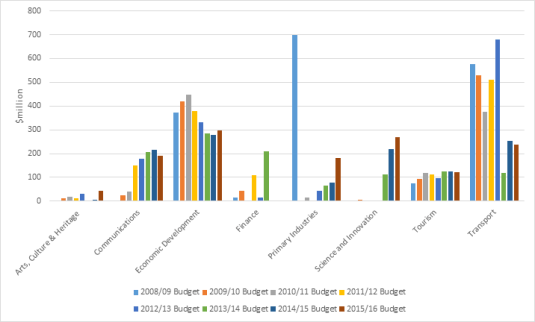
Corporate welfare has ranged between about $1 billion and $1.4 billion per year in each of the seven budgets presented by the current National-led Government – see Table 1 and Figures 1 and 2.
Figure 2: Corporate welfare, Budgets 08/09 to 15/16 by Vote
Source: New Zealand budget papers, various years; note: Vote Commerce and Consumer Affairs omitted in all years from Figure 2.
The predominant recipient of corporate welfare in this year’s budget, and all of those since 2008 is KiwiRail. Vote Transport accounts for a third of all corporate welfare – see Figures 3 and 4. Vote Economic Development is the next largest source of corporate welfare and accounts for 28% of the total since 2008 – see Figures 3 and 4.
Figure 3: Distribution of total corporate welfare across votes, 2008/09 to 2015/16

Source: New Zealand budget papers, various years.
Figure 4: State-owned enterprise welfare, Vote Transport and Vote Finance (KiwiRail), Budgets 08/09 to 15/16

Source: New Zealand budget papers, various years.
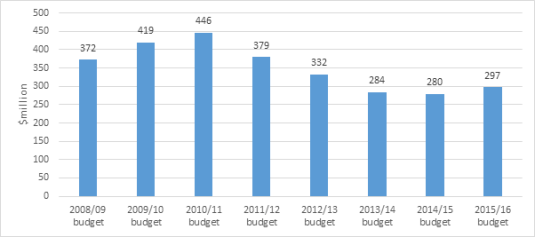
$280 – $450 million in corporate welfare has been under the patronage of the Minister for Economic Development over the last eight budgets – see Figure 5. In this year’s budget, corporate welfare under the Minister’s hand has increased slightly from $280 million to $297 million.
Figure 5: Corporate welfare, Vote Economic Development, Budgets 2008/09 to 2015/16
Source: New Zealand budget papers, various years.
Up until the 2013/14 budget, science and innovation spending was targeted at research that would not find private sponsors because it could not capture the returns from their discoveries – see Figure 6. Figure 6 shows that there is being rapid growth within Vote Science and Innovation of various forms of start-up and commercialisation grants in recent budgets.
Figure 6: Corporate welfare, Vote Science and Innovation, Budgets 08/09 to 15/16

Source: New Zealand budget papers, various years.
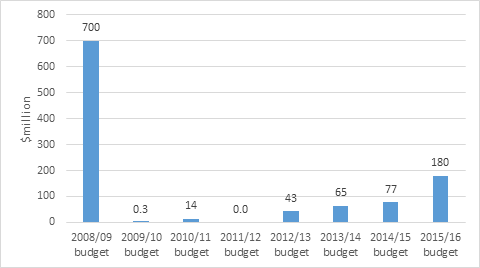
Figure 7 shows that the Government is getting back into the business of subsidising agriculture. The Primary Growth Partnership (PGP) is an R&D grants programme for the primary industry sector. There are 18 PGP programmes underway with a funding commitment from government and from industry combining to $708 million by 2017.
Figure 7: Farm welfare, Vote Primary Industries, Budgets 08/09 to 15/16
Source: New Zealand budget papers, various years.
Figure 8 shows that the National Party-led government is a major investor in ultrafast broadband – going where private entrepreneurs fear to tread.
Figure 8: Corporate welfare, Vote Communications, Budgets 08/09 to 15/16

Source: New Zealand budget papers, various years.
The corporate welfare in the Budget 2015 adds about six percentage points to the company tax rate. Should these corporate indulgences should continue or should the company tax rate drop six percentage points?
If that six percentage points on top of the company tax rate was renamed a business subsidies levy, how many businesses would want to pay it rather than developing their own business under much lower company tax rate?
The price, output and acreage effects of a GMO ban
08 Jun 2015 Leave a comment
in development economics, economics of regulation, environmental economics, growth disasters, growth miracles, health economics, politics - Australia, politics - New Zealand, politics - USA, population economics, technological progress Tags: agricultural economics, expressive voting, extreme poverty, global hunger, global poverty, GMOs, Left-wing hypocrisy, rational ignorance, rational irrationality, The Great Fact
Organic farming is a gift….
facebook.com/welovegv http://t.co/iu8Jq0KcHD—
C. S. Prakash (@AgBioWorld) June 05, 2015
Projected increases in corn and soy prices in a world without GMOs
ageconsearch.umn.edu/bitstream/2049… http://t.co/PNydjpl59K—
C. S. Prakash (@AgBioWorld) June 08, 2015
If you outlaw GMOs, be prepared to bring millions of acres of forest land, cropland & pasture under farming http://t.co/H9ftkxhXYe—
C. S. Prakash (@AgBioWorld) June 08, 2015
If GMOs are banned today in the US, what would be the crop yield reduction? http://t.co/pEn73PODcR—
C. S. Prakash (@AgBioWorld) June 08, 2015
Maggie Thatcher on the 2015 New Zealand budget
08 Jun 2015 Leave a comment
in politics - New Zealand Tags: 2015 Budget, Leftover Left
Quote of the Day: Lady Thatcher didn't always get a fair hearing. #QOTD http://t.co/qefQSZScka—
CPS Think Tank (@CPSThinkTank) May 18, 2015
How to argue for doing nothing about global warming when arguing for a climate club enforced by green tariffs!
08 Jun 2015 1 Comment
in environmental economics, global warming, politics - Australia, politics - New Zealand, politics - USA, Public Choice Tags: climate treaties, club goods, free-riders, global warming, green tariffs, international public goods
The best case I’ve seen recently for doing nothing about global warming was put by those arguing with the greatest sincerity and considerable technical skill that the next international climate treaty should be built around a climate club of those that comply with its obligations with green tariffs on those who do not join.
I have long argued that green tariffs are the only reason to do anything about climate change. Much better to collect the revenue ourselves than let it go into the pockets of a foreign taxman.
William Nordhaus has proposed climate clubs as a way of overcoming free riding in international climate negotiations. Specifically, the international climate treaty should authorise members to impose green tariffs on non-members to encourage them to impose their own carbon taxes and carbon emission targets. This has been done before with the Montréal protocol on CFCs. To encourage the phase-out of CFCs countries that did not commit to do so simply could not trade in those goods with members of the club.
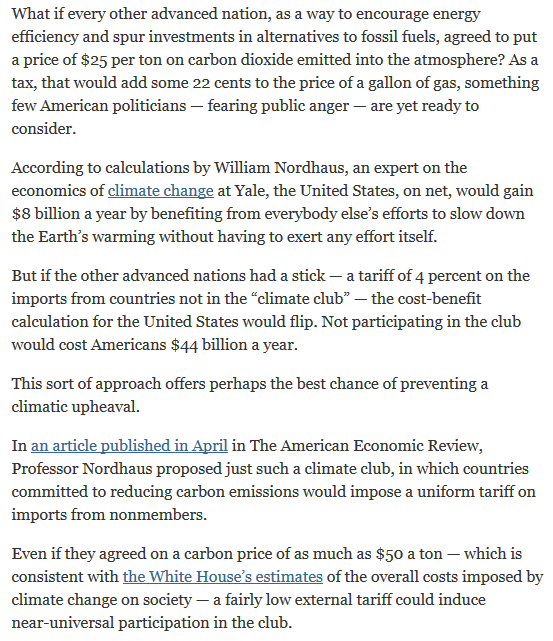
via Climate Deal Badly Needs a Big Stick – NYTimes.com.
4%! A 4% global green tariff is all that is necessary under a climate change treaty that proposes that a carbon price of $50 to apply globally! A 4% green tariff is hardly worth worrying about considering tariffs used to be much much higher than that.
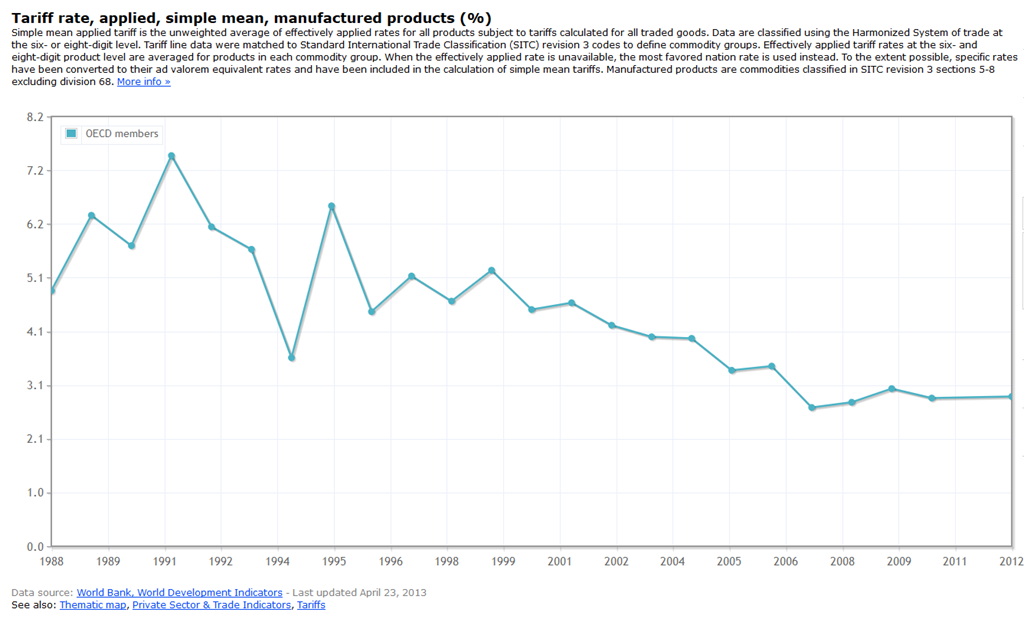
Given all the stories of why woe and doom touted out by the climate alarmists, climate salvation and the keys to environmental heaven should cost much more than 4% tax?! Your sins are forgiven for a 4% green tariff! Big problems such as a climate crisis are not solved with a 4% green tariff.
I think this green tariff of 4% is an own goal. It reinforces the clear message from the economics of climate change that global warming is actually a small economic problem not a large one.
For developed countries, global warming will be at most a minor irritant. For developing countries, their best solution and the solution they have most control over is to develop faster and become a developed country.
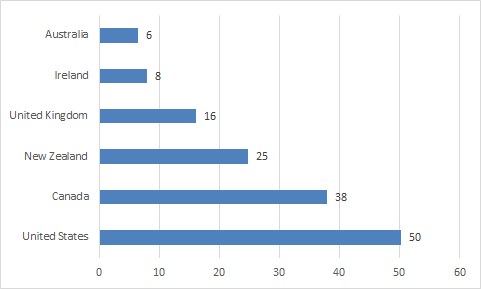
In which Anglo-Saxon country is full-time work not enough to escape family poverty on the minimum wage?
07 Jun 2015 1 Comment
in labour economics, minimum wage, politics - Australia, politics - New Zealand, politics - USA, population economics, poverty and inequality, welfare reform Tags: earned income tax credit, poverty traps, single parents, taxation and the labour supply, welfare state
Figure 1: Weekly working hours needed at minimum-wage to move above a 50% relative poverty line after taxes, mandatory social or private contributions payable by workers, and family benefits for lone parent with two children, Anglo-Saxon countries, 2013


Recent Comments