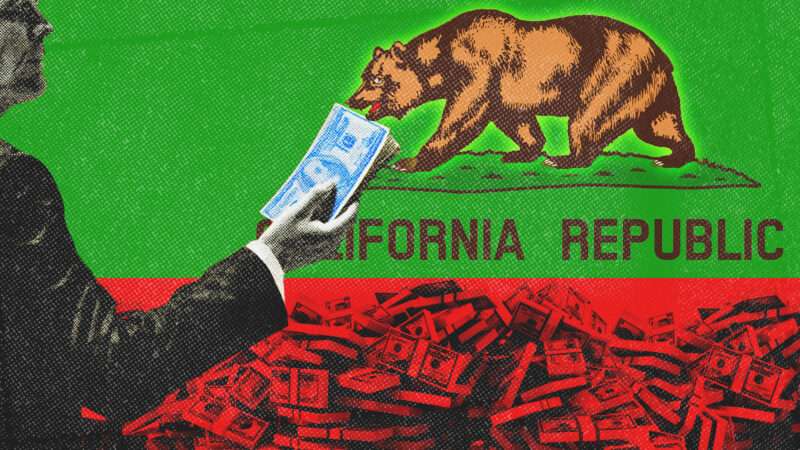
The planned wealth tax leads slightly in the polls and is already driving capital flight.
Report: California’s Proposed ‘Billionaire Tax’ Is Based on Bad Research
Celebrating humanity's flourishing through the spread of capitalism and the rule of law
19 Sep 2026 Leave a comment
in fiscal policy, macroeconomics, Marxist economics, politics - USA, public economics Tags: California, taxation and entrepreneurship, taxation and investment
The planned wealth tax leads slightly in the polls and is already driving capital flight.
Report: California’s Proposed ‘Billionaire Tax’ Is Based on Bad Research
17 Sep 2026 Leave a comment
in economic history, labour economics, politics - USA, poverty and inequality
17 Sep 2026 Leave a comment
in defence economics, economics of crime, law and economics, laws of war, politics - USA, war and peace

The Kentucky congressman says he will force a vote on removing Hegseth, who is accused of “abusing the power of his office to ignore congressional war powers resolutions, to kidnap foreign leaders, and to intimidate critics of the Trump administration.”
Thomas Massie Just Filed 8 Articles of Impeachment Against Pete Hegseth
17 Sep 2026 Leave a comment
in economics of regulation, law and economics, politics - USA, property rights Tags: constitutional law

A challenge to the federal prohibition on home distilling could give the Supreme Court a chance to rein in Congress’ Commerce Clause power.
Can the Feds Ban You From Making Liquor in Your Own Home?
16 Sep 2026 Leave a comment
in economics of climate change, economics of regulation, energy economics, environmental economics, environmentalism, global warming, politics - USA
They’re not only repealing the Endangerment Finding, but also trying to make it so future presidents can’t reinstate it. The post BREAKING: EPA eliminates rule that limits ‘greenhouse gas’ emissions from power plants appeared first on Watts Up With That?.
BREAKING: EPA eliminates rule that limits ‘greenhouse gas’ emissions from power plants
15 Sep 2026 Leave a comment
in discrimination, economics of regulation, human capital, labour economics, labour supply, occupational choice, occupational regulation, politics - USA Tags: racial discrimination
Bob Edlin writes – After a year in the job as chief executive of the Real Estate Institute of New Zealand, Lizzy Fyley discussed a range of industry issues with The Post. One matter that was not addressed was the governance role of the Real Estate Authority in the light of its cancellation of Auckland […]
Post article overlooks REINZ chief’s thought about the REA’s treatment of Janet Dickson and the role of Maori culture
15 Sep 2026 Leave a comment
in politics - New Zealand Tags: 2026 general election
This week’s Taxpayers Union/Curia poll attracted far more attention than a single poll should. This was principally because it recorded support for Labour now being below what it was at the time of its defeat at the last election. However, at their best, polls are but a snapshot in time, with the long-term trends they […]
Hipkins’ uphill battle
15 Sep 2026 Leave a comment
in international economics, law and economics, politics - USA, Public Choice Tags: child labour, free trade, tarrifs
The Cato Institute, Michael McConnell, and I filed an amicus brief in litigation challenging Trump’s massive Section 301 tariffs, which use “forced labor” as a pretext for sweeping protectionism.
Our New Amicus Brief in the Section 301 Tariff Case
15 Sep 2026 Leave a comment
in economics of crime, law and economics, politics - USA
The prison abolitionist movement has been gaining steam across the country with the rise of radical left candidates such as…
The Abolitionist Movement: Professor Argues for “Care and Accountability Circles” as an Alternative to Prisons
14 Sep 2026 Leave a comment
in applied price theory, economic growth, economic history, macroeconomics, politics - USA Tags: The Great Enrichment
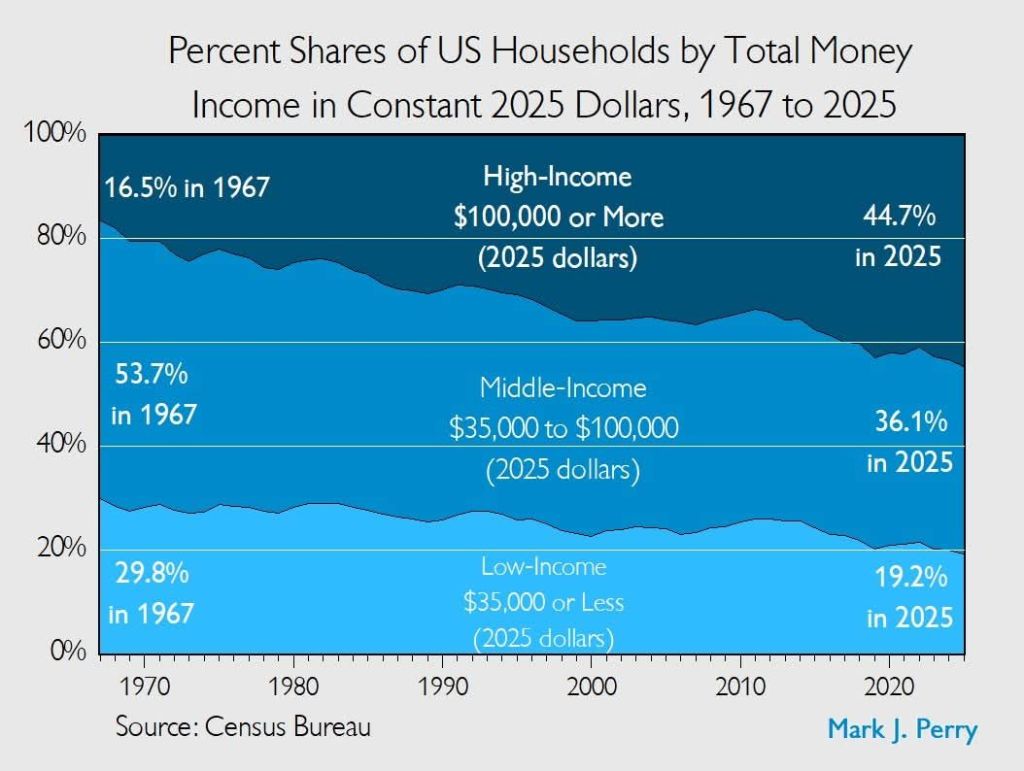
I have a four-part series (here, here, here, and here) documenting that Americans are getting richer over time, yet many people feel pessimism and dissatisfaction. This Kite & Key video helps to explain this seeming contradiction. If you don’t want to watch a 10-minute video, here are two charts that summarize the message. This first […]
How to Make Life Better for the Middle Class (and Everyone Else)
13 Sep 2026 Leave a comment
in applied price theory, discrimination, economic history, economics of education, gender, human capital, labour economics, labour supply, occupational choice, politics - New Zealand, poverty and inequality Tags: feminism, gender, gender wage gap, history, politics, sex discrimination, women
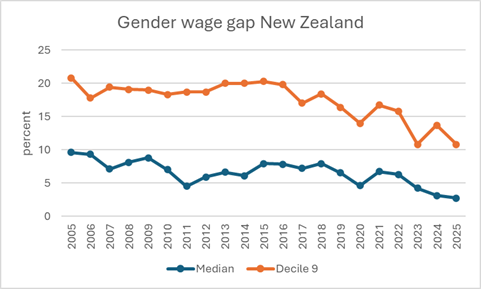
The gender wage gap has dropped by two-thirds in the last 30 years. It has halved since the first pay equity claim was filed 14 years ago. The gender wage gap is now barely 5.5% in June 2026 according to the recently released Statistics New Zealand data. It is a stretch to file pay equity claims asking for 30% more when the gender wage gap struggles to stay above 5%.
The gender wage gap data released by Statistics New Zealand recently is the raw data. There are no adjustments to that pay gap for differences in educational backgrounds, continuity of employment and dedication to demanding careers, unsocial hours, risk of injury, and the greater desire of women for work-life balance and jobs with more working from home options.
It is not mischievous to say that the gender wage gap may round down to zero once these factors are considered.
From time-to-time, detailed datasets become available on male and female workers that show that the gender wage gap goes down or close to zero. There are even detailed datasets where hiring and job assignments are made without any management intervention or possible bias.
There is a large gender wage gap driven by work-life balance under a bus and train drivers’ collective agreement in Massachusetts. The work-force was one-third female with hiring via a lottery among applicants with a clean record. Shifts are chosen by drivers strictly according to their seniority at each depot.
There was still a 11% gender wage gap because women drivers elected to work less overtime, they avoided overtime shifts on short notice, and they worked fewer shifts at nights and weekends. This gender wage gap among bus and train drivers cannot be the fault of their sexist employer because work was allocated by an exceptionally detailed union contract.
A 7% gender wage gap emerged even when a computer algorithm is allocating the work first come, first served.
A study of Uber drivers found a gender pay gap of zero once account is taken for male Uber drivers driving more at nights, weekends and in the more dodgy neighbourhoods with drinking establishments. Male Uber drivers also worked more hours per year which meant they had much more work experience than female Uber drivers. These additional hours meant men became more skilled in deciding when and where to best cruise for the best paying jobs. The fact that men drive faster explained the last two percentage points of the gender pay gap at Uber. Speed meant men were available for the next Uber job quicker.
The gender wage gap is just into the double digits for the top 10% of female earners in New Zealand in 2025 (see OECD graphic). This is because their chosen careers are often not family friendly. But even at the top end of town the gender pay gap has halved in the last 20 years.
Women’s willingness to trade work-life balance for lower wages and fewer promotions is a big driver of the gender wage gap and the channelling of women into family friendly occupations. The wages of men and women at all levels are similar in the years leading up to motherhood then everything changes.
Top American labour economist Claudia Goldin found that some careers severely penalise any time off such as for motherhood or working less than punishingly long or rigid hours. Goldin refers to these jobs as greedy jobs. Women’s preference for family friendly occupations that can pay less and a tendency to avoid greedy jobs will mean that the gender wage gap may always be with us at least at the big end of town.
12 Sep 2026 Leave a comment
in defence economics, politics - USA, war and peace Tags: war against terror
I just read this transcript of the call from Todd Beamer on United Airlines Flight 93, and it made me cry. I recall reading it back in 2001, but not since. 9/11 changed the entire world, but it also was about huge personal tragedies for families and friends, and feats of heroism. I also was…
9/11 25 years on
11 Sep 2026 Leave a comment
in defence economics, economics of crime, law and economics, laws of war, politics - USA, war and peace Tags: war against terror

Before I get into the story of Mohamed Atta, there is something I need to get off my chest. It appears that in the last few years, there has been a gradual downgrading of acts of terrorism. Terrorists are no longer called terrorists but militants. There are two definitions of a militant:1, Engaged in warfare […]
Mohamed Atta—The Evil Ringleader of the 9/11 Attacks
11 Sep 2026 Leave a comment
in defence economics, economics of crime, International law, law and economics, laws of war, politics - USA, war and peace Tags: war against terror
11 Sep 2026 Leave a comment
in applied price theory, economics of information, economics of regulation, industrial organisation, international economic law, international economics, politics - Australia, politics - New Zealand, regulation
Bilateral, plurilateral, and multilateral are words that New Zealand’s civil service love. There is nothing that can’t be improved by doing it in concert with others. Sometimes there’s good reason for just doing stuff. New Zealand made the right decision when it unilaterally slashed all of its tariffs. It also progressed all the other trade agreements that helped…
The case for unilateral recognition
Celebrating humanity's flourishing through the spread of capitalism and the rule of law
Celebrating humanity's flourishing through the spread of capitalism and the rule of law
Celebrating humanity's flourishing through the spread of capitalism and the rule of law
Celebrating humanity's flourishing through the spread of capitalism and the rule of law
Celebrating humanity's flourishing through the spread of capitalism and the rule of law
Celebrating humanity's flourishing through the spread of capitalism and the rule of law
Celebrating humanity's flourishing through the spread of capitalism and the rule of law
Celebrating humanity's flourishing through the spread of capitalism and the rule of law
Celebrating humanity's flourishing through the spread of capitalism and the rule of law
A History of the Alt-Right
Econ Prof at George Mason University, Economic Historian, Québécois
Celebrating humanity's flourishing through the spread of capitalism and the rule of law
Scholarly commentary on law, economics, and more
Beatrice Cherrier's blog
Celebrating humanity's flourishing through the spread of capitalism and the rule of law
Celebrating humanity's flourishing through the spread of capitalism and the rule of law
Celebrating humanity's flourishing through the spread of capitalism and the rule of law
Why Evolution is True is a blog written by Jerry Coyne, centered on evolution and biology but also dealing with diverse topics like politics, culture, and cats.
Celebrating humanity's flourishing through the spread of capitalism and the rule of law
A rural perspective with a blue tint by Ele Ludemann
DPF's Kiwiblog - Fomenting Happy Mischief since 2003
Celebrating humanity's flourishing through the spread of capitalism and the rule of law
The world's most viewed site on global warming and climate change
Tim Harding's writings on rationality, informal logic and skepticism
A window into Doc Freiberger's library
Let's examine hard decisions!
Commentary on monetary policy in the spirit of R. G. Hawtrey
Thoughts on public policy and the media
Celebrating humanity's flourishing through the spread of capitalism and the rule of law
Politics and the economy
A blog (primarily) on Canadian and Commonwealth political history and institutions
Reading between the lines, and underneath the hype.
Economics, and such stuff as dreams are made on
"The British constitution has always been puzzling, and always will be." --Queen Elizabeth II
Celebrating humanity's flourishing through the spread of capitalism and the rule of law
Celebrating humanity's flourishing through the spread of capitalism and the rule of law
WORLD WAR II, MUSIC, HISTORY, HOLOCAUST
Undisciplined scholar, recovering academic
Celebrating humanity's flourishing through the spread of capitalism and the rule of law
Res ipsa loquitur - The thing itself speaks
In Hume’s spirit, I will attempt to serve as an ambassador from my world of economics, and help in “finding topics of conversation fit for the entertainment of rational creatures.”
Researching the House of Commons, 1832-1868
Reflections on books and art
Posts on the History of Law, Crime, and Justice
Celebrating humanity's flourishing through the spread of capitalism and the rule of law
Exploring the Monarchs of Europe


Recent Comments