RT @NickEvershed: Swimmers v cozzies, scallops v potato cakes – maps of Australian language http://t.co/bkmQVVhF8O http://t.co/DZe5M3Q90i
— Guardian Data (@GuardianData) October 20, 2014
Australian dialects mapped
18 Jun 2015 Leave a comment
in politics - Australia Tags: Australia, economics of languages
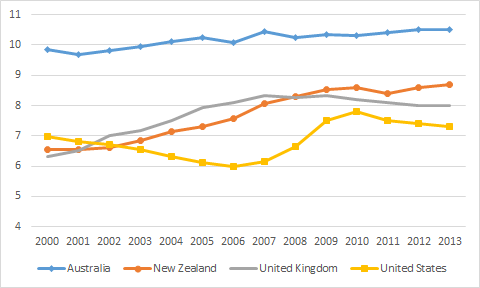
Trends in the real minimum wage, PPP, Australia, New Zealand, USA and UK since 2000
18 Jun 2015 Leave a comment
in economic history, labour economics, minimum wage, politics - Australia, politics - New Zealand, politics - USA Tags: Australia, British economy
Figure 1: real minimum wage, 2013 constant prices, purchasing power parity, US$, Australia, New Zealand, USA and UK
Source: OECD StatExtract.
Education and single motherhood
18 Jun 2015 Leave a comment
in economics of education, gender, labour economics, labour supply, occupational choice, politics - Australia, politics - New Zealand, politics - USA, welfare reform Tags: single mothers
There's a clear increase in single-parent households for parents who haven’t gone to college: on.wsj.com/1B1Xeuq http://t.co/eW2fH8bX5O—
Real Time Economics (@WSJecon) May 17, 2015
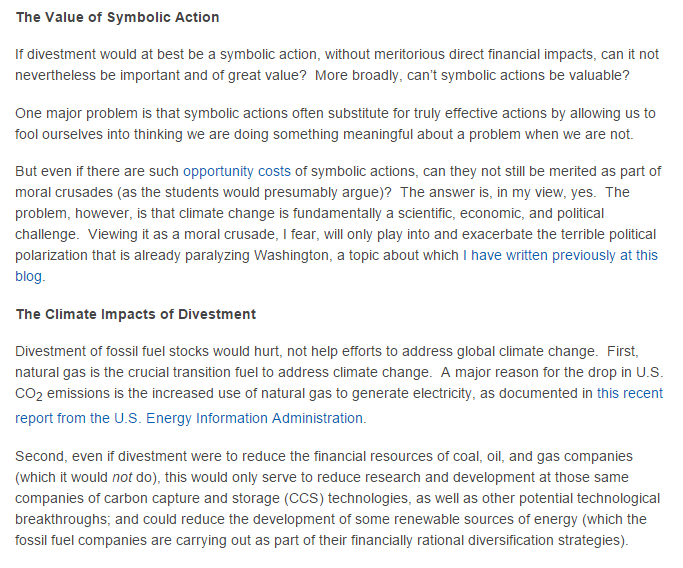
The opportunity cost of expressive politics: fossil fuels disinvestment versus actually doing something that might help
17 Jun 2015 Leave a comment
in applied price theory, applied welfare economics, comparative institutional analysis, environmental economics, global warming, politics - Australia, politics - New Zealand, politics - USA, Public Choice, rentseeking Tags: cap and trade, carbon tax, carbon trading, climate alarmism, expressive voting, fossil fuel disinvestment, global warming, rational irrationality, Robert Stavins
Gender differences in PISA scores, 2012, UK, USA, New Zealand and Australia
16 Jun 2015 Leave a comment
in economics of education, human capital, labour economics, occupational choice, politics - Australia, politics - New Zealand, politics - USA Tags: economics of personality traits, gender gap, PISA, reversing gender gap
Boys’ dominance just about endures in maths: at age 15 they are, on average, the equivalent of three months’ schooling ahead of girls. In science the results are fairly even.
But in reading, where girls have been ahead for some time, a gulf has appeared. In all 64 countries and economies in the study, girls outperform boys. The average gap is equivalent to an extra year of schooling.
Figure 1: : Gender differences (boys – girls) in student performance in reading, mathematics and science in PISA 2012

Source: OECD family database.
Yield of organic crops as percentage of conventional crops
16 Jun 2015 Leave a comment
in environmental economics, environmentalism, health economics, politics - Australia, politics - New Zealand, politics - USA Tags: agricultural economics, food snobs, organic farming
Yield of organic row crops as percentage of conventional
ganaderiayagro.blogspot.com/2015/05/organi… http://t.co/pjdbNEhvSH—
C. S. Prakash (@AgBioWorld) June 01, 2015
Why organic food costs more? -relative yield vs. conventional
ganaderiayagro.blogspot.com/2015/05/organi… http://t.co/xWcQiJoZ6K—
C. S. Prakash (@AgBioWorld) June 01, 2015
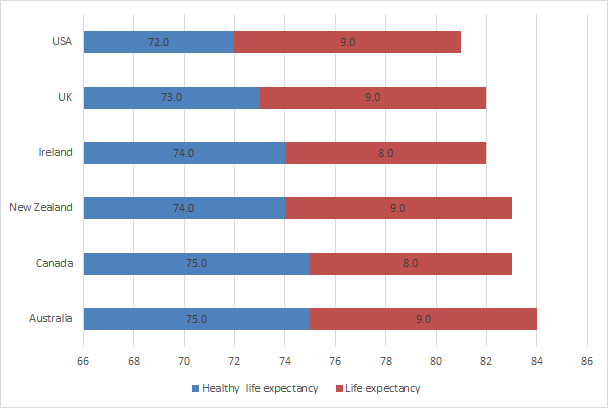
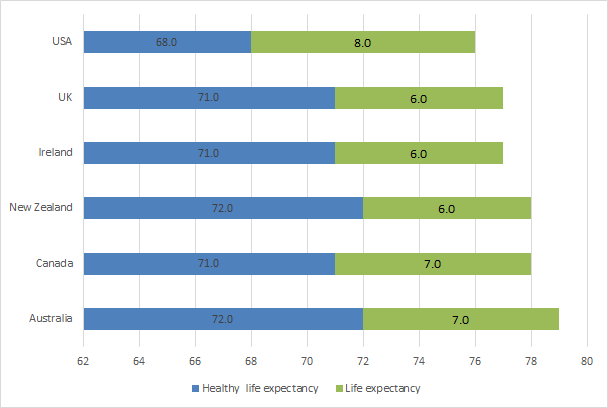
Life expectancy and healthy life expectancy by gender, Anglo-Saxon countries
15 Jun 2015 Leave a comment
in health economics, labour economics, politics - Australia, politics - New Zealand, politics - USA, population economics Tags: ageing society, healthy life expectancy, life expectancy, The Great Escape
Figure 1: life expectancy and healthy life expectancy of women, Anglo-Saxon countries, 2010
Source: OECD family database.
Figure 2: life expectancy and healthy life expectancy of men, Anglo-Saxon countries, 2010
Source: OECD family database
The reverse gender tertiary education gap for ages 25–34, Anglo-Saxon countries
14 Jun 2015 Leave a comment
in discrimination, economics of education, gender, human capital, labour economics, labour supply, occupational choice, politics - Australia, politics - New Zealand, politics - USA Tags: Australia, British economy, Canada, College premium, education premium, gender wage gap, Ireland
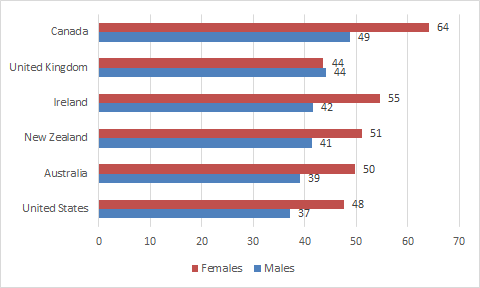
Figure 1: % population who have attained at least tertiary education, age 25 – 34 by gender (2012)
Source: OECD family database.
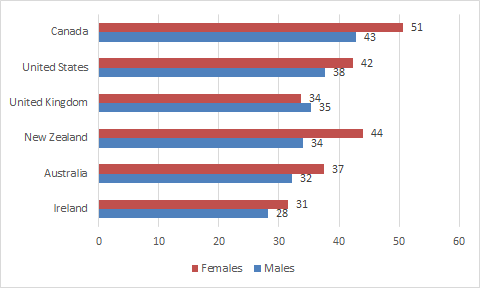
Figure 2 shows that the stark reversing of the gender gap in educational attainment shown in figure 1 was somewhat more recent in the US, UK and to a lesser extent in Ireland and Australia. In the UK and USA, educational attainment by gender was pretty equal for the earlier generation of graduates as compared to today’s 25 to 34-year-olds. The reversing of the gender gap in educational attainment dates back several decades in Canada and New Zealand.
Figure 2: % population who have attained at least tertiary education, age 45 – 54 by gender (2012)
Source: OECD family database.
Gender wage gaps for tertiary educated and high school educated full-time workers in Anglo-Saxon countries
13 Jun 2015 Leave a comment
in discrimination, gender, human capital, labour economics, labour supply, occupational choice, politics - Australia, politics - New Zealand, politics - USA, poverty and inequality Tags: asymmetric marriage premium, Australia, British economy, Canada, gender wage gap, Ireland, labour demographics, maternal labour supply
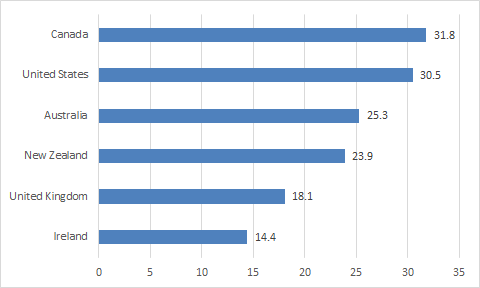
In another blow for the inherent inequality of bargaining power between workers and employers, and for the patriarchy, the wage gap is larger for tertiary educated female full-time workers aged 35-44 than it is for female full-time workers who just finished high school.
Figure 1: gender wage gap for mean full-time, full-year earnings for tertiary educated workers aged 35 – 44, 2012
Source: OECD family database.
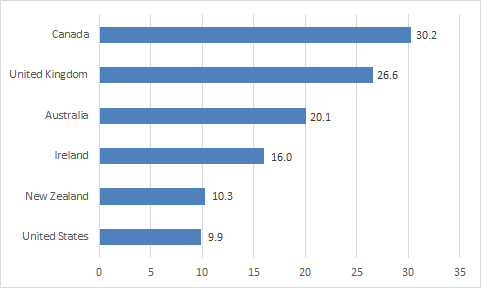
To add insult to injury, the gender wage gap further tertiary educated female workers is quite large in the USA but quite small for high school graduates.
Figure 2: gender wage gap for mean full-time, full-year earnings for below upper secondary educated workers aged 35 – 44, 2012
Source: OECD family database.
Canada seems to be a bit of a patriarchal hellhole while New Zealand does pretty well in gender wage gaps.
The gender gap in figure 1 and in figure 2 are unadjusted and calculated as the difference between mean average annual full-time, full-year earnings of men and of women as a percentage of men’s earnings.
Milton Friedman on the essence of the Age of the Worker
13 Jun 2015 Leave a comment
in applied price theory, applied welfare economics, economic growth, economic history, health and safety, income redistribution, industrial organisation, labour economics, labour supply, macroeconomics, Milton Friedman, occupational choice, politics - Australia, politics - New Zealand, politics - USA, Public Choice, rentseeking, unions Tags: competition and monopoly, The Great Enrichment, union power, union wage premium
Union membership varies by a lot more than do wages between countries
13 Jun 2015 Leave a comment
in labour economics, politics - Australia, politics - USA, unions Tags: trade union density, union power, union wage premium
Union membership
Finland 69%
Sweden 68
Canada 27
UK 26
Japan 19
Australia 19
Germany 18
US 11
Korea 10
Turkey 5 http://t.co/03cRHnbLlH—
Conrad Hackett (@conradhackett) March 28, 2015
What are the Anglo-Saxon gender wage gaps for the bottom, median and top deciles?
12 Jun 2015 Leave a comment
in discrimination, gender, human capital, labour economics, labour supply, occupational choice, politics - Australia, politics - New Zealand, politics - USA Tags: Australia, British economy, Canada, gender wage gap, Ireland
If there is an inherent inequality of bargaining power between workers and employers, as we are so frequently lectured by those in the self appointed know, why is the gender wage gap so small at the bottom of the earnings distribution?
Figure 1: % Gender gap in full-time earnings at the bottom decile of earnings distribution, 2012

Source: OECD family database
Figure 2: % Gender gap in full-time earnings at the median decile of earnings distribution, 2012

Source: OECD family database
Figure 3: % Gender gap in full-time earnings at the top decile of earnings distribution, 2012

Source: OECD family database
The gender gaps are unadjusted, and are calculated as the difference between the earnings of men and women for their respective earnings percentile.
The essence of the Left over Left
12 Jun 2015 Leave a comment
in liberalism, politics - Australia, politics - New Zealand, politics - USA Tags: expressive voting, Green Left, Leftover Left, political correctness, rational irrationality, Twitter left
@KayHymowitz i find it passing strange that counter-culturals left like Winner now are the most reactionary.. http://t.co/hj2MEc4Buu—
Old Whig (@aClassicLiberal) April 06, 2015
Supplements to wages and salaries have grown dramatically, but labour compensation inequality has not
12 Jun 2015 Leave a comment
in applied price theory, applied welfare economics, politics - Australia, politics - New Zealand, politics - USA Tags: Leftover Left, Piketty, top 1%
Gross Domestic Income (GDI) is a complete measure of all income earned in the United States. About half is wages, salaries, and benefits. A quarter goes to business-level taxes and the replacement of worn out machinery. Another quarter of gross domestic income is returned to owners of capital, including business owners and private homeowners.
The shares of income returned to workers and owners of capital remain constant over time once benefits, taxes, and depreciation are accounted for – two-thirds of net income goes to labour and one-third goes to capital.
Rather than focus on shares of GDP, a recent preoccupation of the Left over Left, we should focus on shares of labour compensation, that is, wages, salaries and fringe benefits. Both Piketty and his critics agree on that.

via A Walkthrough of Gross Domestic Income | Tax Foundation.


Recent Comments