Irrational nonsense mapped
12 Jun 2015 Leave a comment
in health economics, liberalism, politics - Australia, politics - New Zealand, politics - USA Tags: anti-vaccination movement, antifluoridation movement, antiscience left, BlackBerry, conjecture and refutation, conspiracy theories, conspiracy theorists, expressive voting, infotopia, rational ignorance, rational irrationality
What are the Anglo-Saxon gender wage gaps?
11 Jun 2015 Leave a comment
in discrimination, gender, human capital, labour economics, labour supply, occupational choice, politics - Australia, politics - New Zealand, politics - USA Tags: Australia, British economy, Canada, gender wage gap, Ireland
Figure 1: % gender gap in median earnings of full-time employees, 2012

Source: OECD family database
Have the mass kidnappings extended to Oxfam and other principled ODA activists?
11 Jun 2015 Leave a comment
in applied welfare economics, development economics, economic history, growth disasters, growth miracles, politics - Australia, politics - New Zealand, politics - USA Tags: extreme poverty, global poverty, Left-wing hypocrisy, The Great Enrichment, The Great Escape, The Great Fact
Oxfam and other ODA activists should be dancing in the streets to celebrate the doubling of global median income in the last 10 years.
This is awesome news!!
Global median income has doubled(!) over the last 10 yearsNew paper: bit.ly/1JRwv90 http://t.co/4cq6x5pXpu—
Max Roser (@MaxCRoser) May 17, 2015
The only reason for them not doing this as they must have been kidnapped en mass.
Staggering #inequality: Top 1% will own 50% of world's wealth by 2016. Help us to #EvenItUp! http://t.co/NcNOqVcTgS—
Oxfam International (@Oxfam) March 20, 2015
We can only hope for their safe release.
Securing a just world means challenging the power of the 1% say civil society groups #WSF2015 oxf.am/ZfkL http://t.co/r2S0lkBoC2—
Oxfam New Zealand (@oxfamnz) March 23, 2015
Lower prices for oil/other commodities have intensified the slowdown in dev'ing countries wrld.bg/O9hq8 #GEP http://t.co/2IsmedNmgW—
World Bank Pubs (@WBPubs) June 11, 2015
Composition of the bottom 40% of the population in #LAC countries: wrld.bg/NkKZP #sharedprosperity http://t.co/MdublHSp59—
World Bank Pubs (@WBPubs) June 09, 2015
The extreme poor live in conflict & rural areas: wrld.bg/Nynge #endpoverty http://t.co/43HDDI11JR—
World Bank (@WorldBank) May 31, 2015
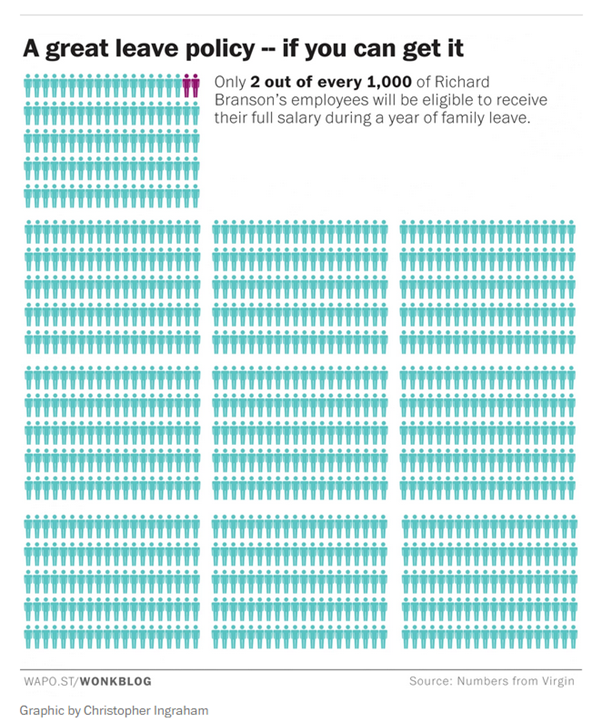
Richard Branson has announced a great paid leave policy for .2 percent of his workers
11 Jun 2015 Leave a comment
in discrimination, entrepreneurship, gender, labour economics, labour supply, occupational choice, politics - Australia, politics - New Zealand, politics - USA Tags: entrepreneurial alertness, maternity leave, paternity leave, Richard Branson
Trends in what drives single motherhood
11 Jun 2015 Leave a comment
Divorce used to be biggest engine of single parenthood in America. No more. It's nonmarital childbearing cc@davidfrum http://t.co/J5yZtUukNW—
W Bradford Wilcox (@WilcoxNMP) June 10, 2015
New Zealand primary school teachers have experienced rapid wages growth by international standards
10 Jun 2015 Leave a comment
in economics of education, human capital, labour economics, labour supply, occupational choice, politics - Australia, politics - New Zealand, politics - USA Tags: teachers pay
The price, output and acreage effects of a GMO ban
08 Jun 2015 Leave a comment
in development economics, economics of regulation, environmental economics, growth disasters, growth miracles, health economics, politics - Australia, politics - New Zealand, politics - USA, population economics, technological progress Tags: agricultural economics, expressive voting, extreme poverty, global hunger, global poverty, GMOs, Left-wing hypocrisy, rational ignorance, rational irrationality, The Great Fact
Organic farming is a gift….
facebook.com/welovegv http://t.co/iu8Jq0KcHD—
C. S. Prakash (@AgBioWorld) June 05, 2015
Projected increases in corn and soy prices in a world without GMOs
ageconsearch.umn.edu/bitstream/2049… http://t.co/PNydjpl59K—
C. S. Prakash (@AgBioWorld) June 08, 2015
If you outlaw GMOs, be prepared to bring millions of acres of forest land, cropland & pasture under farming http://t.co/H9ftkxhXYe—
C. S. Prakash (@AgBioWorld) June 08, 2015
If GMOs are banned today in the US, what would be the crop yield reduction? http://t.co/pEn73PODcR—
C. S. Prakash (@AgBioWorld) June 08, 2015
How to argue for doing nothing about global warming when arguing for a climate club enforced by green tariffs!
08 Jun 2015 1 Comment
in environmental economics, global warming, politics - Australia, politics - New Zealand, politics - USA, Public Choice Tags: climate treaties, club goods, free-riders, global warming, green tariffs, international public goods
The best case I’ve seen recently for doing nothing about global warming was put by those arguing with the greatest sincerity and considerable technical skill that the next international climate treaty should be built around a climate club of those that comply with its obligations with green tariffs on those who do not join.
I have long argued that green tariffs are the only reason to do anything about climate change. Much better to collect the revenue ourselves than let it go into the pockets of a foreign taxman.
William Nordhaus has proposed climate clubs as a way of overcoming free riding in international climate negotiations. Specifically, the international climate treaty should authorise members to impose green tariffs on non-members to encourage them to impose their own carbon taxes and carbon emission targets. This has been done before with the Montréal protocol on CFCs. To encourage the phase-out of CFCs countries that did not commit to do so simply could not trade in those goods with members of the club.
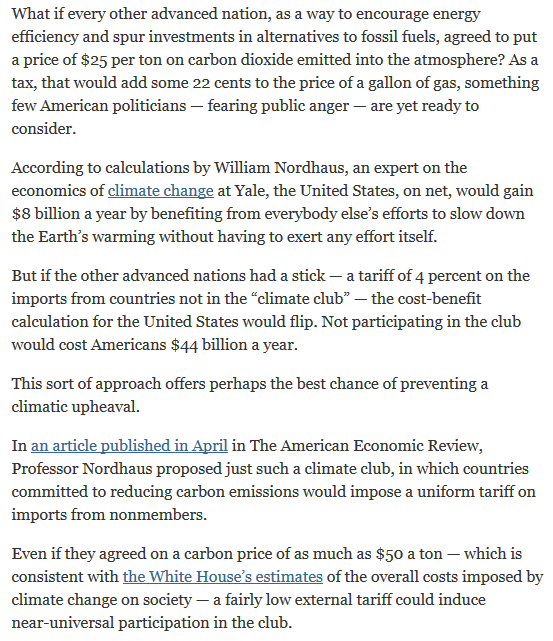
via Climate Deal Badly Needs a Big Stick – NYTimes.com.
4%! A 4% global green tariff is all that is necessary under a climate change treaty that proposes that a carbon price of $50 to apply globally! A 4% green tariff is hardly worth worrying about considering tariffs used to be much much higher than that.
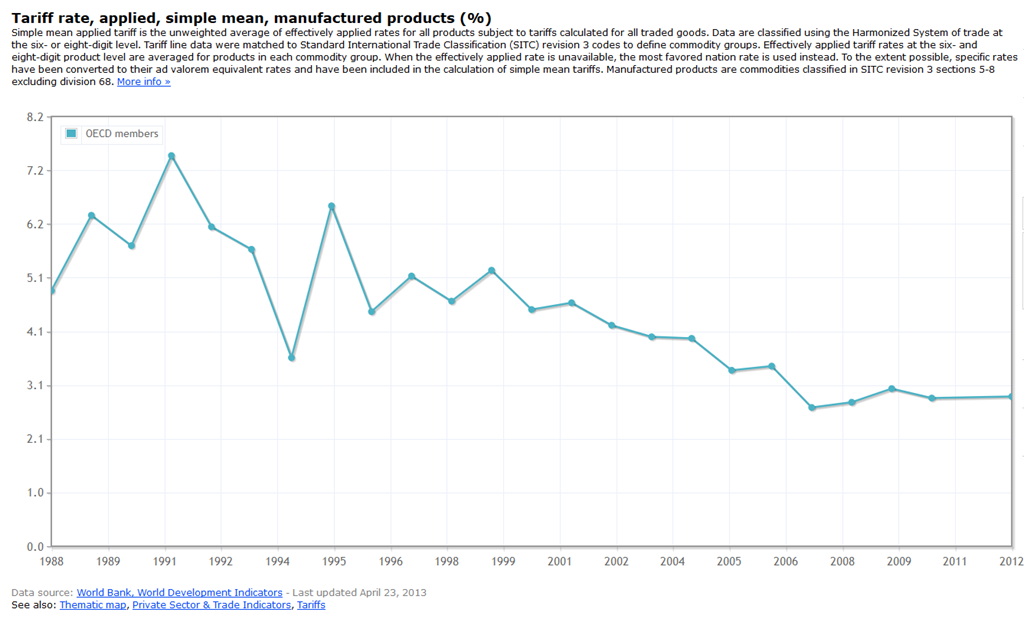
Given all the stories of why woe and doom touted out by the climate alarmists, climate salvation and the keys to environmental heaven should cost much more than 4% tax?! Your sins are forgiven for a 4% green tariff! Big problems such as a climate crisis are not solved with a 4% green tariff.
I think this green tariff of 4% is an own goal. It reinforces the clear message from the economics of climate change that global warming is actually a small economic problem not a large one.
For developed countries, global warming will be at most a minor irritant. For developing countries, their best solution and the solution they have most control over is to develop faster and become a developed country.
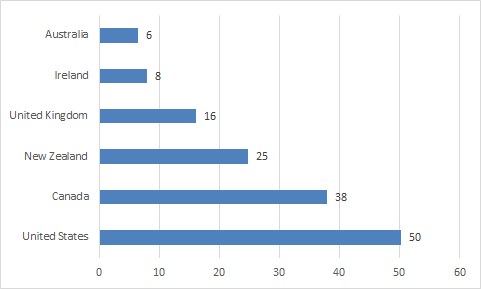
In which Anglo-Saxon country is full-time work not enough to escape family poverty on the minimum wage?
07 Jun 2015 1 Comment
in labour economics, minimum wage, politics - Australia, politics - New Zealand, politics - USA, population economics, poverty and inequality, welfare reform Tags: earned income tax credit, poverty traps, single parents, taxation and the labour supply, welfare state
Figure 1: Weekly working hours needed at minimum-wage to move above a 50% relative poverty line after taxes, mandatory social or private contributions payable by workers, and family benefits for lone parent with two children, Anglo-Saxon countries, 2013
Supply-side economics and the migration of inventors
07 Jun 2015 Leave a comment
in applied price theory, entrepreneurship, fiscal policy, human capital, labour economics, labour supply, occupational choice, politics - Australia, politics - New Zealand, politics - USA Tags: economics of migration, taxation and the labour supply
#Braindrain is real, even quantifiable — as per NBER paper 21024. Geniuses don't tolerate extra taxes easily. http://t.co/HVP8uEFAfz—
Amity Shlaes (@AmityShlaes) June 07, 2015
Deranged conspiracy theories versus the domestic political reality of the Indonesian resumption of executions
05 Jun 2015 Leave a comment
in development economics, economics of crime, law and economics, politics - Australia Tags: Australia, capital punishment, conspiracy theories, crime and punishment, expressive voting, Indonesia, left-wing condescension, Left-wing hypocrisy, Leftover Left, rational ignorance, rational irrationality
The Australian human rights commissioner has put forward a bizarre conspiracy theory linking the recent execution of two drug traffickers in Indonesia to the Australian policy of turning back refugee boats.

Ignorance and condescension of Indonesian domestic politics is prevalent among the left wing elite in Australia.
Indonesia started executions again under the new president after a long hiatus and in particular for death sentences for narcotics drug trafficking. Indonesia had an unofficial moratorium on the death penalty between 2008 and 2012 but resumed executions in 2013. Executions were infrequent.
The new president was recently elected on a platform of being tough on crime and in particular on drug trafficking and the 64 drug traffickers currently on death row:
[The clemency requests] are not on my table yet. But I guarantee that there will be no clemency for convicts who committed narcotics-related crimes
Secondly, making concessions to Australia does not win votes in Indonesia which is a democracy. Thirdly, a range of foreigners are on death row in Indonesia. The best way to have kept those two Australians alive was to say nothing so hopefully they are not moved up in the queue to spite Australia to win domestic political points.
Fourthly, someone of her legal training should be better at spinning conspiratorially yarns than this particularly weak work of imagination.
Economists are actually centre-left but are conservative compared to anthropologists
04 Jun 2015 Leave a comment
in economics, labour economics, occupational choice, personnel economics, politics - Australia, politics - New Zealand, politics - USA Tags: academic bias, voter demographics
Verdant Labs published charts on the average political affiliations of various professions. Data from the Federal Election Commission on contributions to political parties was used that information as a proxy for political views. The ratios are Democrats (blue) vs. Republicans (red).

via Chart: The most liberal and conservative jobs in America – The Washington Post.
Unions have been on the way out for a long time
03 Jun 2015 Leave a comment
in economic history, labour economics, politics - Australia, politics - New Zealand, politics - USA, unions Tags: the withering away of the proletariat, union power, union wage premium
The economics of low wages: When what comes down doesn’t go up econ.st/1zlP1G0 http://t.co/AujgeDIAUX—
The Economist (@EconEconomics) May 02, 2015
How Qatar is the odd man out in World Cup hosting
01 Jun 2015 Leave a comment
Six ways in which Qatar doesn't make a lot of sense as a World Cup host 53eig.ht/1BpVlrH #FIFA http://t.co/0N87zTO07x—
(@FiveThirtyEight) May 30, 2015
Is Canada diverging from Australia in labour productivity to become like New Zealand?
31 May 2015 1 Comment
in economic growth, economic history, macroeconomics, politics - Australia, politics - New Zealand Tags: Australia, Canada, economic geography, endogenous growth theory, lost decades
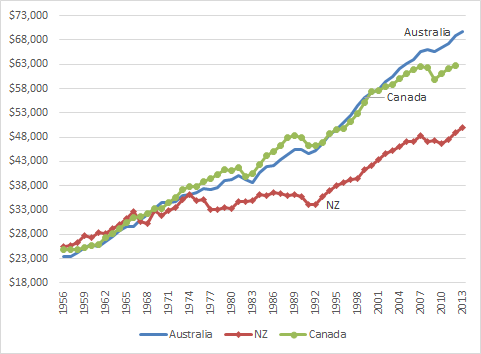
Figure 1 shows that Canada has been diverging from Australia in real GDP per working age person since the mid-1990s particularly since the global financial crisis.
Figure 1: Real GDP per New Zealander, Canadian and Australian aged 15-64, converted to 2013 price level with updated 2005 EKS purchasing power parities, 1956-2013
Source: Computed from OECD StatExtract and The Conference Board, Total Database, January 2014, http://www.conference-board.org/economics
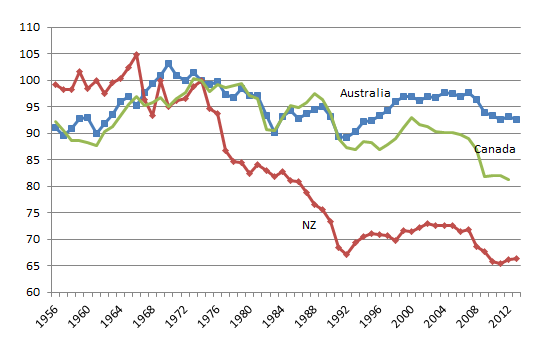
In common with New Zealand, Figure 2 shows that Canadian productivity has been in a pretty much along declines is about 1974, rarely catching up with any lost ground. Figure 1 shows that Canada used to be richer than Australia but is now poorer than Australia. Figure 2 is real GDP growth data detrended by the growth rate of the USA in the 20th century. A flat line in figure 2 is annual real GDP growth at 1.9%; a rising line is growth above 1.9%; a falling line is annual growth below 1.9% a year.
Figure 2: Real GDP per New Zealander, Canadian and Australian aged 15-64, converted to 2013 price level with updated 2005 EKS purchasing power parities, 1.9 per cent detrended, 1956-2013
Source: Computed from OECD StatExtract and The Conference Board, Total Database, January 2014, http://www.conference-board.org/economics
Figure 2 shows that Canadian productivity has been below trend for perhaps 30 years. There has been the occasional recovery but followed by a further decline. If Canadian labour productivity had grown at the same rate as the USA since 1974, labour productivity in Canada is something like 18% better.
Australia, as shown in figure 2, has neither caught up nor falling behind the USA in labour productivity for the entire post-war period since 1956. Canada has been falling behind its neighbour most markedly since the mid-1970s.
- Canada fell 10 percentage points further behind the USA in relative labour productivity between the mid-1970s and the mid-1990s.
- Canada stopped falling further behind the USA after 1995 to 2005 but, in common with New Zealand, Canadian labour productivity did not rebound to recover the prior lost ground.
The proximate causes of the Canadian productivity gap with the USA have a familiar echo to New Zealand ears. Relative to the USA, Rao et al. (2006) and Sharp (2003) attributed the gap to less capital per worker, an innovation gap as shown by lower R&D expenditure, a smaller and less dynamic high technology sector, less developed human capital at the top end of the labour market, and more limited scale and scope economies.
These factors have been put forward, at one time or another, as the proximate causes of the New Zealand productivity gap with the USA. Identifying the barriers to higher Canadian productivity may offer fresh insights into removing similar productivity barriers in New Zealand.
Canada, New Zealand and Australia should be catching-up with the USA in productivity per capita because copying the global leader is cheaper than innovation. Canada, New Zealand and Australia all have the basics to do this: a market economy, the rule of law and openness to foreign technology and international trade.
Instead of asking why New Zealand is not catching-up with Australian productivity, further study of the lack of productivity catch-up of Australia and Canada with the USA may uncover subtle barriers to productivity growth with similarities in New Zealand.
The productivity decline in Canada is of interest in New Zealand because Canada certainly cannot blame remoteness because it borders the USA. Canada cannot blame lack of size because it is noticeably larger than Australia and certainly New Zealand.


Recent Comments