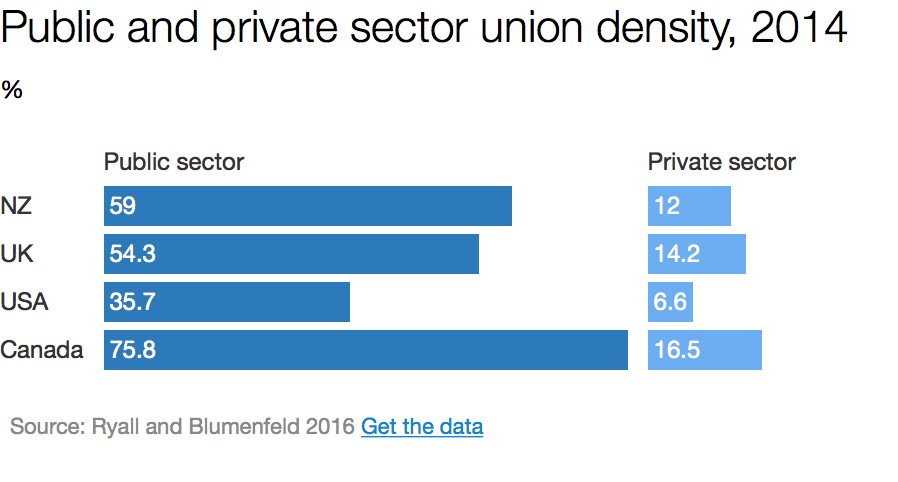
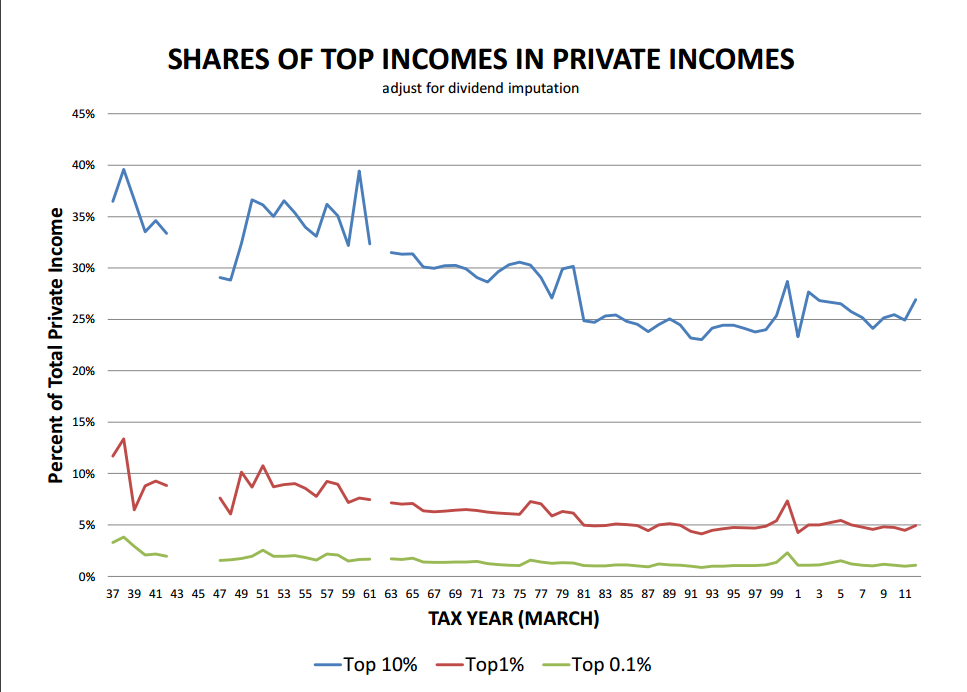
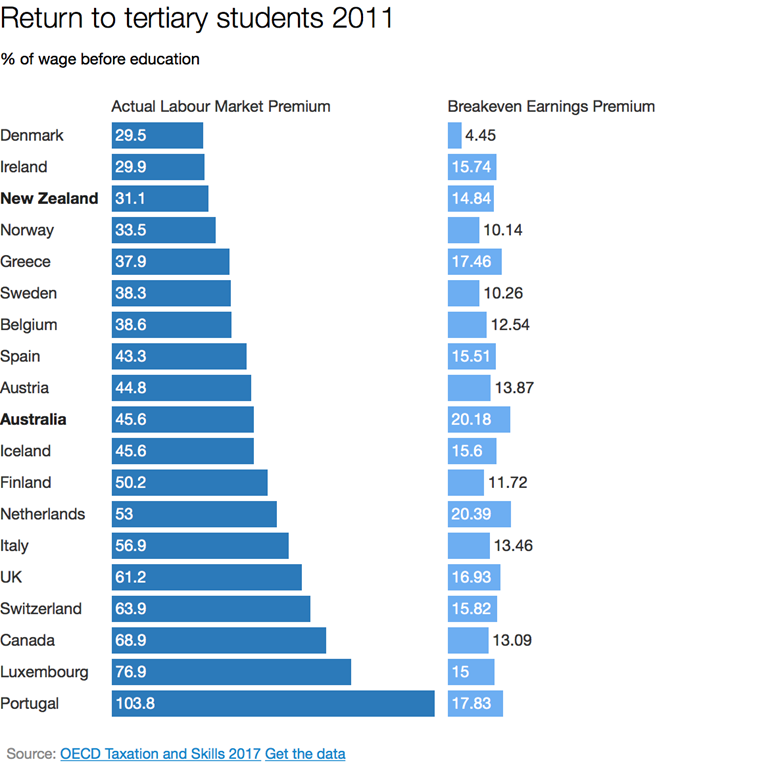
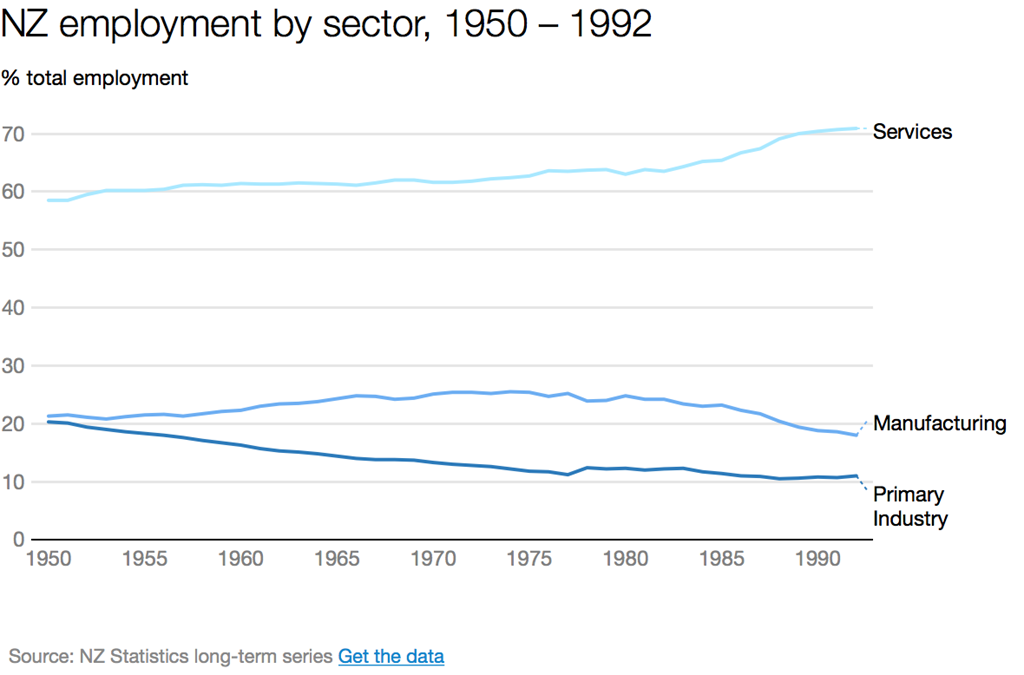
Is inequality just getting worse and worse in #NewZealand?

Source: New Zealand Treasury Long-Term Fiscal Projections 2016.

“What if” projections of #NewZealand government expenses

Source: New Zealand Treasury LongLong-Term Fiscal Projections 2016.

Image

Fossil Fuels: The Greenest Energy

How much is too much to rebuild? @JulieAnneGenter @NZGreens @JordNZ

Image

#nzeq Post-disaster labour market adjustment: Alaska in the pipeline era & Darwin after Cyclone Tracy

Experiences from abroad suggest that labour markets have a history of rapid adaptation to regional surges in construction demand and that workers are prepared to tolerate lower quality housing provided there are compensating wage premiums.

The Trans-Alaska Pipeline was the largest privately funded construction project to that time. Alaskan wages during the building period between 1974 and 1977 were very flexible in the construction and related industries.

Labour supply was responsive in terms of more hours worked per worker and more local workers entering the workforce with many others moved temporarily to Alaska even though the Alaskan climate and culture would not appeal to everyone.

The Alaskan labour force increased by 50%, from about 50,000 to about 90,000 workers, hours worked per week increased by about the same, and many people worked 2 jobs.

High school hours were moved to the morning so that students and their teachers could take an afternoon job in pipeline construction. There is hot beading of accommodation and a 1000% labour turnover rate at the local McDonald’s. By 1979, the Alaskan labour force returned pretty much to its preconstruction era size.

Moving to a region still prone to after-shocks also would not appeal to everyone. Many energy industry construction projects in modern times were completed in unappealing locations and extreme climates on land and sea.

As another and much nearer example, Cyclone Tracy destroyed about 60 per cent of the 8,000 houses in Darwin on 24 December 1974 and more than 30 per cent were severely damaged. Most of Darwin’s population of 48,000 people became homeless; 71 lives were lost.

After a mass evacuation of 35,000, Darwin’s population was 10,000 by 1 January 1975. Darwin’s population recovered to 30,000 by May 1975. This influx was dominated by newcomers, especially construction workers. Temporary housing, caravans, hotels and an ocean liner were all pushed into service.

When the Darwin Reconstruction Commission was wound up two years ahead of the initial reconstruction timeline on 12 April 1978, 3,000 new dwellings had been completed. By mid-1978, the city could again house its pre-Tracy population numbers. Darwin is now home for about 125,000 people.

The key role of housing costs in disaster recovery @ericcrampton @JordNZ #nzeq

The evidence abroad after earthquakes, hurricanes, flooding, tornados, and wartime bombing is that for growing cities, disasters, including carpet bombing and atomic bombs, are only temporary set-backs with few long-run economic and population consequences. A few years after a disaster, these cities even recover the industries they had before their calamities.

image

For growing cites, the loss of housing and other destruction does not affect the underlying demand from workers and businesses to be at the location. Florida has prospered despite over twenty hurricanes striking since 1988 and five of the six most damaging Atlantic hurricanes of all time striking since 1988.

Cities that are already in decline drop down onto an even faster downward population and economic trend after a major natural disaster. A large scale destruction of housing takes away the one compensating feature of these declining cities, which was cheap housing.

Housing prices in declining cities are usually well below construction costs. Low living costs partly offset the relative lack of local economic opportunity in these cities. New Orleans is an example of a declining city that did not recover fully from a disaster for this reason.

After Hurricane Katrina, New Orleans had much higher costs of housing because of flood damage but there were limited local economic opportunities to attract back old and new residents. About 20 per cent of the Katrina evacuees did not return.

Natural disasters be they earthquakes or hurricanes turn declining cities and towns from a dump with cheap housing to a dump with expensive housing. They can be a killer blow.

The main policy enabler of growing cities in the USA has been the avoidance of land use regulations that raise housing costs. Over the past 20 years, the fastest growing U.S. regions have not been those with the highest income or most attractive climates.

Flexible housing supply is the key determinant of regional growth. Land use regulations drive housing supply and determine which regions are growing. A regional approach to enabling increases in land and housing supply might reduce the tendency of many localities to block new construction.

How to get back to the eastern suburbs from the CBD after an earthquake #eqnz

Take the bus. But not a trolley bus. We were going to walk home (7.8 km) but once we got to the edge of Mount Victoria, bus drivers were picking people up.

15039665_1226822937376797_3786107579487178196_o (1)

Buses could not get into the centre of town because of gridlock, so drivers showed the initiative to go to the perimeter of the CBD and going back out and in on their normal routes. They picked up many people. Do not start me on how useless trolley buses are after a natural disaster

#Uber price gouging trebled US post-disaster supply @MaxRashbrooke @EricCrampton #nzeq

Source: Hurricane Sandy / Pricing Update.

Image

US, Australian and NZ real house prices, March 1975 to June 2016

image

Source: International House Price Database – Dallas Fed.

Gareth Morgan has fallen for the oldest populist delusion

In founding his own political party, Gareth Morgan has fallen to the populist delusion that all that is needed is for a great leader to get in who is one of us rather than one of them and she will be alright.

image

Source: About – The Opportunities Party.

In common with all populists, Morgan believes there is one will of the people frustrated by a conniving elite rather than many clashing visions of the good life that politicians must balance. Judis explains

Leftwing populists champion the people against an elite or an establishment. Theirs is a vertical politics of the bottom and middle, arrayed against the top.

Rightwing populists champion the people against an elite that they accuse of favouring a third group, which can consist, for instance, of immigrants, Islamists, or African American militants. Rightwing populism is triadic: it looks upward, but also down upon an out group.

Leftwing populism is historically different to socialist or social democratic movements. It is not a politics of class conflict, and it does not necessarily seek the abolition of capitalism. It is also different to a progressive or liberal politics that seeks to reconcile the interests of opposing classes and groups. It assumes a basic antagonism between the people and an elite at the heart of its politics.

John Rawls talked about the need for reasonable pluralism because so many people have different ideas of the way to go forward. Political institutions must be designed with that diversity in mind as David Gordon explained in a book review

The situation that drives Rawls to his theory is that of people in a large society like the United States who are divided by conflicting conceptions of the good. Some of these conceptions may be better than others, and one may in fact be the correct one: Rawls does not commit himself on this question. But none of these conceptions can be shown to be true in the strong sense that it would be unreasonable for anyone to reject it. This state of affairs Rawls terms “the fact of reasonable pluralism.”

Given reasonable pluralism, it would be wrong for the holders of one conception to impose their views on others; respect for others requires that we defend our political views with reasons others could acknowledge.

Our aim, Rawls holds, should not be a mere modus vivendi with those who profess other conceptions of the good. Rather, we should seek a stable society in which people decide disputed questions by democratic discussion.

The idea is to have a political system with sufficient checks and balances that whoever is in power does not do too much harm nor gets seriously out of alignment with the wishes of the electorate. That was the idea behind MMP: divide power between more parties and make all elections close.

It goes back to James Madison’s idea that governments are not populated by angels and so the powers of government and how they are distributed should take account of that. The idea is politicians behave in line with public interest because of the institutions that constrain and shape their choices.

It is wise to design constitutional safeguards to minimise the damage done when those crazies to the right or left of you get their chance in office, as they will sooner or later rather than focus on the powers you and those that currently agree with you should have in your few days in which you fleetingly have a majority.

Too many policies and ideas of the one political party or another assume that they are the face of the future, rather than just another political party that will hold power as often as not and always for an uncertain time. Too many policies and ideas of the Left assume that they are the face of the future, rather than just another political party that will hold power as often as not.

.@JudithCollinsMP showed that @JacindaArdern does not know when to stop digging

Judith Collins today in Question Time showed that Jacinda Ardern does not know when to stop digging. Ardern quoted a snippet of the question put to the police minister at the recent police conference.

That selectivity allowed Collins to right to quote the conference question in full and her full answer, which was not just about money poverty but also about

“… a poverty of ideas, a poverty of parental responsibility, a poverty of love, a poverty of caring …”.

Later Collins said she does not agree with Labour saying today that poverty causes crime.

The Labour Party showed that it is no longer rooted in working class values when it argues that poverty is not linked to a poverty of responsibility and of parental love.

There are plenty of poor people who do not resort to crime and who despise those that do, in part because they often make them the victims of their crimes including burglary.

#WomensBoatToGaza @MaramaDavidson silent on Hamas rocket attacks

IMG_20161011_093443

#homeslessnessinquiry champions contracting-out @NZLabour @NZGreens @Maori_Party

Did they swallow a dead rat! After complaining bitterly about the privatisation of social housing and the contracting out of government services and in particular social services generally, the New Zealand Labour Party, the New Zealand Greens and the Maori Party all accepted that part of the solution to better emergency housing services to the homelessness is to fund community housing providers to build them houses. A greater role for the private sector, be it the NGO sector, in solving pressing social problems.

Source: Cross-party enquiry into homelessness.

It is pious to say that NGOs should build new social housing but existing social housing should not be sold to them to administer better than the bureaucrats.

The private sector has always been the last line of the defence for the social safety net for the homeless. Hotels and motels are used for emergency housing. There are plenty of them and it takes very little time to book into one as long as WINZ sends along the documentation to guarantee payment.

The report of Labour, the Greens and the Maori Party included reference to the Kate Amore data on homelessness which comfirms its credibility. That data shows that homelessness has fallen significantly in NZ since 2001 and 2006.

Homelessness is a by-product of bureaucratic inefficiency. So few people are actually sleeping rough or in shelters on any one night that is really an issue of why are those people are not in a shelter or permanent social housing.

The problem of homelessness is the efficiency of the bureaucracy in identifying these people, putting them in temporary quarters be at a hotel or motel if necessary, and then moving them into social housing.

No one is surprised at a homelessness shelter is run by a church or charity all with the assistance of government funding. No one seriously expects bureaucrats to be any good at running homeless shelters or the hotels or motels where the homeless are occasionally booked in.

Justice Scalia on Hobson’s pledge

Image

Crime victimisation rates of Maori compared

image

Source: New Zealand Crime and Safety Survey, Resources & downloads | New Zealand Ministry of Justice.

image

Source: New Zealand Crime and Safety Survey, Resources & downloads | New Zealand Ministry of Justice.

Previous Older Entries Next Newer Entries

Bassett, Brash & Hide

Celebrating humanity's flourishing through the spread of capitalism and the rule of law

Truth on the Market

Scholarly commentary on law, economics, and more

The Undercover Historian

Beatrice Cherrier's blog

Matua Kahurangi

Celebrating humanity's flourishing through the spread of capitalism and the rule of law

Temple of Sociology

Celebrating humanity's flourishing through the spread of capitalism and the rule of law

Velvet Glove, Iron Fist

Celebrating humanity's flourishing through the spread of capitalism and the rule of law

Why Evolution Is True

Why Evolution is True is a blog written by Jerry Coyne, centered on evolution and biology but also dealing with diverse topics like politics, culture, and cats.

Down to Earth Kiwi

Celebrating humanity's flourishing through the spread of capitalism and the rule of law

NoTricksZone

Celebrating humanity's flourishing through the spread of capitalism and the rule of law

Homepaddock

A rural perspective with a blue tint by Ele Ludemann

Kiwiblog

DPF's Kiwiblog - Fomenting Happy Mischief since 2003

The Dangerous Economist

Celebrating humanity's flourishing through the spread of capitalism and the rule of law

Watts Up With That?

The world's most viewed site on global warming and climate change

The Logical Place

Tim Harding's writings on rationality, informal logic and skepticism

Doc's Books

A window into Doc Freiberger's library

The Risk-Monger

Let's examine hard decisions!

Uneasy Money

Commentary on monetary policy in the spirit of R. G. Hawtrey

Barrie Saunders

Thoughts on public policy and the media

Liberty Scott

Celebrating humanity's flourishing through the spread of capitalism and the rule of law

Point of Order

Politics and the economy

James Bowden's Blog

A blog (primarily) on Canadian and Commonwealth political history and institutions

Science Matters

Reading between the lines, and underneath the hype.

Peter Winsley

Economics, and such stuff as dreams are made on

A Venerable Puzzle

"The British constitution has always been puzzling, and always will be." --Queen Elizabeth II

The Antiplanner

Celebrating humanity's flourishing through the spread of capitalism and the rule of law

Bet On It

Celebrating humanity's flourishing through the spread of capitalism and the rule of law

History of Sorts

WORLD WAR II, MUSIC, HISTORY, HOLOCAUST

Roger Pielke Jr.

Undisciplined scholar, recovering academic

Offsetting Behaviour

Celebrating humanity's flourishing through the spread of capitalism and the rule of law

JONATHAN TURLEY

Res ipsa loquitur - The thing itself speaks

Conversable Economist

In Hume’s spirit, I will attempt to serve as an ambassador from my world of economics, and help in “finding topics of conversation fit for the entertainment of rational creatures.”

The Victorian Commons

Researching the House of Commons, 1832-1868

The History of Parliament

Articles and research from the History of Parliament Trust

Books & Boots

Reflections on books and art

Legal History Miscellany

Posts on the History of Law, Crime, and Justice

Sex, Drugs and Economics

Celebrating humanity's flourishing through the spread of capitalism and the rule of law

European Royal History

Exploring the Monarchs of Europe

Tallbloke's Talkshop

Cutting edge science you can dice with

Marginal REVOLUTION

Small Steps Toward A Much Better World

NOT A LOT OF PEOPLE KNOW THAT

“We do not believe any group of men adequate enough or wise enough to operate without scrutiny or without criticism. We know that the only way to avoid error is to detect it, that the only way to detect it is to be free to inquire. We know that in secrecy error undetected will flourish and subvert”. - J Robert Oppenheimer.

STOP THESE THINGS

The truth about the great wind power fraud - we're not here to debate the wind industry, we're here to destroy it.

Lindsay Mitchell

Celebrating humanity's flourishing through the spread of capitalism and the rule of law

Alt-M

Celebrating humanity's flourishing through the spread of capitalism and the rule of law

croaking cassandra

Economics, public policy, monetary policy, financial regulation, with a New Zealand perspective

The Grumpy Economist

Celebrating humanity's flourishing through the spread of capitalism and the rule of law

International Liberty

Restraining Government in America and Around the World