
Why hasn’t @JulieAnneGenter reintroduced @metiria’s 2009 bill on medical marijuana?
28 Apr 2017 Leave a comment
in economics of crime, health economics, law and economics, politics - New Zealand Tags: expressive voting, marijuana decriminalisation, medical marijuana decriminalisation
The case against an immigration economics and for a population economics
28 Apr 2017 Leave a comment
in labour economics, labour supply, politics - New Zealand, population economics Tags: economics of fertility, economics of immigration

Source: The case for immigration – Vox.
#livingwage movement just can’t handle the truth @LWEmployerNZ
27 Apr 2017 Leave a comment
in industrial organisation, labour economics, labour supply, minimum wage, personnel economics, politics - New Zealand Tags: conjecture and refutation, critical discussion, crybaby left, living wage, Twitter left

Looks like the living wage movement will not be taking up my challenge for a public debate anytime soon.
#Maori #atheists failed by @reomaori Maori Language Commission
27 Apr 2017 Leave a comment
in economics of bureaucracy, politics - New Zealand Tags: atheism, Freedom of religion, Maori economic development, Te reo Māori

What victory at Gallipoli could have stopped #AnzacDay #Anzacday2017
25 Apr 2017 Leave a comment
in defence economics, politics - Australia, politics - New Zealand, war and peace Tags: Armenian genocide, crimes against humanity, Gallipoli, war crimes trials, World War I
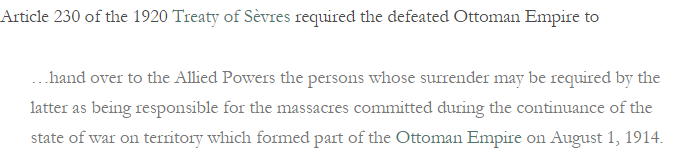
But for victory at Gallipoli, the Anzacs would have been the first Sergeant at Arms of a war crimes trial. By marching victorious into Constantinople, the Anzacs may have been able to prevent the purging of the Ottoman archives of evidence of complicity of specific individuals.
Today is marked by Armenians worldwide as the 100th anniversary of the Armenian genocide. vox.com/2015/4/22/8465… http://t.co/7pqqSowW3O—
Vox Maps (@VoxMaps) April 24, 2015
On May 24, 1915, the Allied Powers jointly issued a statement explicitly charging for the first time ever another government of committing `a crime against humanity’. The Allied Governments announce publicly that they will hold personally responsible all members of the Ottoman Government, as well as those of their agents who are implicated in the Armenian massacres.
Ottoman military and high-ranking politicians were transferred to the Crown Colony of Malta on board of the SS Princess Ena and the SS HMS Benbow by the British forces, starting in 1919. These war criminals were eventually returned to Constantinople in 1921 in exchange for 22 British hostages held by the government in Ankara.
Australian and New Zealand participation in the invasion of the Ottoman Empire as a by-product set the legal and moral infrastructure for the Nuremberg trials: governments would hold others to account for crimes against humanity and genocide.
#AnzacDay: why did we fight?
25 Apr 2017 3 Comments
in defence economics, politics - Australia, politics - New Zealand, war and peace Tags: Anzac Day, national security policy, World War I
Australia and New Zealand were filled with first and second generation migrants happy to rally to defend their mother country:
- 12 per cent of the population of New Zealand volunteered to fight; and
- 13 per cent of the male population of Australia volunteered to fight in World War 1.
The people and governments of New Zealand and Australia of that time were British to their boot straps. The Union Jack was in their flags for a reason.
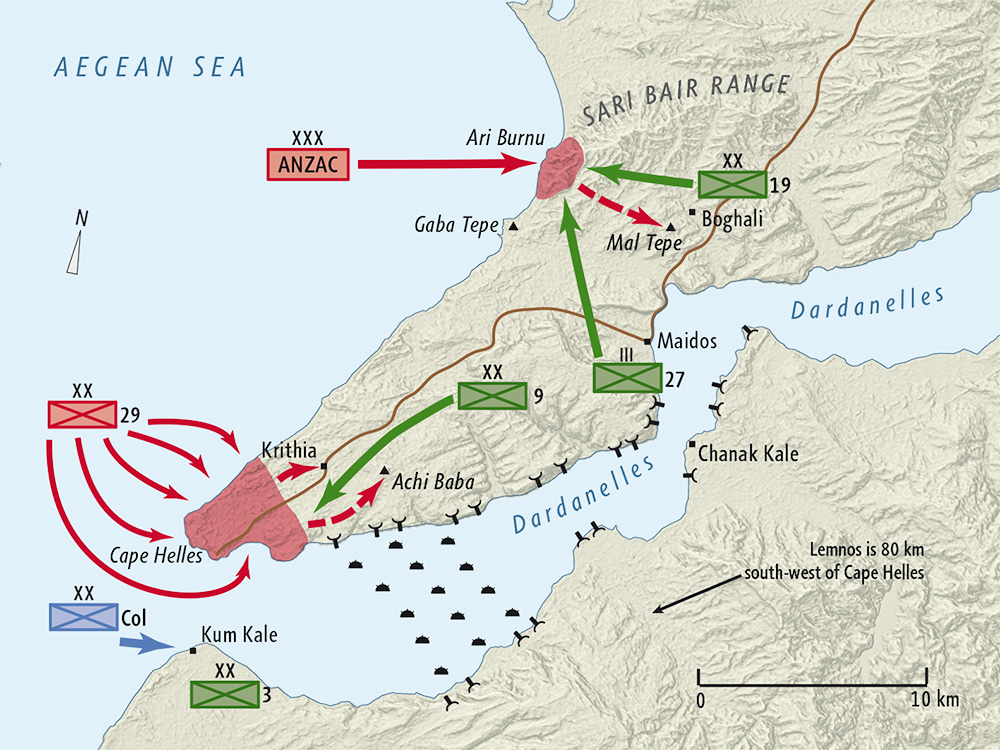
Our specific quarrel with the Ottoman Empire was it joined Germany and others to be at war with the UK, Australia and New Zealand.
Removing the Ottoman Empire from that war would have strengthened Russia. A stronger Russia would have weakened Germany and its allies and brought the war to an earlier end.
The governments of Australian and New Zealand fell over themselves to declare war and pledge troops in 1914.
World War 1 started in the middle of an Australian election campaign in 1914.
In the September 1914 election, both opposition leader Andrew Fisher and Prime Minister Joseph Cook stressed Australia’s unflinching loyalty to Britain, and Australia’s readiness to take its place with the allied countries. Labor Party leader Fisher’s campaign pledge was to:
stand beside the mother country to help and defend her to the last man and the last shilling.
Labor defeated the incumbent government to win majorities in both houses. Billy Hughes and his nationalist party won the 1917 election in a landslide.
New Zealanders had even a better chance to reflect on the war-making choices of their leaders in 1914. Our election was in December of 1914. The passions of the moment had some chance to calm, and the fighting has started for real.
The will of the people at the December 1914 Parliamentary elections was a 90 per cent vote for the war parties. New Zealanders could have voted for the Labour MPs, several of whom were later imprisoned for their anti-conscription activities or for refusing military service.
In New Zealand, after that wartime election, the Prime Minister was an Irish Protestant who formed a coalition with an Irish Catholic as his deputy.
Do you know of a superior mechanism to elections for measuring the will of the people? Are elections inadequate to the task of deciding if the people support a war and that support of the public is based on well-founded reasons?
The reasons for New Zealand and Australia fighting are the just cause of fighting militarism and territorial conquest, empire solidarity, regional security interests such as the growing number of neighbouring German colonies, and long-term national security. A victorious Germany would have imposed a harsh peace.
New Zealand and Australian national security is premised on having a great and powerful friend. That was initially Britain. When the USA arrived in 1941 as a better great and powerful friend, the British were dropped like a stone.
Neither @jamespeshaw nor @metiria would make this speech #marchforscience
22 Apr 2017 Leave a comment
in health economics, politics - Australia, politics - New Zealand Tags: Anti-Science left, anti-vaccination movement, vaccinations
Making trouble again for @stevenljoyce for @TaxpayersUnion
21 Apr 2017 Leave a comment
in applied price theory, applied welfare economics, industrial organisation, international economics, politics - New Zealand, Public Choice, rentseeking, survivor principle Tags: picking winners
The biggest gender gap that dare not speak its name
21 Apr 2017 1 Comment
in discrimination, gender, health and safety, labour economics, labour supply, occupational choice, politics - New Zealand Tags: and gender gap, compensating differentials, gender wage gap, value of life, workplace injuries
Gender gaps in injuries and fatalities go beyond those industries demanding physical.strength.
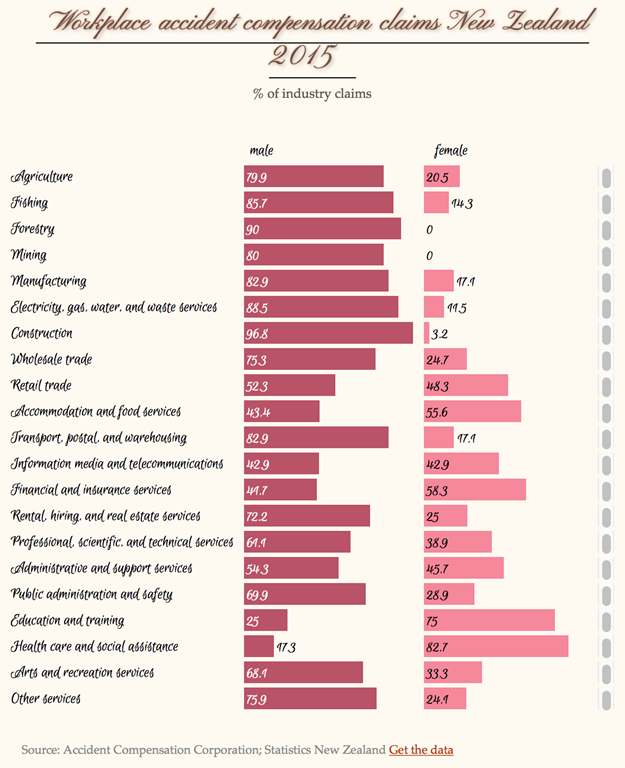
There are noticeable differences in the occupational choices of single people, parents, and single parents. Women choose safer jobs than men; single moms or dads are most averse to fatal risk because they have the most to lose. About one quarter of occupational differences between men and women can be attributed to the risks of injury and death.
All but 3 of the fatal workplace accidents in New Zealand in 2015 were men.
![image_thumb[1]](https://utopiayouarestandinginit.com/wp-content/uploads/2017/04/image_thumb13.png "image_thumb[1]")
Source: Accident Compensation Corporation, Statistics New Zealand.
This gender gap in the risk of injury and death can lead to a significant gender wage gap because of the wage premium associated with these risks and in particular the risk of death as Viscusi explained.
The bottom line is that market forces have a powerful influence on job safety. The $120 billion in annual wage premiums referred to earlier is in addition to the value of workers’ compensation. Workers on moderately risky blue-collar jobs, whose annual risk of getting killed is 1 in 10,000, earn a premium of $300 to $500 per year.
The imputed compensation per “statistical death” (10,000 times $300 to $500) is therefore $3 million to $5 million. Even workers who are not strongly averse to risk and who have voluntarily chosen extremely risky jobs, such as coal miners and firemen, receive compensation on the order of $600,000 per statistical death…
Other evidence that the safety market works comes from the decrease in the riskiness of jobs throughout the century. One would predict that as workers become wealthier they will be less desperate to earn money and will therefore demand more safety.
A German study was able to reduce a raw gender wage gap of 20% to 1% after accounting for differences between gender in the risk of injury and death in addition to the usual factors. This 2007 study found that they were the 2nd study ever to make this adjustment.
Important to mention tax credits when discussing the working poor? @JordNZ
21 Apr 2017 Leave a comment
in labour economics, politics - New Zealand, poverty and inequality, public economics, welfare reform Tags: child poverty, family poverty, family tax credits, taxation and labour supply
Which matters more to the incentive effects of income tax? @JordNZ
20 Apr 2017 Leave a comment
in politics - New Zealand, public economics Tags: average tax rates, family taxation, Marginal tax rates, taxation and labour supply
The Dutch disease for the benefit of #GarethMorgan @stevenljoyce
18 Apr 2017 1 Comment
in applied price theory, applied welfare economics, economic history, industrial organisation, international economics, politics - New Zealand, Public Choice, rentseeking, survivor principle Tags: Dutch disease, export subsidies, picking winners
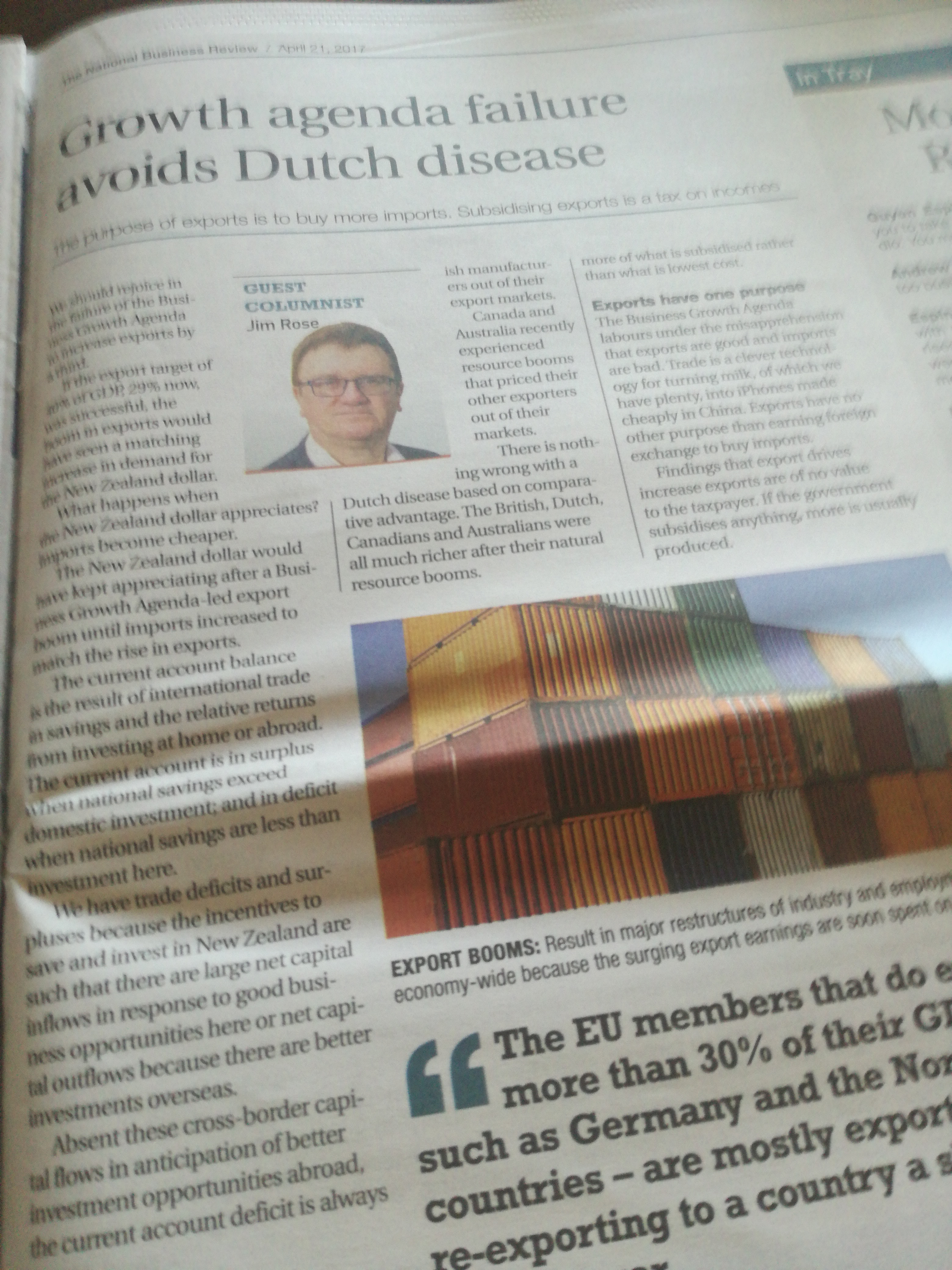
I am putting in a Official Information Act request to see if anyone advise ministers that a export promotion target results in a matching increase in imports along with a large appreciation in the New Zealand dollar. Did New Zealand dodge the Dutch disease from this foolhardy export promotion policy? The Dutch Disease story is one of sectoral shifts.
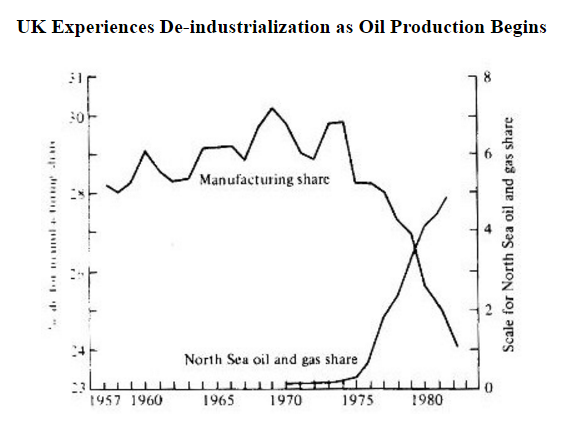
In the 1960s, with fixed exchange rates under the Bretton Woods system, the Netherlands discovered off-shore natural gas. As natural gas was extracted, it increased domestic income and spending. Investment was redirected toward the natural gas sector. Dutch wages and prices began to rise gradually. The Dutch guilder became overvalued in real terms, their industrial products became uncompetitive, and the manufacturing sector shrunk. This phenomenon of de-industrialization in the presence of rich natural resources was called the Dutch disease. They got natural gas but lost manufacturing.
In the late 1970s and early 80s, the UK experienced similar de-industrialization under a floating exchange rate regime. They discovered and exploited the North Sea oil fields. Since the global oil price was rising, the UK was expected to earn a great amount of foreign exchange in the future. But even before these earnings were realized, the British pound appreciated suddenly in both nominal and real terms. This damaged the British manufacturing sector.
Source: MF model – float
If there is an increasing demand for New Zealand exports if the Business Growth Agenda target of increasing New Zealand exports was successful, there is an increase in demand for New Zealand dollars to pay for these exports. This will result in an appreciation of the New Zealand dollar making imports cheaper. This will switch demand for New Zealand competing industries to these imports.
This process of currency appreciation and expenditure switching will continue until export match exports again. There is nothing wrong with an export boom as long as it is based on comparative advantage rather than subsidies.


Recent Comments