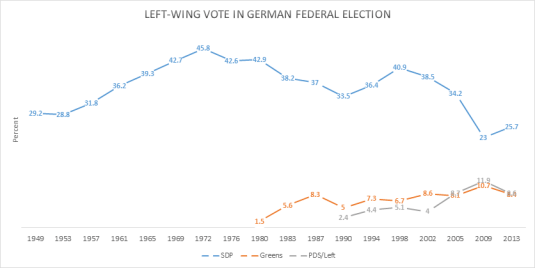
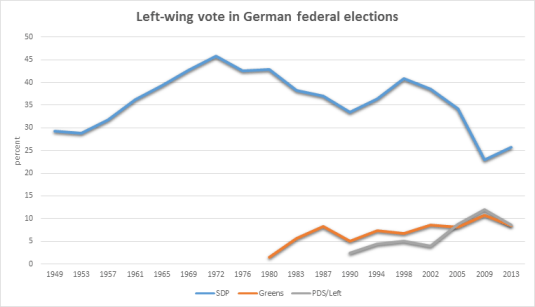
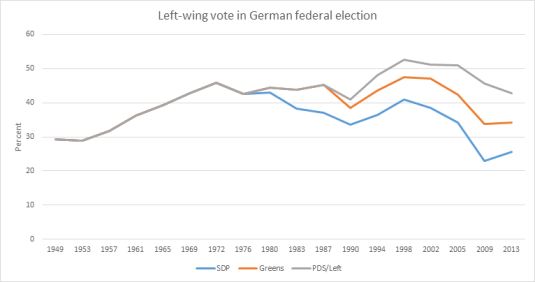
The far left of the German Bundestag is so wacky that the Social Democratic prefer a grand coalition with the Conservative parties over teaming up with the Greens and the Left party.
Source: Wikipedia.
Celebrating humanity's flourishing through the spread of capitalism and the rule of law
11 Oct 2015 Leave a comment
in economic history, population economics
The far left of the German Bundestag is so wacky that the Social Democratic prefer a grand coalition with the Conservative parties over teaming up with the Greens and the Left party.
Source: Wikipedia.
11 Oct 2015 Leave a comment
in economic history, population economics
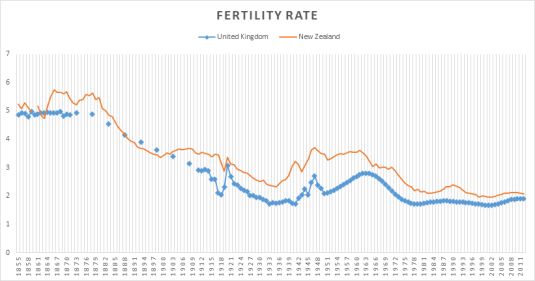
New Zealand women have always had more children than British women with a sizeable gap in the 20th century. Putting the baby boom aside, British fertility has often not been much more than replacement rate since the 1920s.
Source: GapMinder data.
10 Oct 2015 1 Comment
in economic history, population economics, war and peace
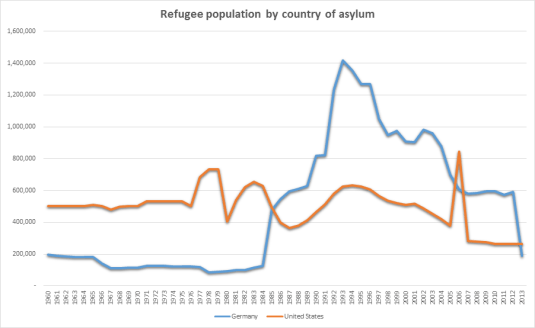
I had to use two charts because Germany hosted so many refugees after in the early 1990s that it made the reading the remaining data not possible because of the scale of the axis.
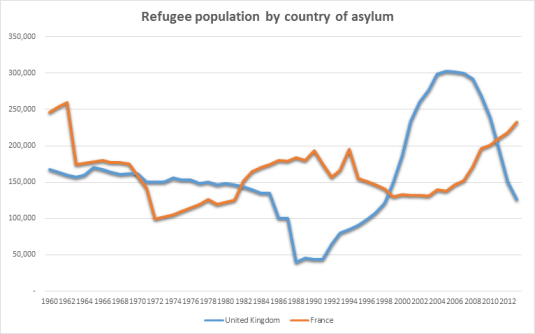
UNHCR – UNHCR Statistical Online Population Database.
09 Oct 2015 Leave a comment
in economic history, population economics, war and peace
The Germans admitted so many asylum seekers in the early 1990s that I have had to reproduce the graph without Germany so some meaningful interpretation can be made of the three other countries.

Data extracted on 08 Oct 2015 09:06 UTC (GMT) from OECD.Stat.
The British started to admit a great many more refugees at the end of the 1990s compared to the already large number admitted at the beginning. Italy is only started offering shelter to a significant number of asylum seekers since the end of the 1990s. The French have been pretty consistently admitting reasonable numbers of asylum seekers and adjusting their quota upwards in a crisis.
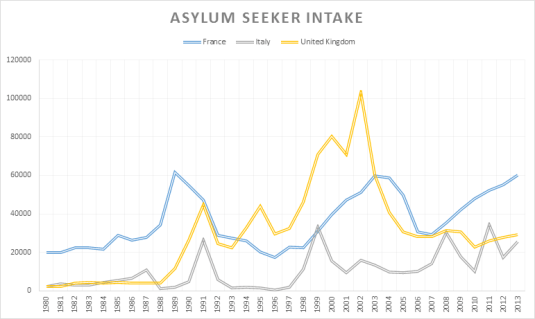
Data extracted on 08 Oct 2015 09:06 UTC (GMT) from OECD.Stat.
09 Oct 2015 Leave a comment
in economic history, population economics, war and peace
Sweden took in so many asylum seekers in the early 1990s that I am reproducing the graph for the period after to give the data more meaning. Swedish generosity so dominates the rest of Scandinavia that it distorts any reading of the graph unless it is split into two.
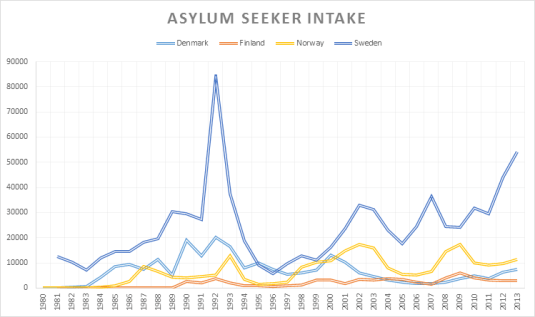
Data extracted on 08 Oct 2015 09:06 UTC (GMT) from OECD.Stat
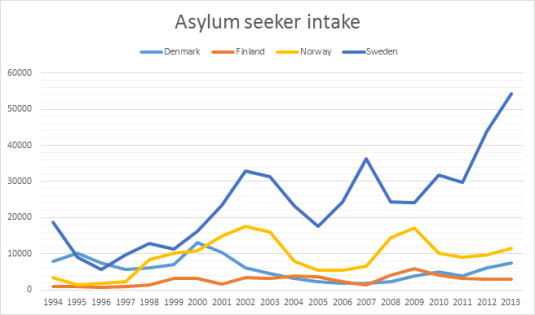
Data extracted on 08 Oct 2015 09:06 UTC (GMT) from OECD.Stat
09 Oct 2015 Leave a comment
in economic history, population economics, war and peace
When notoriously insular Japan and South Korea overtake New Zealand as a refuge for asylum seekers, the Left of New Zealand politics, which loves to lecture the rest of the world on peace and human rights, clearly dropped the ball as the self-appointed consciences of the nation. Being a nuclear free New Zealand is not a passport to moral superiority in the 21st century.
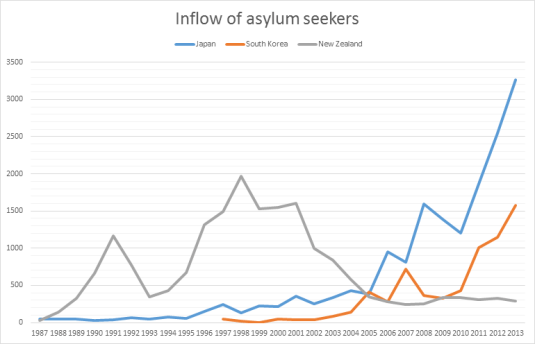
Source: Data extracted on 08 Oct 2015 09:06 UTC (GMT) from OECD.Stat.
The last time a large number of refugees were admitted to New Zealand was under the 1990s National Party government.
09 Oct 2015 Leave a comment
in economic history, population economics
New Zealand and the USA were much more serious about the post-war baby boom than were the British or Germans. The German fertility rates drop below replacement rates in the late 1960s with the British and Americans following them in in the 1970s. Only New Zealand still has a fertility rate of above replacement or thereabouts. German fertility has struggled to stay above replacement rates for coming on 100 years.

09 Oct 2015 Leave a comment
in economic history, population economics
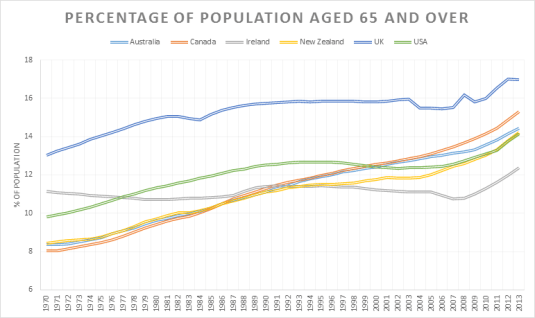
Population ageing seemed to have passed the Irish by until the Global Financial Crisis. The British (in dark blue) started older but really did not have much of an ageing until this squiggly behaviour in the last 10 years in their population data. Canada simply got older. There is a long pause in ageing in the USA but ageing started again apace in the last 10 years. Population ageing in Australia (in light blue) and New Zealand was pretty consistent over the entire period since 1970. Australians and New Zealanders simply got older.
09 Oct 2015 Leave a comment
in economic history, population economics
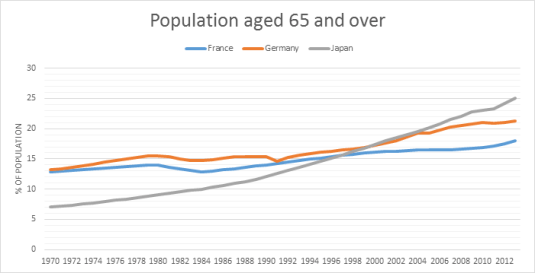
There are certainly rapid ageing in Japan but the Germans are doing their best to catch up with the French not far behind.
09 Oct 2015 Leave a comment
08 Oct 2015 Leave a comment
in economic history, Economics of international refugee law, International law, politics - Australia, politics - New Zealand, population economics Tags: Australia, British politics, economics of migration, refugees
New Zealand’s intake of asylum seekers has been embarrassingly low. The left-wing parties in New Zealand should be ashamed of themselves given the way they wear their international consciences on their sleeves about New Zealand being above it all morally, nuclear free, and can lecture the rest about war, peace and compassion from on high.

Data extracted on 08 Oct 2015 09:06 UTC (GMT) from OECD.Stat; Dataset: International Migration Database.
The UK absorbed an immense number of asylum seekers in the 1990 as did Canada. The data stops in 2013.
07 Oct 2015 Leave a comment
in labour economics, population economics
New Zealand is a humble 37th in the running. Mind you, the New Zealand resident population of the UK on a per capita basis of the home population and compares well with Canada and Australia are much larger countries such as the Philippines and the USA.
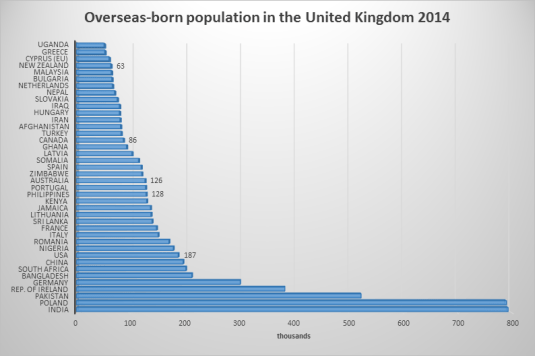
Source: Population by Country of Birth and Nationality Report, August 2015 – ONS.
07 Oct 2015 Leave a comment
in politics - Australia, politics - New Zealand, population economics
05 Oct 2015 1 Comment
in economic growth, economic history, economics of education, human capital, politics - New Zealand, politics - USA, population economics, poverty and inequality Tags: economics of personality traits, economics of schools, education premium, endogenous growth theory, IMF, James Heckman, Leftover Left, OECD, student loans, top 1%, Twitter left
Rick Noack did a great job in the Washington Post today to concisely summarise the hypothesis behind the OECD’s claim that inequality holds back growth. In the case of New Zealand 15 ½ percentage points of economic growth was lost due to rising equality since the late 1980s.
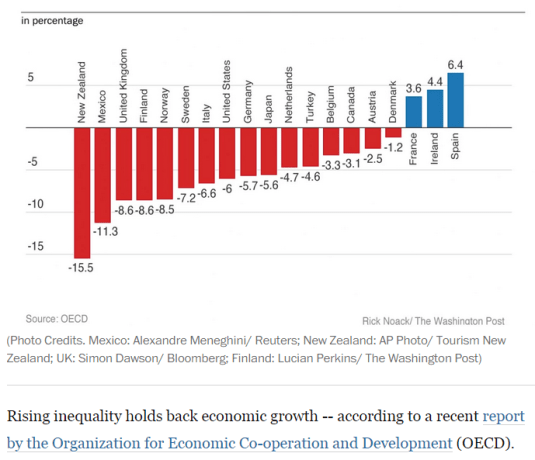
Source: How inequality made these Western countries poorer – The Washington Post.
According to the OECD, it is all about the ability to lower middle class and working class families to finance the human capital investments of their children. The OECD theory of inequality and lower growth is there is a financing constraint because of inequality that reduces economic growth because of less human capital accumulation by lower income families.
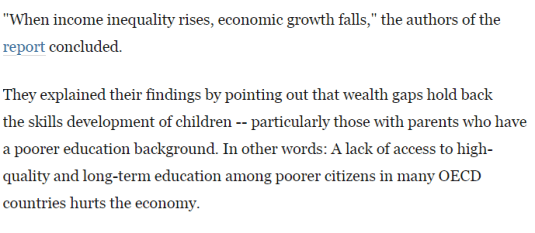
Source: How inequality made these Western countries poorer – The Washington Post.
In an age of interest-free student loans or cheap student loans everywhere for several decades now at least, the OECD is nonetheless hanging its head on the notion that not enough has been done to ensure there is enough graduates from the lower middle class and working class families making it to university. Taylor also has the same problem as me with the OECD’s human capital and inequality nexus:
There are a few common patterns in economic growth. All high-income countries have near-universal K-12 public education to build up human capital, along with encouragement of higher education. All high-income countries have economies where most jobs are interrelated with private and public capital investment, thus leading to higher productivity and wages. All high-income economies are relatively open to foreign trade.
In addition, high-growth economies are societies that are willing to allow and even encourage a reasonable amount of disruption to existing patterns of jobs, consumption, and ownership. After all, economic growth means change.
One of the findings of the Coleman report in the 1960s, which is been pretty much backed up since then such as by top labour economists such as James Heckman, is family background is the key to skills development in children, not the quality of their schools or their access to finance for higher education.

Schools work with what families present to them in terms of innate ability, and personality traits such as to pay attention and work. There is not much difference between an average bad public school and an average good public school when it comes to getting on in life. Going to really bad public school is different from just going to an average bad public school in terms of the chaos imposes on a child’s education and upbringing. What matters is the home environment rather than the ability to access good schools and families of ordinary means to finance higher education for their teenagers.
Most of the skill gaps that are present at the age of 18 – skill gaps which substantially explain gaps in adult earnings and employment in all groups – are also present at the age of five (Cunha and Heckman 2007). There is much evidence to show that disadvantaged children have lower levels of soft skills (non-cognitive skills): motivation, persistence, self-discipline, the ability to work with others, the ability to defer gratification and plan ahead, etc. (Heckman 2008). Most of the skills that are acquired at school build on these soft skills that are moulded and reinforced within the family.
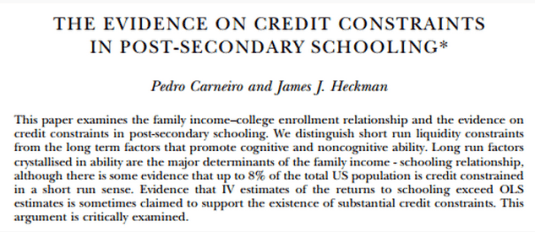
In 2002, with Pedro Carneiro, James Heckman showed that lack of access to credit is not a major constraint on the ability of young Americans to attend college. Short-term factors such as the ability to borrow to fund higher education has been found to be seriously wanting as an explanation for who and who does not go on to higher education.
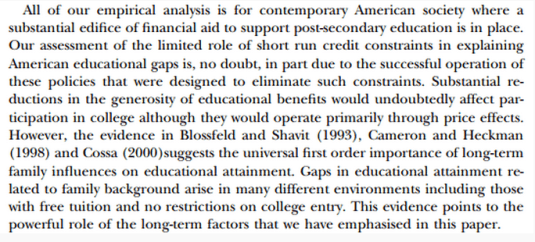
Only a small percentage of young people are in any way constrained from going on to higher education because of the lack of money. This is not surprising in any society with student loans freely available at low or zero rates without any need to post collateral. Heavily subsidised tuition fees and cheap student loans have been around for several generations.

Source: James Heckman.
The biggest problem with the OECD hypothesis linking a lack of skill development within lower income and working class families is it is such an easy problem to solve for the ambitious politician of either the left or the right by throwing money at the problem. Schooling until the age of 16 has been free for a century and universities have been virtually free for at least two generations. Lack of access to a good education does not cut it as the explanation for large disparities in growth rates.

The OECD and more recently the IMF have placed a lot of weight in access to human capital as a driver of inequality because human capital accumulation is hypothesised to be a major driver of economic growth.
The evidence that human capital is a key contributor to higher economic growth is weakening rather than strengthening. If human capital accumulation is not a major driver of productivity growth and productivity disparities, the inequality and growth hypothesis of the OECD and the IMF based on access to finance for human capital accumulation does not get out of the gate. Moreover, as Aghion said:
Economists and others have proposed many channels through which education may affect growth–not merely the private returns to individuals’ greater human capital but also a variety of externalities.
For highly developed countries, the most frequently discussed externality is education investments’ fostering technological innovation, thereby making capital and labour more productive, generating income growth. Despite the enormous interest in the relationship between education and growth, the evidence is fragile at best.
The trend rate of productivity growth did not accelerate over the 20th century despite a massive rise in investments in human capital and R&D because of the rising cost of discovering and adapting new technological knowledge. The number of both R&D workers and highly educated workers increased many-fold over the 20th century in New Zealand and other OECD member countries including the global industrial leaders such as the USA, Japan and major EU member states.
Cross-country differences in total factor productivity are due to differences in the technologies that are actually used by a country and the degree in the efficiency with which these technologies are used. Differences in total factor productivity, rather than differences in the amount of human capital or physical capital per worker explain the majority of cross-country differences in per capita real incomes (Lucas 1990; Caselli 2005; Prescott 1998; Hall and Jones 1999; Jones and Romer 2010).
Differences in the skills of the individual worker or in the total stock of human capital of all workers in a country cannot explain cross national differences in value added per worker at the industry level.
The USA, Japan, France, the UK and Germany all have relatively well-educated, experienced and tested labour forces. For example, the 1993 McKinsey’s study inquired into the education and skills levels of Japanese and German steel workers. Comparably skilled German steel workers were half as productive as their Japanese counterparts (Prescott and Parente 2000, 2005).
The ability to finance human capital accumulation and go to good schools is a weak theory of inequality. Human capital accumulation itself is a weak theory of growth unless linked to sophisticated theories of the institutions fostering innovation and technology absorption which it now is.
To be fair, I will not point out that this period of rising inequality since 1980s so damned by the OECD and the Twitter Left in the Washington Post today coincided with the return of real wages growth in New Zealand after 20 years of wage stagnation. That would be kicking the Twitter Left when they are down. I was a sneak in a graph instead.
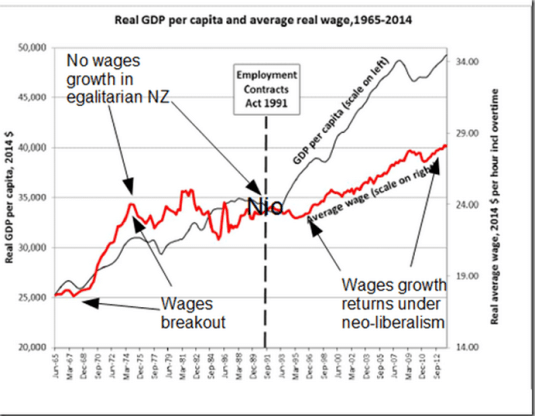
Data source: New Zealand Council of Trade Unions.
I will leave it for your own imagination to think of what happened to female labour force participation, the gender wage gap and female participation in higher education since the late 1980s and the onset of this horrific inequality which was mainly for men.
The failure of the Twitter Left to undertake a gender analysis of any labour force or income statistic they use is a major analytical shortcoming. Hardly any labour force statistics make any sense unless broken down by male and female outcomes.
04 Oct 2015 Leave a comment
in economic history, economics of crime, population economics
There is a spike in murder rates are of young Latinos males and Latina females in the late 1980s and early 1990s consistent with the crack cocaine epidemic and the associated drug trafficking and turf wars.

Source: Centres for Disease Control and Prevention.

Source: Centres for Disease Control and Prevention.
Celebrating humanity's flourishing through the spread of capitalism and the rule of law
Scholarly commentary on law, economics, and more
Beatrice Cherrier's blog
Celebrating humanity's flourishing through the spread of capitalism and the rule of law
Celebrating humanity's flourishing through the spread of capitalism and the rule of law
Celebrating humanity's flourishing through the spread of capitalism and the rule of law
Why Evolution is True is a blog written by Jerry Coyne, centered on evolution and biology but also dealing with diverse topics like politics, culture, and cats.
Celebrating humanity's flourishing through the spread of capitalism and the rule of law
Celebrating humanity's flourishing through the spread of capitalism and the rule of law
A rural perspective with a blue tint by Ele Ludemann
DPF's Kiwiblog - Fomenting Happy Mischief since 2003
Celebrating humanity's flourishing through the spread of capitalism and the rule of law
The world's most viewed site on global warming and climate change
Tim Harding's writings on rationality, informal logic and skepticism
A window into Doc Freiberger's library
Let's examine hard decisions!
Commentary on monetary policy in the spirit of R. G. Hawtrey
Thoughts on public policy and the media
Celebrating humanity's flourishing through the spread of capitalism and the rule of law
Politics and the economy
A blog (primarily) on Canadian and Commonwealth political history and institutions
Reading between the lines, and underneath the hype.
Economics, and such stuff as dreams are made on
"The British constitution has always been puzzling, and always will be." --Queen Elizabeth II
Celebrating humanity's flourishing through the spread of capitalism and the rule of law
Celebrating humanity's flourishing through the spread of capitalism and the rule of law
WORLD WAR II, MUSIC, HISTORY, HOLOCAUST
Undisciplined scholar, recovering academic
Celebrating humanity's flourishing through the spread of capitalism and the rule of law
Res ipsa loquitur - The thing itself speaks
Celebrating humanity's flourishing through the spread of capitalism and the rule of law
Researching the House of Commons, 1832-1868
Articles and research from the History of Parliament Trust
Reflections on books and art
Posts on the History of Law, Crime, and Justice
Celebrating humanity's flourishing through the spread of capitalism and the rule of law
Exploring the Monarchs of Europe
Cutting edge science you can dice with
Small Steps Toward A Much Better World
“We do not believe any group of men adequate enough or wise enough to operate without scrutiny or without criticism. We know that the only way to avoid error is to detect it, that the only way to detect it is to be free to inquire. We know that in secrecy error undetected will flourish and subvert”. - J Robert Oppenheimer.
The truth about the great wind power fraud - we're not here to debate the wind industry, we're here to destroy it.
Celebrating humanity's flourishing through the spread of capitalism and the rule of law
Celebrating humanity's flourishing through the spread of capitalism and the rule of law
Economics, public policy, monetary policy, financial regulation, with a New Zealand perspective
Celebrating humanity's flourishing through the spread of capitalism and the rule of law
Restraining Government in America and Around the World
 Utopia, you are standing in it!
Recent Comments