Working for Families and work incentives
08 Nov 2014 Leave a comment
in labour economics, labour supply, politics - New Zealand, public economics, taxation, welfare reform Tags: effective marginal tax rates, tax – welfare system interactions

There are 3.38 million individual taxpayers. Of these, about 120,000 (3.4 percent) face EMTRs over 60%, 120,000 (3.4 percent) face EMTRs between 50% and 60%, and 160,000 (4.5 percent) face EMTRs between 40% and 50%. Slightly more than 88 percent of taxpayers face EMTRs below 40%.
HT: New-Zealand-tax-system-and-how-it-compares-internationally
The Economics of Europe’s Insane History of Putting Animals on Trial and Executing Them
02 Oct 2014 Leave a comment
in applied price theory, economics of religion, law and economics, Public Choice, public economics, rentseeking, taxation Tags: economics of religion, follow the money, Peter Leeson, rent seeking

The fantastically creative and insightful Peter Leeson published an article in the Journal of Law and Economics in 2013 on the practice of putting animals on trial in the Medieval ages.
Abstract
For 250 years insects and rodents accused of committing property crimes were tried as legal persons in French, Italian, and Swiss ecclesiastic courts under the same laws and according to the same procedures used to try actual persons.I argue that the Catholic Church used vermin trials to increase tithe revenues where tithe evasion threatened to erode them.
Vermin trials achieved this by bolstering citizens’ belief in the validity of Church punishments for tithe evasion: estrangement from God through sin, excommunication, and anathema.
Vermin trials permitted ecclesiastics to evidence their supernatural sanctions’ legitimacy by producing outcomes that supported those sanctions’ validity. These outcomes strengthened citizens’ belief that the Church’s imprecations were real, which allowed ecclesiastics to reclaim jeopardized tithe revenue
Leeson’s paper is also closely connected to Ekelund, Herbert, and Tollison’s (1989, 2002, 2006) and Ekelund et al.’s (1996) work. They study the medieval Catholic Church as a firm. They discuss how ecclesiastics used supernatural sanctions to protect the Church’s monopoly on spiritual services against heretical competition.
HT: Wired – fantastically-wrong-europes-insane-history-putting-animals-trial-executing/


The most forgotten diagrams in the political economy of taxation-updated
30 Jul 2014 Leave a comment
in applied price theory, public economics, taxation Tags: incidence of taxes, the burden of taxes

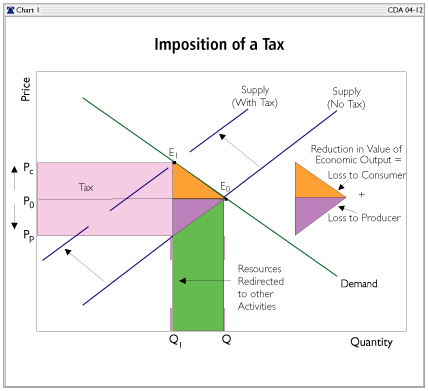
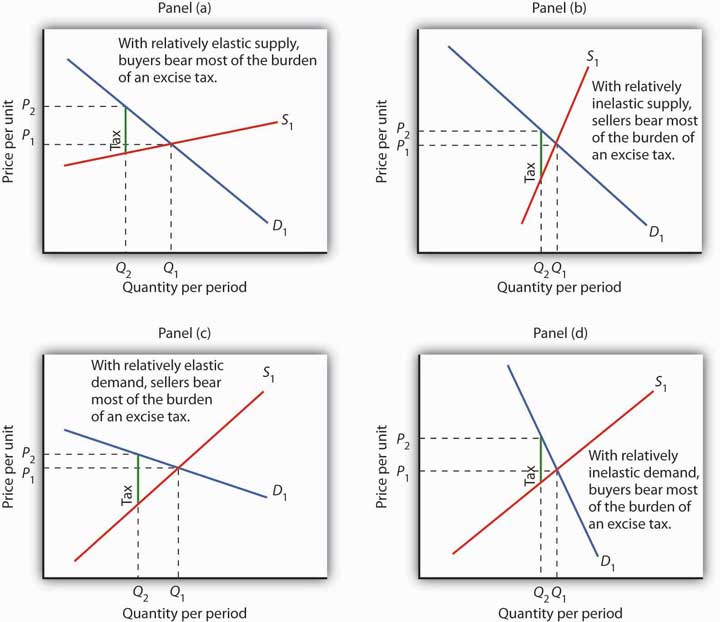
The ability to pass the burden of the tax depends on price elasticity of demand and price elasticity of supply.
UK Labour supporters admit it: taxes are to punish the rich, not to raise revenue
08 Jul 2014 Leave a comment
in labour supply, liberalism, Public Choice, Rawls and Nozick, taxation Tags: envy, expressive voting, top tax rate

via Labour supporters admit it: taxes are to punish the rich, not to raise revenue – Telegraph Blogs and http://danieljmitchell.wordpress.com/2014/02/04/what-motivates-the-left-envy-or-greed/

Tax Freedom Day
04 Jun 2014 Leave a comment
in public economics, taxation Tags: taxes

HT: Daniel Mitchell
The Company Tax Laffer curve
03 Jun 2014 Leave a comment
in public economics, taxation Tags: company tax rate, laffer curve
The Australian, New Zealand and Irish company taxes raised similar amounts of revenue as a percentage of GDP. The Irish company tax rate was 12.5% in 2003.

from The U.S. Corporate Income Tax System: Once a World Leader, Now A Millstone Around the Neck of American Business by the Tax Foundation via The Solution is the problem blog
Peter Saunders on The Spirit Level Delusion
30 May 2014 Leave a comment
in applied welfare economics, taxation, technological progress Tags: inequality, Peter Saunders, Sprite Level Delusion
Warren Buffett: I Build Wind Turbines To Lower My Taxes
22 May 2014 Leave a comment
in entrepreneurship, environmental economics, taxation Tags: bootleggers and baptists, rentseeking, wind power
“I will do anything that is basically covered by the law to reduce Berkshire’s tax rate,” Buffett told an audience in Omaha, Nebraska this weekend. “For example, on wind energy, we get a tax credit if we build a lot of wind farms. That’s the only reason to build them. They don’t make sense without the tax credit.”

Buffett has invested billions into wind power to get federal subsidies.
via Warren Buffett: I Build Wind Turbines To Lower My Taxes | The Daily Caller.
The empirical foundations of supply-side economics – Michael Keane – YouTube
19 May 2014 Leave a comment
in labour economics, taxation Tags: labour supply, taxes
Most economists believe male labour supply elasticities are small, but a sizable minority of studies have large values. There is no clear consensus on this point.
The key factor driving these tensions is the failure of most studies to account for human capital returns to work experience.
In a model that includes human capital, even modest elasticities—as conventionally measured—can be consistent with large efficiency costs of taxation.
Conventional estimates of male labour supply elasticities have a severe downward bias because of their failure to include human capital accumulation. The opportunity cost of time includes their after tax wage and present value of increased earnings in all future years.
The return to work experience is high so working more has large long-term payoffs for younger male workers. Wages start low for young grow and then peak in 40s. When adjusted for the return for work experience, a large part of compensation when younger is human capital, and this peters away by the 40s.

Estimates where wages grow with work experience, with the accumulation of human capital, yield large male labour supply elasticities, as high as 3.8 rather than close to zero (Keane 2010, 2011). That is a profound difference.
Women have high labour supply elasticities, especially on the labour force participation margin, as most agree.
Estimates of long-run female labour supply elasticities—estimates that allow for dynamic effects of wages on fertility, marriage, education and work experience—are generally quite high.
Why I am not reviewing Thomas Piketty’s Capital in the Twenty-First Century – updated again
29 Apr 2014 Leave a comment
in applied welfare economics, entrepreneurship, macroeconomics, market efficiency, politics, Rawls and Nozick, taxation, technological progress Tags: Greg Mankiw, Jon Elster, Mirrlees Review, Robert Lucas, Thomas Piketty, Tyler Cowen
It’s 700 pages long and goes on about Marx. Some people were watching the other channel when the Berlin Wall fell.

My 1 o’clock lecture at ANU in 1990 was next to a room rented out ironically from 12 to 1 to the Campus Trots and then to the Campus Christians for an hour of prayer to another saviour.
The Twitter summary of Piketty is this:
Karl Marx wasn’t wrong, just early. Pretty much. Sorry, capitalism. #inequalityforevah
The only Marxist I bother with is Jon Elster. He is a leading proponent of Analytical Marxism and one of the last polymaths. Brian Barry once wrote that to review one of Elster’s books one:
would either have to have taken off several years to master the many fields which fall within Elster’s purview or would be a consortium of at least twenty carefully-chosen experts.
All of Elster’s books and writings are worth reading, including
- Ulysses and the Sirens (1979);
- Sour Grapes: Studies in the Subversion of Rationality (1983);
- Making Sense of Marx (1985); and
- An Introduction to Karl Marx (1986).
As Jon Elster noted:
Marxian economics is, with a few exceptions, intellectually dead
and Marx’s labour theory of value is:
useless at best, harmful and misleading at its not infrequent worst.
To go on with my non-review, I will quote Tyler Cowen:
The crude seven-word version of Piketty’s argument is “rates of return on capital won’t diminish.”
Piketty’s reasons why rates of return on capital won’t diminish are fairly specific and restricted to only a small share of capital.
.. In any case this is pure speculation and Piketty’s entire argument depends upon it.
… Piketty converts the entrepreneur into the rentier.
To the extent capital reaps high returns, it is by assuming risk…
Yet the concept of risk hardly plays a role in the major arguments of this book.
Once you introduce risk, the long-run fate of capital returns again becomes far from certain.
In fact the entire book ought to be about risk but instead we get the rentier…
Overall, the main argument is based on two (false) claims.
First, that capital returns will be high and non-diminishing, relative to other factors.
Second, that this can happen without significant increases in real wages.
Piketty’s advocacy of a top marginal income tax rate of 80% and a an international treaty for a wealth tax are wildly impractical and destructive of economic growth and entrepreneurship. His advocacy of 60% marginal tax rates on incomes above $200,000 strike at the heart of the professional and managerial occupations that are the backbone of day-to-day capitalism. Piketty’s wealth tax would tax the homes and the retirement savings of the ordinary middle class:
- wealth below 200,000 euros be taxed at a rate of 0.1 percent,
- wealth between 200,000 and one million euros at 0.5 percent,
- wealth between one million and five million euros at 1.0 percent, and
- wealth above five million euros at 2.0 percent.
Piketty’s reason for these high top tax rates is not to bring in more revenue or to redistribute wealth to poor and the downtrodden but simply “to put an end to such incomes.” Harsanyi argues that:
Like many progressives, Piketty doesn’t really believe that most people deserve their wealth anyway, so confiscating it presents no real moral dilemma.
He also argues that we can measure a person’s productivity and the value of a worker (namely, low-skilled labourers) while arguing that other groups of workers (namely, the kind of people he doesn’t admire) are bequeathed undeserved, “arbitrary” salaries. What tangible benefit does a stockbroker or a kulak or an explanatory journalist offer society, after all?
This takes me back to Jon Elster who had this to say on socialism:
Optimism and wishful thinking have been features of socialist thought from its inception.
In Marx, for instance, two main premises appear to be that whatever is desirable is possible, and that whatever is desirable and possible is inevitable.
…It has become clear that classical socialism massively underestimated the importance of economic incentives
.
Greg Mankiw is less harsh, but still to the point:
Like President Obama and others on the left, Piketty wants to spread the wealth around.
Another philosophical viewpoint is that it is the government’s job to enforce rules such as contracts and property rights and promote opportunity rather than to achieve a particular distribution of economic outcomes.
No amount of economic history will tell you that John Rawls (and Thomas Piketty) offers a better political philosophy than Robert Nozick (and Milton Friedman).
John Rawls was actually very much alive to the importance of incentives in a just and prosperous society.
Unequal incomes might turn out to be to the advantage of everyone. Work effort and entrepreneurial alertness respond to incentives; incentives channel people into the occupations and jobs where they produce more.
Rawls lent qualified support to the idea of a flat-rate consumption tax because these taxes:
impose a levy according to how much a person takes out of the common store of goods and not according to how much he contributes.
A simple way to have a progressive consumption tax is to exempt all savings from taxation.
With his emphasis on fair distributions of income, Rawls’ initial appeal was to the Left. Left-wing thinkers then started to dislike his acceptance of capitalism and his tolerance of large discrepancies in income and wealth.
It’s impossible to make the workers better off by taxing capital. The optimal rate of tax on income from capital is zero. This is why the Mirrlees Review of the UK taxation system argued for zero taxation of the returns to capital.
Robert Lucas estimated in 1990 that eliminating all taxes on income from capital would increase the U.S. capital stock by about 35% and consumption by 7%.
Hans Fehr, Sabine Jokisch, Ashwin Kambhampati, and Laurence J. Kotlikoff (2014) found that eliminating the corporate income tax completely would raise the U.S. capital stock (machines and buildings) by 23%, output by 8% and the real wages of unskilled and skilled workers each by 12%.
Book reviews serve the same purpose as film reviews. They are filters for our time. Do you agree?
I made a time management decision to not read a long book plenty of others reviewed and some even understood.
As for the growing income inequality, there is a long literature dating back 25-years arguing that skill-biased technological change is increasing the returns to investing in education as Gary Becker blogged in 2011:
Earnings inequality in the United States and many other countries has increased greatly since the late 1970s, due in large measure to globalization and technological progress that raised the productivity of more educated and more skilled individuals.
While the average American college graduate earned about a 40% premium over the average high school graduate in 1980, this premium increased to over 70% in 2000.
The good side of this higher education-based earnings inequality is that it induced more young men, and especially more young women, to go to and finish college.
The bad side is that many sufficiently able children could not take advantage of the greater returns from a college education because their parents did not prepare them to perform well in school, or they went to bad schools, or they lacked the financing to attend college.
As a result, the incomes of high school dropouts and of many high school graduates stagnated while incomes boomed for many persons who graduated college, and even more so for those with post graduate education.
There is nothing new under the sun.
Tax reforms lead to higher taxes
22 Mar 2014 3 Comments
in constitutional political economy, James Buchanan, Public Choice, public economics, taxation Tags: Casey Mulligan, efficient taxes, Gary Becker, growth of government, James M. Buchanan, tax reform, taxation in Nordic countries
After the 1970s tax revolts and California’s Proposition 13, Buchanan and Brennan wrote The Power to Tax. Their message was that if you don’t always trust governments, beware of efficient taxes.

More efficient taxes make it easier for government to extract more tax revenue from the population with less resistance. Taxes can be made more efficient by broadening tax bases and removing loopholes while lowering marginal rates. A GST that replaces a web of sales taxes is a common example. The GST always goes up over time, never down over time. Most tax reforms are revenue neutral.
When Brennan said at a tax reform conference in Australia 20 years or so ago that efficient taxes and tax reforms are both bad because they lead to higher taxes and a larger government, no one understood him.
Idealists all, the audience including me assumed they were advising a benevolent government, not a revenue-maximising leviathan government – a beast that needed to be staved with constitutional constraints on the number and size of tax bases and tax instruments.
Fiscal arrangements were analysed by Buchanan and Brennan in The Power to Tax in terms of the preferences of citizen-taxpayers who are permitted at some constitutional level of choice to select the fiscal institutions they are to be subject to over an uncertain future.
Those in elected office are assumed to exploit the power assigned to them to the maximum possible extent: government is a revenue-maximising leviathan.
Buchanan and Brennan were all for inefficient tax systems because they do not raise as much revenue. A government that cannot raise much revenue cannot grow very large.

Gary Becker and Casey Mulligan attributed the growth in the size of governments in the 20th century to demographic shifts, more efficient taxes, more efficient spending, a shift in the political power from the taxed to the subsidised, shifts in political power among taxed groups, and shifts in political power among the subsidised groups:
An improvement in the efficiency of either taxes or spending would reduce political pressure for suppressing the growth of government and thereby increase total tax revenue and spending.
Tax reform saved the late 20th century welfare state by raising the same or more revenue with less taxpayer resistance. Taxes are very efficient in the Nordic countries – high tax rates on labour income and consumption but lower on capital income. And light regulation too.
 Utopia, you are standing in it!
Recent Comments