

Real business cycles and learning the value of major technological changes
17 Dec 2014 Leave a comment
in business cycles, entrepreneurship, macroeconomics, technological progress Tags: boom and bust, general purpose technologies, real business cycles
The true value of any technological improvement is uncertain. Investors adopt a new technology after forecasting the likely productivity of the new technology. Investor learning in the face of imperfect information about the true value of major new technologies can also lead to business cycle fluctuations (Li 2007).

As a new technology slowly diffuses, entrepreneurs learn more about the true potential of the new technology and re-evaluate in hindsight whether they have invested beyond the optimal amount. If entrepreneurs have not over-invested, they revise their beliefs about the magnitude of the innovation and invest more.
Because the agents have to learn the magnitude of the technology shock, they are cautious in making investment decisions before they have learned much about the underlying technology. Consequently, GDP growth is gradual, which stretches out the length of booms.
When entrepreneurs later find that investment has over-shot the optimal amount, they reduce investment demand perhaps sharply and start a recession (Li 2007). This eventuality may seed a recession within many major technology advances such as the IT boom in the 1990s and the computer revolution in the 1970s.
The true value of the major technological improvement is often discovered only after investment over-shoots the optimal level (Li 2007). A general technological innovation affecting many industries is required for the cluster of entrepreneurial errors about the true magnitude of the productivity increase to seed a recession (Li 2007).
The 2001 US recession followed a long boom involving major new information and communication technologies that raised the productivity of many existing technologies. The information, communications and software boom lasted over a decade in the US (Li 2007).

Entrepreneurs invested gradually in new information and communication capital to learn more about the underlying technologies that they embodied. These new information and communication technologies were productivity improvements of a major but uncertain scope (Li 2007).
The eventual productivity gains come from two complex sources – both from adopting the new technology itself and from its interface with existing capital and expertise. Because both productivity gains must be forecasted and because both are discovered only by experimentation and learning by doing, it is entirely possible that entrepreneurs can invest ahead of consumer demand.
This surplus capacity will emerge despite the best efforts of investors to mitigate this risk by staggering investments to learn more about the true value of the new technology. This investor caution and staggering to allow for more learning is an important factor that stretches out the length of investment booms in major new technologies (Li 2007).

There was a sharp decline in US investment in 2001, with large accumulations of unused capital in some sectors. For example, 90% of the optical fibre laid in the US in the 1990s was unused in the years that followed. Entrepreneurs discovered the optimum investment level in, for example, optical cable fibre by investing past it and revised plans for further investments in light of this over-shooting (Li 2007).

Real business cycles of a significant magnitude can emerge simply from technological learning.
Li (2007) argued that many investment booms start with the advent of a revolutionary technology and ended with overinvestment. For example, canal building boomed after the invention of the steamboat, and by the year 1860 more than 4,000 miles of canal had been completed. However, many of these canals did not live up to the expectations of their promoters. Many of these projects eventually turned out to be financial failures.
Later in the same century, the railroad expansion shared a similar fate. Thousands of miles of railroad were built and left unused or under used, a phenomenon described by Schumpeter (1949) as construction “ahead of demand.”
That real business cycle theory required technological regress for there to be recessions is one of its oldest criticisms. That criticism that standard equilibrium business cycle models have difficulties in predicting the investment boom and overshooting grows weaker by the day.
Li presents a strong internal propagation mechanism with respect to technology shocks and endogenous recessions without invoking technological regress:
…firms invest in new capital to take advantage of the IT revolution, without knowing the limit to which this new technology can increase productivity.
The belief of this limit becomes increasingly optimistic over time as investors repeatedly realize that they have not invested enough to exhaust the potential of the new technology. Such belief revisions lead to increasingly aggressive investment and a capital overhang, followed by a recession.
@bryce_edwards New Zealand’s war on the poor – a fact check
15 Dec 2014 Leave a comment
in economic history, income redistribution, labour economics, Marxist economics, politics - USA, technological progress Tags: Bryce Edwards, Leftover Left, poverty and inequality
Bryce Edwards has shown in today’s column that he knows nothing about inequality in New Zealand, despite the statistics being at his fingertips:
Under capitalism there’s always going to be a war against the poor.
The process by which we divide up the resources of any society normally involves exploiting the majority for the benefit of the minority.
It’s called inequality. And this is how it is in New Zealand: those who have the most power look for ways to extract that money for themselves, or at least retain the status quo.
Against this are those who want to have a more equal society. It’s an age-old political issue, and one that has traditionally been at the heart of the left-right political divide.
In 2014 this concern about inequality has been a key feature of politics, underpinning much of what has occur…
Although the rich appear to have been winning for three decades in their ‘war against the poor’, perhaps the tide is turning?
There’s still every indication of severe poverty and inequality in this country.
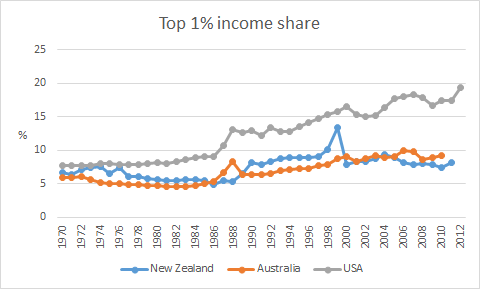
Firstly, inequality has not increased in New Zealand for at least 20 years when either measured in figure 1 by the Gini coefficient or in figure 2, the top 1% income shares. Both the Gini coefficient and the top 1% income shares have not risen for 20 years.
Figure 1: Gini coefficient New Zealand 1980-2015

Source: Bryan Perry, Household incomes in New Zealand: Trends in indicators of inequality and hardship 1982 to 2013. Ministry of Social Development (July 2014).
Figure 2: Top 1% income shares, USA, New Zealand and Australia, 1970-2012
Source: top incomes database
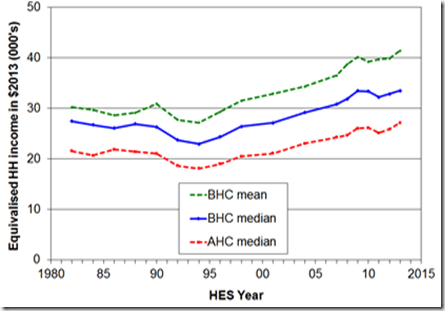
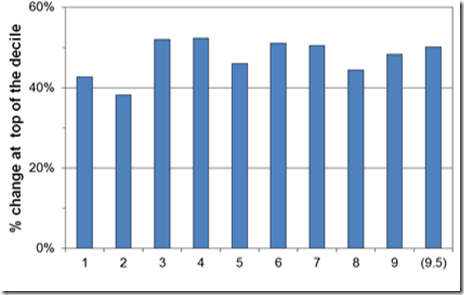
Secondly, the benefits of the economic boom that lasted 15 years from the early 1990s until the onset of the global financial crisis would spread broadly across all sections of the New Zealand community. As shown in figure 3, both before and after housing costs increased. As shown in figure 4, real household incomes increased pretty much evenly across all of the 10 income deciles between 1994 and 2013.
Figure 3: Real household income trends before housing costs (BHC) and after housing costs (AHC), 1982 to 2013 ($2013)
Source: Bryan Perry, Household incomes in New Zealand: Trends in indicators of inequality and hardship 1982 to 2013. Ministry of Social Development (July 2014).
Figure 4: Real household incomes (BHC), changes for top of income deciles, 1994 to 2013
Source: Bryan Perry, Household incomes in New Zealand: Trends in indicators of inequality and hardship 1982 to 2013. Ministry of Social Development (July 2014).
Thirdly, as shown in figure 5, between 1994 and 2010, real equivalised median household income rose 47% from 1994 to 2010; for Māori, this rise was 68%; for Pasifika, the rise was 77%. Median household income increases of nearly 50% in 16 years should be celebrated.
Figure 5: Real equivalised median household income (before housing costs) by ethnicity, 1988 to 2013 ($2013).

Source: Bryan Perry, Household incomes in New Zealand: Trends in indicators of inequality and hardship 1982 to 2013. Ministry of Social Development (July 2014).
The massive improvements in Māori incomes since 1992 were based on rising Māori employment rates, fewer Māori on benefits, more Māori moving into higher paying jobs, and greater Māori educational attainment. Māori unemployment reached a 20-year low of 8 per cent from 2005 to 2008.
Over the last more than two decades in New Zealand, there has been sustained income growth spread across all of New Zealand society contrary to the warmed over Marxism of Bryce Edwards. Perry (2014) reviews the data every year for the Ministry of Social Development. He concluded that:
Overall, there is no evidence of any sustained rise or fall in inequality in the last two decades.
The level of household disposable income inequality in New Zealand is a little above the OECD median.
The share of total income received by the top 1% of individuals is at the low end of the OECD rankings.
Bryce Edwards’ analysis was in the typical Marxist tradition – it had no gender analysis. He failed to mention that New Zealand has the smallest gender wage gap of all the industrialised countries.

As he did not notice these great successes in household incomes, incomes of every decile, Māori economic development and the empowerment of women, Bryce Edwards had nothing to add in terms of either consolidating or improving on them.
The Economic History of the Last 2,000 Years in 1 Little Graph – The Atlantic
14 Dec 2014 Leave a comment
in development economics, growth disasters, growth miracles, technological progress Tags: capitalism and freedom, The Great Fact


Global Warming Was Worth It – And if we had to, we’d do it again
13 Dec 2014 Leave a comment
in climate change, development economics, environmental economics, global warming, growth disasters, growth miracles, history of economic thought, liberalism, population economics, technological progress Tags: capitalism and freedom, The Great Enrichment, The Great Escape, The Great Fact
Now, my conception (read: European) of progress and a better standard of living would place many advances above composting, organic farming, or even urban chicken coops.
- Higher incomes that allow people to make livings that afford them more than merely survival or avoiding starvation.
- A low poverty rate.
- High quality and diversity of employment opportunities. Rather than the choice of being a farmer or being a blacksmith, the average citizen should have an array of careers to choose from, and the ability to be industrious and take risks for profit.
- The availability of housing. On an average night in the United States, a country with a population of somewhere around 350 million, fewer than one million people are homeless.
- Consistent GDP growth.
- Access to quality health care.
- The availability of quality education. (I suppose we could quibble over the word “quality,” but certainly there is widespread free education availability.)
- High life expectancy. Worldwide life expectancy has more than doubled from 1750 to 2007.
- Low frequency of deadly disease.
- Affordable goods and services.
- Infrastructure that bolsters economic growth.
- Political stability.
- Air conditioning.
- Freedom from slavery, torture and discrimination.
- Freedom of movement, religion and thought.
- The presumption of innocence under the law.
- Equality under the law regardless of gender or race.
- The right to have a family – as large as one can support. Maybe even larger.
- The right to enjoy the fruits of labor without government – or anyone else – stealing it.
There’s much more, of course. If the “sustainability movement” had its way, many of these advances would be degraded.
And since Caradonna offered a few charts highlighting climate change and population growth (a bad thing), I too was assembling a number of graphs that could offer visual examples of the rise of positive developments since the Industrial Revolution. I also soon noticed that all of them looked virtually identical.
So below is what a graph encompassing nearly every one of my bullet points looks like:

Darwin Awards ‘winners’ are overwhelmingly male, analysis reveals
13 Dec 2014 Leave a comment
in economics of media and culture, health economics, liberalism, population economics, technological progress Tags: Darwin awards
- Darwin Awards is an annual review of most foolish way people have died
- Nominees improve the gene pool by eliminating themselves from the human race using foolish methods
- Scientists were surprised to discover 90% of award ‘winners’ were male
- Worthy candidates include a terrorist who opened his own letter bomb
- Another man attempted to travel by hitching a shopping trolley to a train

According to “male idiot theory” (MIT) many of the differences in risk seeking behaviour, emergency department admissions, and mortality may be explained by the observation that men are idiots and idiots do stupid things…
In addition, alcohol may play an important part in many of the events leading to a Darwin Award. It is conceivable that the sex difference is attributable to sociobehavioural differences in alcohol use.
Anecdotal data support the hypothesis that alcohol makes men feel “bulletproof” after a few drinks, and it would be naïve to rule this out.
For example, the three men who played a variation on Russian roulette alternately taking shots of alcohol and then stamping on an unexploded Cambodian land mine.
HT: dailymail.co.uk and The Darwin Awards: sex differences in idiotic behaviour | The BMJ.
Bill Gates on The Great Fact
12 Dec 2014 Leave a comment
in development economics, growth disasters, growth miracles, technological progress Tags: Bill Gates, capitalism and freedom, The Great Enrichment, The Great Fact
Is everything getting worse? Household technology adoption rates 1997-2010s
09 Dec 2014 Leave a comment
in politics - USA, technological progress Tags: technology diffusion, technology usage rates, The Great Enrichment, The Great Fact

HT: infodocket.com
Creative destruction alert: whatever happened to the Microsoft monopoly?
09 Dec 2014 Leave a comment
Everyone is getting worse alert: unbelievable cellphone ad from the early 1990s
08 Dec 2014 Leave a comment
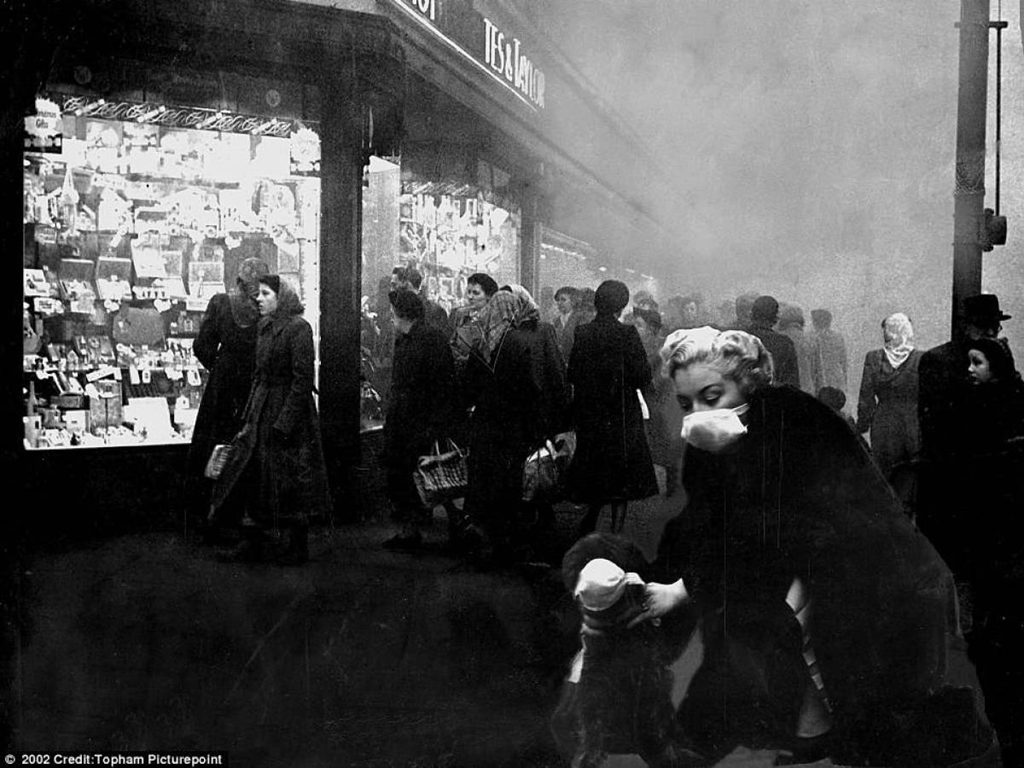
Good old days alert: the London smog that killed 12,000
07 Dec 2014 Leave a comment
in environmental economics, environmentalism, technological progress Tags: air pollution, The Great Escape, The Great Fact





Who chooses to be a vegetarian?
06 Dec 2014 Leave a comment
in applied welfare economics, development economics, economics of media and culture, growth disasters, growth miracles, population economics, technological progress Tags: food snobs, growth disasters, growth miracles, The Great Escape, The Great Fact
 Utopia, you are standing in it!
Recent Comments