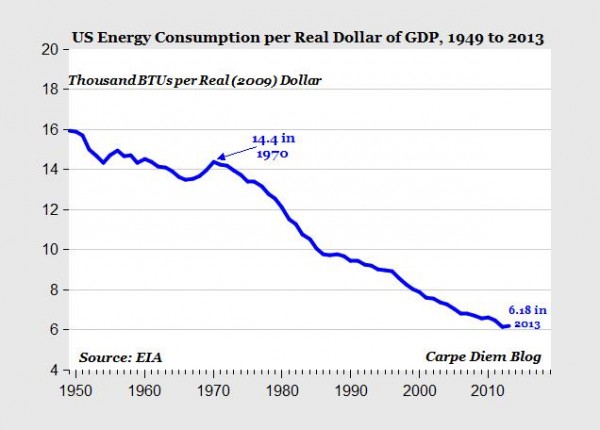
Chart of the day: In 2013, America was more than twice as energy efficient compared to 1970 when Earth Day started | AEIdeas
23 Apr 2014 Leave a comment
in entrepreneurship, environmental economics, environmentalism, liberalism, technological progress Tags: Earth Day, energy conservation
Wild Swans and Star Trek
29 Mar 2014 1 Comment
in applied price theory, development economics, economics of bureaucracy, Marxist economics, Public Choice, technological progress, television Tags: economics of planning, star trek
About the only book I almost read in one sitting was Wild Swans. I stopped reading at 2 in the morning. This autobiography is 676 pages long. Wild Swans is the story of three generations of women and their families in 20th century China. It is the biggest grossing non-fiction paperback in publishing history.

Wild Swans starts with Jung Chang’s grandmother whose feet were bound at the age of two in 1909. She was later to be a concubine to the local warlord. Her mother was a communist revolutionary in the 1940s onwards and her own story as among other things a teenage Red Guard in the Cultural Revolution. The Guardian described Wild Swan as “For many in the west, Wild Swans was their first real insight into life under the Chinese Communist party.”
I will only mention the part of it that reminded me of Steven Cheung’s analysis of how class ridden communist societies were.
A party membership card puts you above others. That card described in enormous detail what privileges you received depending on your rank in the party.
This is exactly what happened in wild swans. Jung Chang’s father was of the 14th rank while her mother was of the 17th rank. This rank decided what food you got, your accommodation, whether your parents could live with you and even the type of seat you got on the railways.
Star Trek was supposed to be a society that had abolished money and as a post-scarcity economy because everything was available through a replicator. The type of economics it is based on is cooperative economics. To quote Captain Picard:
A lot has changed in three hundred years. People are no longer obsessed with the accumulation of ‘things’. We have eliminated hunger, want, the need for possessions.
The economics of the future is somewhat different. You see, money doesn’t exist in the 24th century… The acquisition of wealth is no longer the driving force in our lives. We work to better ourselves and the rest of Humanity.
The Ferengi and their 285 rules of acquisition were a satire on capitalism. The Ferengi was originally meant to replace the Klingons as the Federation’s arch-rival but they were far too comical.
Gene Roddenberry’s love story with socialism is the most class-ridden society I have ever seen. In Star Trek, higher ranked officers had larger cabins, and most of all they always beamed back from the planet.
Anyone who beamed down with Captain Kirk dressed in those red security officer tops were expendables. Death and accommodation were class based on Star Trek.
The U.S.S. Enterprise also spent a lot of time negotiating trade treaties and visiting planets where the Earth colonists lived in agrarian poverty with famines and preventable diseases.
Terry, Arthur and Maggie Thatcher
19 Mar 2014 Leave a comment
in economics, technological progress Tags: 1970s Britain, 1970s UK TV, economic decline, pop culture, Thatcher, The Minder
Some are one-eyed enough to look upon pre-Thatcher Britain fondly – good jobs and more equality. Watching re-runs of The Minder, I do not see Terry and Arthur, after a hard day of ducking, diving and ‘strictly cash only’ operations, sitting at the bar of the Winchester Club with Dave talking about how they never had it so good.
British TV of the 1970s was gritty. The Sweeney is another example, reflecting the economic stagnation of that time.

The Minder was a slow starter in the ratings, not helped by delay from a 9-week technicians’ strike which blacked out the ITV network. It was almost cancelled after one season.
The 25% annual CPI inflation, the productivity slowdown, the three-day week, and the 1978 winter of discontent earned the U.K. in those good old days of good jobs and more equality the moniker ‘the sick man of Europe’.
During the 1960s and 1970s, the main parties competed to reverse Britain’s relative economic decline. There was a growing awareness that the economic league tables showed that Britain was at the wrong end for figures regarding strikes, productivity, inflation, economic growth and rising living standards.
Virtually all European countries, except Britain, had so-called ‘economic miracles’. The targets for blame included: failure to invest in new plant and machinery, restrictive working practices and outdated attitudes on the shop floor (‘us and them’), amateurish management, loss of markets, and rise of competition.
Some believe, as surely as night follows day, that life got worse under Thatcher –
“The 70s was Britain’s most equal decade. The jobs that went during the 80s tended to be good, skilled jobs, delivering decent incomes and some security. She failed to replace those jobs with well-paid equivalents. Demonising unions and stripping the great mass of private-sector workers of a voice and power in the workplace is still the root of the great living standards crisis that saw the share of wealth going to wages slide long before Lehman Brothers failed.”
My high school economics teacher took us on a tour of a carpet factory. The boredom in the eyes of those workers motivated me big time to go to university.
Hoxton, London, 1974 http://t.co/dFVLNaU1gC—
Old Pics Archive (@oldpicsarchive) May 05, 2015
Some members of the educated middle-class forget what a factory job was like in the 1970s. Dangerous too were those good jobs of the 1970s. One reason for low-paid jobs paying a little less now is they are safer and less boring.

What would a socialist Britain look like today – again the Guardian backcasting to a decade of nationalisations, nuclear disarmament and state-run pubs:
Perhaps we would be waiting six months for a mobile telephone, and paying the bills to the post office, headed by the Postmaster General – I don’t believe it would be a very advanced telephone, either. Perhaps there would be three TV channels and the requirement for a licence before you could use the internet.
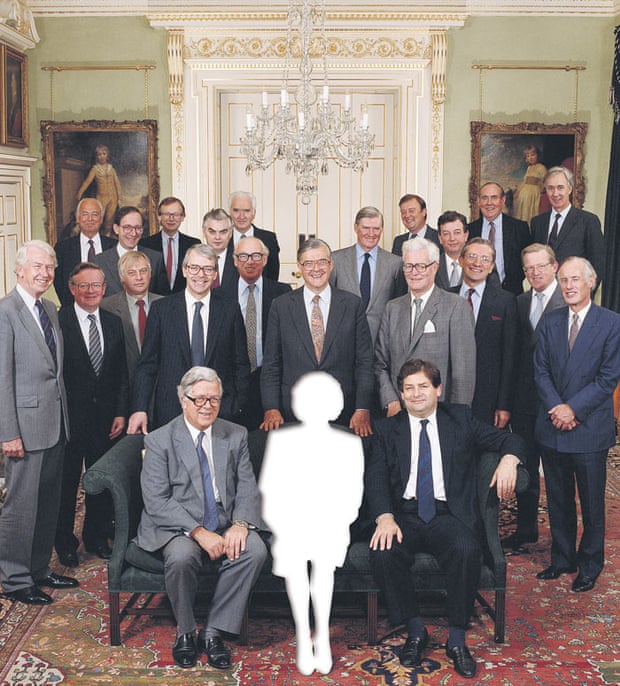
Thatcher won office and stayed in office for so long because the previous arrangements were not working and there had to be a better way. UK Labour spent 17 years in the political wilderness because its ideas failed Britain in the 1970s. As the Minder progressed, the series reflected the improving British economy and Arthur becoming CEO of Daley into Europe Ltd.
Living in the 70s – the BBC documentary Electric Dreams
16 Mar 2014 2 Comments
in economics, liberalism, technological progress Tags: 1970s, Brad De Long, technological progress, the good old days
I grew up in the 70s. But were they the ‘good old days’?
A BBC television documentary placed two parents and four children in their home with only the amenities available during each of the previous three decades (1970s, 1980s and 1990s) and recording their responses to technological change.
The programme follows the family’s adaption and reaction to being thrown back in time to a more technologically sparse period and how their pastimes and attitudes change in response to both landing in the early 1970s and coming up-to-date.
The episodes revealed the huge transformation that technological change has wrought on British family life over the past 40 years. The children have to cope when they swapped Facebook for black-and-white telly and vinyl records.

It was goodbye to their three game consoles, three DVD players, five mobile phones, six televisions and seven computers, not to mention their dishwasher, two washing machines and tumble dryer. The teenager had to do a pre-dawn paper boy run.
Filming occurred over the winter of 2009, which was particularly cold and snowy for England, a fact which figured into the story when the family had to endure cold nights early in the project. The lack of central heating was simulated for the 70s episode.
How much would you pay to go back to the 1970s or whenever you define as the good old days?
A way to grasp the conceptual difficulties of measuring changes in living standards and life expectancies across the decades is to step into Brad De Long’s time machine.
In this thought experiment, De Long asks how much you would want in additional income to agree to go back in time to a specific year. De Long was an economic historian examining the differences in American living standards since 1990.
De Long would have refused to go at all to 1900 unless he could at least have taken mid-20th century modern medicine with him. Otherwise, it would have meant dying from a childhood phenomena. I would have probably died from appendicitis if I was a teenager in 1900. Instead, I spent 10 days in hospital in the 1970s.
 Utopia, you are standing in it!
Recent Comments