
How We Used to Die
28 May 2014 Leave a comment
in technological progress Tags: The Great Escape, The Great Fact
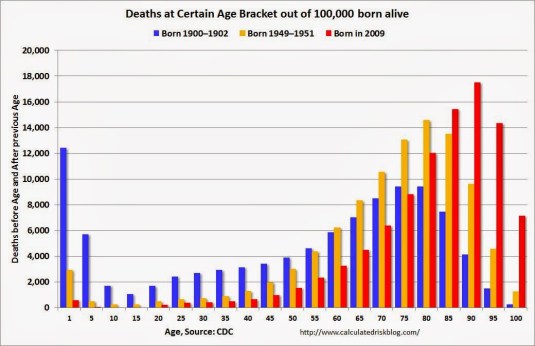
aside from a halving in the chances of dying in an accident, Pneumonia/influenza, tuberculosis, and gastrointestinal infections each claimed more lives per 100,000 people than did heart disease in 1900. The major causes of death 100 years ago are now historic curios rather than current threats.
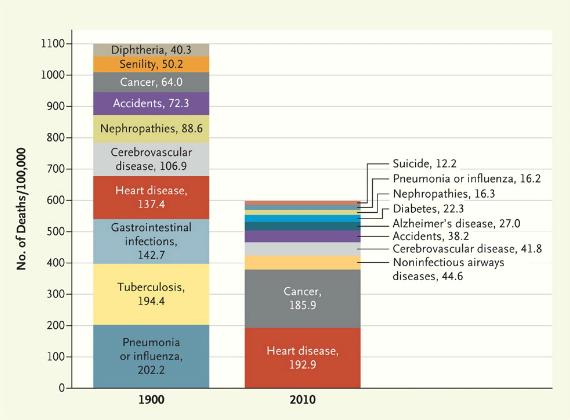
via priceonomics.com
35 sci-fi predictions that came true
26 May 2014 Leave a comment
in technological progress Tags: sci-fi, The Great Fact

Why Life Expectancy Is Misleading
25 May 2014 Leave a comment
in technological progress Tags: life expectancy, The Great Escape, The Great Fact
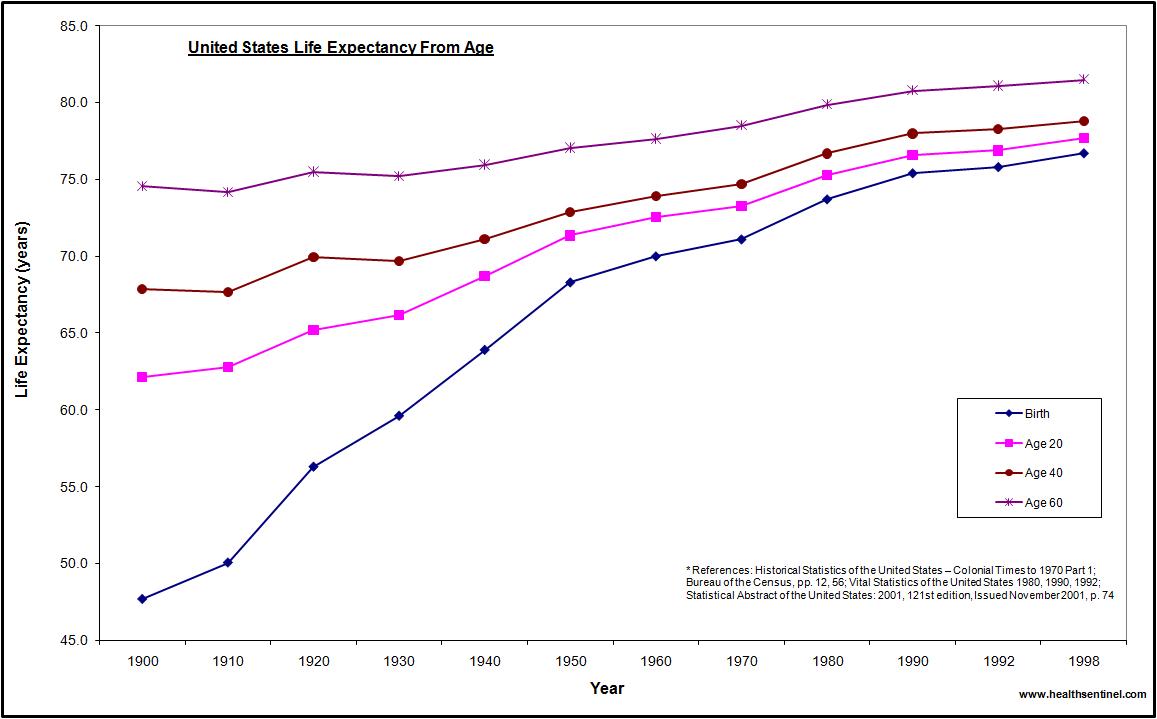
From 1900 to 1998, life expectancy from birth for Americans rose from 47 to 75, an increase of 28 years.
A good deal of that increase in life span had to do with increases in the chances of surviving birth and childhood.
via priceonomics
Paul Ehrlich–still going after 40-years of wrong, wrong, and wrong again
23 May 2014 Leave a comment
in population economics, technological progress Tags: Paul Ehrlich, population bomb
We will soon be asking is it perfectly okay to eat the bodies of your dead because we’re all so hungry?
…In other words between now and 45 years from now, 2.5 billion people will be added to the planet. …We are moving towards resource wars
“Will overpopulation drive us to eat our own DEAD?” The Daily Mail, 23 May 2014
Paul Ehrlich is widely known for his 1968 book ‘The Population Bomb’ which he called for population control to prevent global crises from overpopulation. In his 1968 book, he predicted.
Plainly, he got that wrong. In 1970, Ehrlich predicted that Americans would be subjected to water rationing by 1974 and food rationing by the end of the 1970s. He got that wrong too.
Julian L. Simon and Ehrlich entered in a widely followed scientific wager in 1980.
Simon had Ehrlich choose five commodity metals. Simon bet that their prices would decrease, while Ehrlich bet they would increase. Between 1980 and 1990, the world’s population grew by more than 800 million, the largest increase in one decade in all of history.
Ehrlich lost the bet with Simon. All five commodities bet on declined in price from 1980 through to 1990.

Ehrlich was more than a sore loser. In 1995, he told the Wall Street Journal that
If Simon disappeared from the face of the Earth, that would be great for humanity.
Ehrlich calls those who disagree with him “idiots,” “fools,” “morons,” “clowns” and worse. His righteous zeal is matched by viciousness in disagreement and utter imperviousness to contrary evidence
ICT is changing our lives
23 May 2014 Leave a comment
in technological progress Tags: ICT, technology diffusion, technology usage, The Great Fact
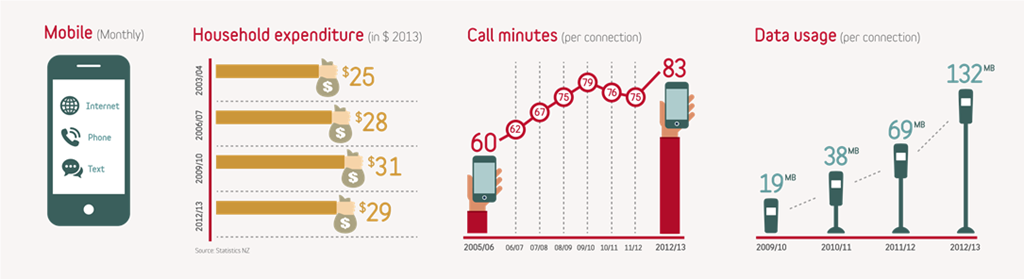
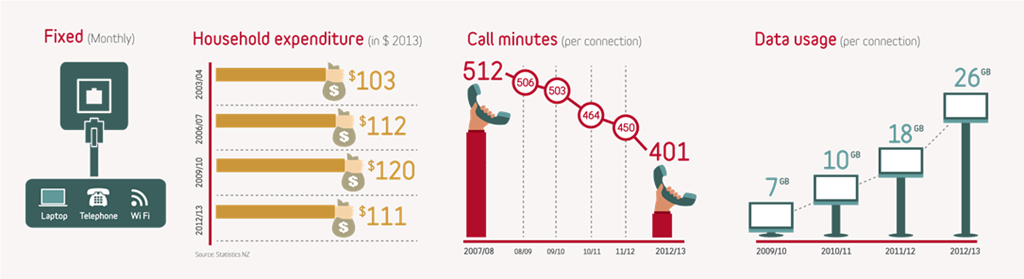
Source: Commerce Commission
Everything’s Amazing and Nobody’s Happy | Bryan Caplan
22 May 2014 Leave a comment
in applied welfare economics, economic growth, technological progress Tags: Bryan Caplan, pessimism
Super-Economy “pre-reviewed ” Piketty in 2010
14 May 2014 Leave a comment
in applied welfare economics, entrepreneurship, labour economics, liberalism, politics - USA, technological progress Tags: Piketty, poverty versus inequality
The French are poorer that the 3rd poorest American state: Arkansas. The EU-15 as a whole would qualify to be the 49th poorest American state.
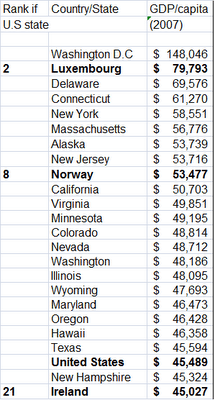
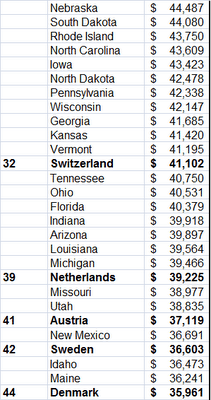

The rich in Europe are poor by American standards. The poor in the USA are middle class by European standards. The European middle class has smaller houses, few cars and few consumers durables that the average poor in the USA.

via Super-Economy: Dynamic America, Poor Europe and Tino Sanandaji

How much would an IPhone cost in 1991? | Techpolicy Daily
12 May 2014 Leave a comment
in entrepreneurship, technological progress Tags: mobile phones, standards of living, The Great Fact
In the beginning, mobile phones were just a walkie-talkie. iPhones have the same capabilities of 13 distinct electronics gadgets worth more than $3,000 in a 1991.

An iPhone incorporates a computer, CD player, phone, and video camera, among other items.
In 1991, a gigabyte of hard disk storage cost around $10,000. Today, it costs around four cents.
Back in 1991, a gigabyte of flash memory, which is what the iPhone uses, would have cost something like $45,000, or more. (Today, it’s around 55 cents ($0.55).)
The mid-level iPhone 5S has 32 GB of flash memory. Thirty-two GB, multiplied by $45,000, equals $1.44 million.
The iPhone used 20,500 millions of instructions per second which in 1991 would have cost around $620,000.
In 1991, a mobile phone used the AMPS analog wireless network to deliver kilobit voice connections.
A 1.44 megabit T1 line from the telephone company cost around $1,000 per month.
Today’s LTE mobile network is delivering speeds in the 15 Mbps range.
Safe to say, the iPhone’s communication capacity is at least 10,000 times that of a 1991 mobile phone.
The 1991 cost of mobile communication was something like $100 per kilobit per second.
Fifteen thousand Kbps (15 Mbps), multiplied by $100, is $1.5 million.
Considering only memory, processing, and broadband communications power, duplicating the iPhone back in 1991 would have (very roughly) cost: $1.44 million + $620,000 + $1.5 million = $3.56 million.
This doesn’t even account for the MEMS motion detectors, the camera, the iOS operating system, the brilliant display, or the endless worlds of the Internet and apps to which the iPhone connects us.
via Techpolicy Daily and Cafe Hayek
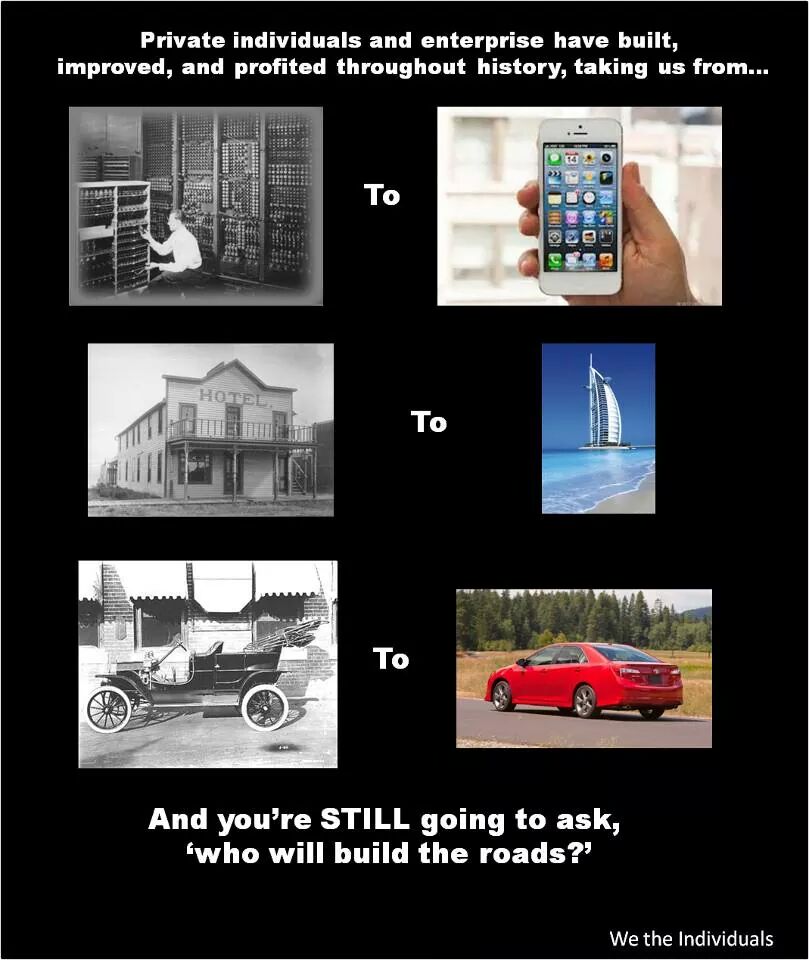
The Projected Improvement in Life Expectancy
11 May 2014 Leave a comment
in technological progress Tags: life expectancy, The Great Escape, The Great Fact
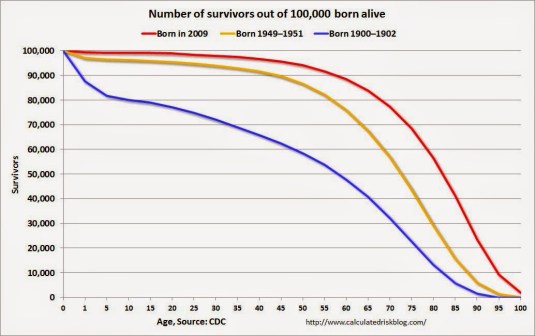
Why Does 1% of History Have 99% of the Wealth? | Learn Liberty – YouTube
04 May 2014 Leave a comment
in constitutional political economy, development economics, entrepreneurship, liberalism, market efficiency, technological progress Tags: Deirdre McCloskey, industrial revolution, Rise of the Western World, rule of law, The Bourgeois Virtues, The Great Fact
Throughout the history of the world, the average person on earth has been extremely poor: subsisting on the modern equivalent of $3 per day.
This was true until 1800, at which point average wages—and standards of living—began to rise dramatically.
Prof. Deirdre McCloskey explains how this tremendous increase in wealth came about.
In the past 30 years alone, the number of people in the world living on less than $3 per day has been halved.
The cause of the economic growth we have witnessed in the past 200 years may surprise you.
It’s not exploitation, or investment. Innovation—new ideas, new inventions, materials, machinery, organizational structures—has fueled this economic boom.
Prof. McCloskey explains how changes in Holland and England in the 1600s and 1700s opened the door for innovation to take off—starting the growth that continues to benefit us today.
via Why Does 1% of History Have 99% of the Wealth? | Learn Liberty – YouTube.
Economic Progress since Howard Hughes in the 1960s
04 May 2014 Leave a comment
in applied welfare economics, technological progress Tags: Cafe Hayek, Howard Hughes
Back in the day, with two flatmates, we bought a VCR for about $1000.

It was a remote control albeit this was connected by a cord to the machine – luxury
These days, DVD players go for $50.
Cafe Hayek makes these wonderful elaborations about how ordinary people live their lives as well as the billionaire Howard Hughes did in 1965:
-
Hughes could afford to talk on the phone for hours to someone hundreds or thousands of miles away. Even the poorest pays no long-distance charges even when making an overseas telephone call. There is Viber and Skype.
-
Hughes could afford to equip his house with a large screen, a state-of-the-art projector, an impressive sound system, and a film library filled with thousands of movies, documentaries, and television shows, so that he had a virtual movie theatre in his home. Today, nearly everyone can buy a large-screen hi-definition television, a surround-sound speaker system, and download movies.
-
Hughes could afford to staff his kitchen with chefs from Thailand, Korea, Japan, Vietnam, Ethiopia, Afghanistan, Morocco, Lebanon, and India. Today, such restaurants are common-place.
-
Hughes could easily afford to equip each member of his family with an automobile of his or her own. Today it’s not unusual for a middle-class household to have one car each for every person in that household who is at least 17 years old.
-
Hughes could easily afford to holiday in a foreign country. In New Zealand, overseas travel is included in living wage calculations.
-
Hughes could afford to fly to whatever distant locations he visited. Air travel is now emphatically routine even for high school students.
-
Hughes hired servants to wash his dishes. Today, automatic dishwashers are the norm.
-
Hughes could afford to equip his residence with an always-at-the-ready dark room so that he could take high-quality photographs and view them minutes later. People upload their photos and videos to Facebook and Instagram moments after they take them.
The Rawlsian social justice case for super-entrepreneurs and many more billionaires
04 May 2014 Leave a comment
in applied welfare economics, economic growth, entrepreneurship, industrial organisation, market efficiency, Rawls and Nozick, technological progress Tags: envy, John Rawls, super-rich, SuperEntrepreneurs, top 1%, top talent
The report SuperEntrepreneurs shows that:
- SuperEntrepreneurs founded half the largest new firms created since the end of the Second World War
- There is a strong correlation between high rates of SuperEntrepreneurship in a country and low tax rates
- a low regulatory burden and high rates of philanthropy both correlate strongly with high rates of SuperEntrepreneurship
- Active government and supranational programmes to encourage entrepreneurship – such as the EU’s Lisbon Strategy – have largely failed.
- Yet governments can encourage entrepreneurialism by lowering taxes (particularly capital gains taxes which have a particularly high impact on entrepreneurialism while raising relatively insignificant revenues); by reducing regulations; and by vigorously enforcing property rights.
- High rates of self-employment and innovative entrepreneurship are both important for the economy.
- Yet policy makers should recognise that they are not synonymous and should not assume policies which encourage self-employment necessarily promote entrepreneurship.
- Policy makers should use a definition of entrepreneurship which is based on innovation.
SuperEntrepreneurs examined about 1,000 self-made men and women who have earned at least $1 billion dollars and who appeared in Forbes magazine list of the world’s richest people between 1996 and 2010.

Hong Kong has the most, with around three SuperEntrepreneurs per million inhabitants, followed by Israel, the US, Switzerland and Singapore.
The US is roughly four times more super-entrepreneurial than Western Europe and three times more super-entrepreneurial than Japan.
Super-entrepreneurs tend to be well-educated – 84% have a university degree.
Many started their own company but there is no clear relationship between self-employment and successful entrepreneurship
Steven Kaplan and Joshua Rauh’s “It’s the Market: The Broad-Based Rise in the Return to Top Talent” Journal of Economic Perspectives 2013 found that those in the Forbes 400 richest are less likely to have inherited their wealth or grown-up wealthy.
Today’s super-rich are self-made rich because they produce new and better products and services that people wanted and are willing to pay for.
John Rawls was alive to the importance of incentives in a just and prosperous society.
With his emphasis on fair distributions of income, Rawls’ initial appeal was to the Left. Left-wing thinkers then started to dislike his acceptance of capitalism and his tolerance of large discrepancies in income and wealth.
Rawls excluded envy when we are behind his veil of ignorance designed the social contract about how the society will be organised. He believed that principles of justice should not be affected by individual inclinations, which are mere accidents.
Rawls also argued that the liberties and political status of equal citizens encourage self-respect even when one is less well off than others; and background institutions (including a competitive economy) make it likely that excessive inequalities will not be the rule. He supposes that
the main psychological root of our liability to envy is a lack of self-confidence in our own worth combined with a sense of impotence
Then there is the old Russian joke that tells the story of a peasant with one cow who hates his neighbour because he has two. A sorcerer offers to grant the envious farmer a single wish any thing he wants: “Shoot my neighbour’s cow!” he demands.


Recent Comments