https://twitter.com/ShellenbergerMD/status/674831519521882112
How insightful was The Population Bomb
14 Dec 2015 Leave a comment
in development economics, economic history, energy economics, environmental economics, environmentalism, growth miracles, population economics, resource economics, technological progress Tags: cranks, doomsday prophets
The coalition of obsolete industries still needs your support! Stop progress now?
14 Dec 2015 Leave a comment
in development economics, economic history, entrepreneurship, industrial organisation, survivor principle, technological progress Tags: creative destruction, entrepreneurial alertness, Luddites, The Great Enrichment, The Great Fact
The gales of creative destruction are quickening
14 Dec 2015 Leave a comment
in economic history, entrepreneurship, industrial organisation, technological progress Tags: creative destruction, technology diffusion, technology diffusion lags
What is creative destruction?
12 Dec 2015 Leave a comment
in economic history, entrepreneurship, industrial organisation, survivor principle, technological progress Tags: creative destruction, entrepreneurial alertness
Creative destruction in cameras
04 Dec 2015 Leave a comment
in economic history, economics of media and culture, entrepreneurship, technological progress Tags: cameras, creative destruction, entrepreneurial alertness, smart phones
Do the European welfare states free ride off American entrepreneurship and innovation?
12 Nov 2015 1 Comment
in applied price theory, applied welfare economics, comparative institutional analysis, constitutional political economy, economic history, economics of regulation, entrepreneurship, industrial organisation, politics - USA, public economics, survivor principle, taxation, technological progress Tags: creative destruction, Daron Acemoglu, Denmark, entrepreneurial alertness, Eurosclerosis, international technology diffusion, taxation and entrepreneurship, taxation and innovation, taxation and investment, taxation and labour supply, technology followers, welfare state
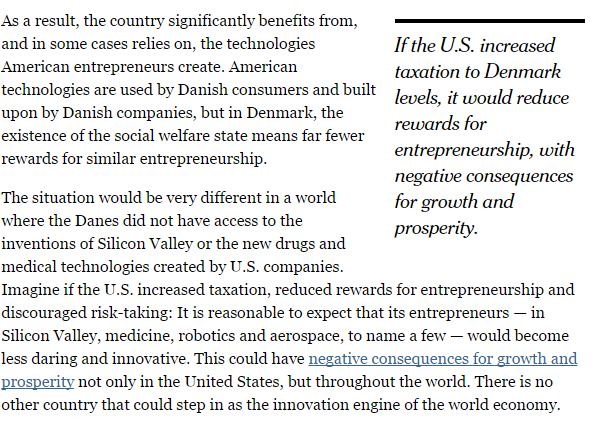
Source: Daron Acemoglu A Scandinavian U.S. Would Be a Problem for the Global Economy – NYTimes.com.
Breathing Beijing’s air
10 Nov 2015 Leave a comment
Breathing Beijing’s air: the equivalent of smoking nearly 40 cigarettes a day. http://t.co/7M3TxrgUPD—
ian bremmer (@ianbremmer) October 13, 2015
The apps in your smartphone cost $900,000 thirty years ago
06 Nov 2015 Leave a comment
in economics of media and culture, entrepreneurship, technological progress Tags: creative destruction, entrepreneurial alertness, smart phones
@NaomiAKlein agrees with #MiltonFriedman on Mancur Olson’s theory of how nations escape institutional sclerosis
25 Oct 2015 Leave a comment
in comparative institutional analysis, constitutional political economy, development economics, economic history, economics of bureaucracy, income redistribution, Marxist economics, Milton Friedman, Public Choice, rentseeking, technological progress Tags: expressive voting, interest groups, Leftover Left, logic of collective action, Mancur Olson, Naomi Klein, pressure groups, rational ignorance, rational irrationality, rise and decline of nations, Twitter left

Source: quoted by Naomi Klein in “The Shock Doctrine”.
LA premiere tonight @NaomiAKlein @avilewis @mrdannyglover in person Q&A 7.30pm sundancecinemas.com http://t.co/wRkPFbnUHu—
Changes Everything (@thischanges) October 16, 2015
1. There will be no countries that attain symmetrical organization of all groups with a common interest and thereby attain optimal outcomes through comprehensive bargaining.
2. Stable societies with unchanged boundaries tend to accumulate more collusions and organizations for collective action over time.
3. Members of “small” groups have disproportionate organizational power for collective action, and this disproportion diminishes but does not disappear over time in stable societies.
4. On balance, special-interest organizations and collusions reduce efficiency and aggregate income in the societies in which they operate and make political life more divisive.
5. Encompassing organizations have some incentive to make the society in which they operate more prosperous, and an incentive to redistribute income to their members with as little excess burden as possible, and to cease such redistribution unless the amount redistributed is substantial in relation to the social cost of the redistribution.
6. Distributional coalitions make decisions more slowly than the individuals and firms of which they are comprised, tend to have crowded agendas and bargaining tables, and more often fix prices than quantities.
7. Distributional coalitions slow down a society’s capacity to adopt new technologies and to reallocate resources in response to changing conditions, and thereby to reduce the rate of economic growth.
8. Distributional coalitions, once big enough to succeed, are exclusive, and seek to limit the diversity of incomes and values of their membership.
9. The accumulation of distributional coalitions increases the complexity of regulation, the role of government, and the complexity of understandings, and changes the direction of social evolution.
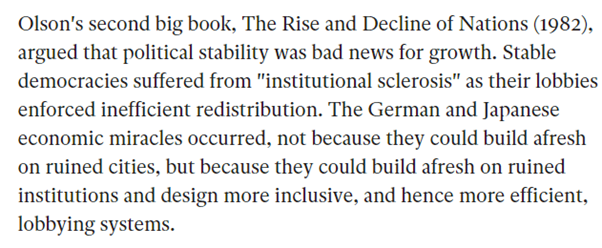
Source: Obituary: Professor Mancur Olson | Obituaries | News | The Independent
50 years of creative destruction in desktops
13 Oct 2015 Leave a comment
in applied welfare economics, economic history, economics of media and culture, entrepreneurship, technological progress Tags: creative destruction, desktops, entrepreneurial alertness, innovation
Computers in 1964 vs. 2014: buff.ly/1NoBa3N http://t.co/4MFBCyk1D3—
HumanProgress.org (@humanprogress) June 28, 2015
Creative destruction in car prices
07 Oct 2015 Leave a comment
in applied welfare economics, economic history, entrepreneurship, politics - USA, technological progress, transport economics Tags: creative destruction
CHART: Since 1995 the CPI for new vehicles has been flat, while the CPI (and wages) increased 60%. What a bargain! http://t.co/DOdlQn8pcK—
Mark J. Perry (@Mark_J_Perry) July 01, 2015
More than likely the earliest born individual captured on a photo
01 Oct 2015 Leave a comment
in economic history, technological progress
Hannah Stilley, born 1746, photographed in 1840. More than likely the earliest born individual captured on a photo. http://t.co/lvOEfgn7Yn—
Historical Pics (@VeryOldPics) August 01, 2015
Is this evidence of the great stagnation?
24 Sep 2015 Leave a comment
in applied price theory, economic history, entrepreneurship, industrial organisation, survivor principle, technological progress Tags: creative destruction, great stagnation, The Great Enrichment
Are today's young Americans the luckiest generation in history? ow.ly/R425e @Mark_J_Perry @AEIdeas http://t.co/8lHZNkq1Ak—
AEI on Campus (@AEIonCampus) August 18, 2015
Creative destruction in computing power
19 Sep 2015 Leave a comment
in entrepreneurship, industrial organisation, survivor principle, technological progress Tags: creative destruction, Moore's law
One dollar buys you increasingly more computing power – vastly more computing power!
from: bit.ly/1AGa3NP http://t.co/vrNf5TOyKI—
Max Roser (@MaxCRoser) June 26, 2015
 Utopia, you are standing in it!
Recent Comments