
Just how many wars could @JeremyCorbyn’s diplomatic skills have avoided?
03 Jun 2017 Leave a comment
in defence economics, war and peace Tags: diplomacy, game theory
Christopher Hitchens – Dispels two widespread illusions about islamic terror [2006]
31 May 2017 Leave a comment
in defence economics, economics of religion, war and peace Tags: war against terror
A kind word for Senator Joe McCarthy after watching the movie Trumbo
23 May 2017 Leave a comment
in constitutional political economy, defence economics, economics of crime, law and economics, liberalism, movies, politics - USA, war and peace Tags: communist party, espionage, free speech, McCarthyism, Red Menace, subversion, war against terror

Source: Bernstein, David, The Red Menace Revisited. Northwestern University Law Review.
The deciphered cables of the Venona Project identify 349 citizens, immigrants, and permanent residents of the United States who had had a covert relationship with Soviet intelligence agencies… Further, American cryptanalysts in the Venona Project deciphered only a fraction of the Soviet intelligence traffic, so it was only logical to conclude that many additional agents were discussed in the thousands of unread messages…
Source: Venona Decoding Soviet Espionage in America By JOHN EARL HAYNES and HARVEY KLEHR Yale University Press 1999, Chapter 1.
Map of Europe if the Central Powers won World War I
22 May 2017 Leave a comment
in International law, war and peace Tags: economics of borders, maps, World War I
The V-2 Rocket (A 4) – How Effective was it?
09 May 2017 Leave a comment
in war and peace Tags: World War II
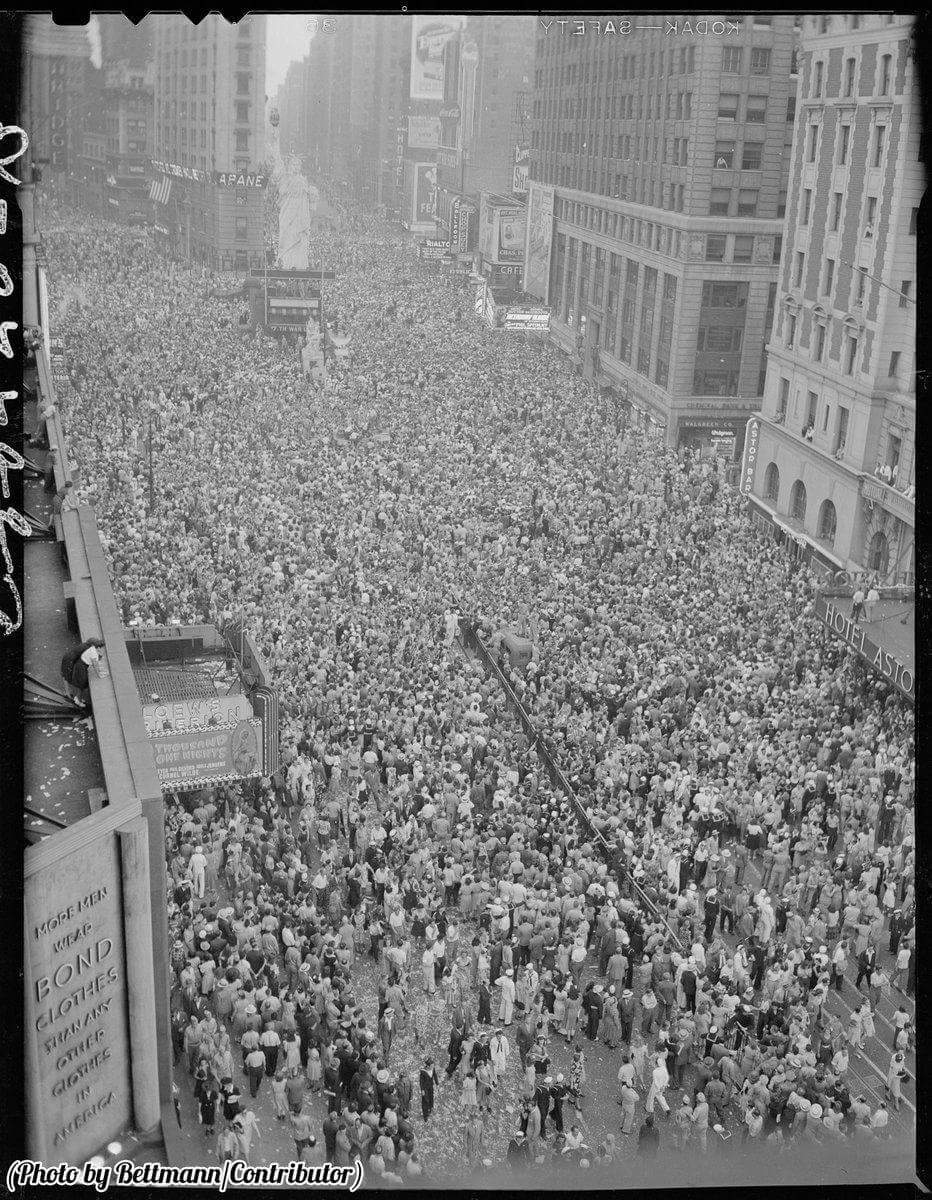

Stirring the possum again
01 May 2017 Leave a comment
in defence economics, laws of war, politics - New Zealand, war and peace Tags: Anzac Day, World War I

#OTD Liberation of Concentration Camp 1945
30 Apr 2017 Leave a comment
in war and peace Tags: Holocaust, World War II
What victory at Gallipoli could have stopped #AnzacDay #Anzacday2017
25 Apr 2017 Leave a comment
in defence economics, politics - Australia, politics - New Zealand, war and peace Tags: Armenian genocide, crimes against humanity, Gallipoli, war crimes trials, World War I
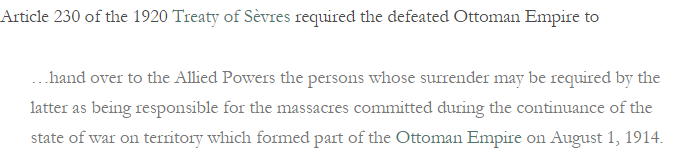
But for victory at Gallipoli, the Anzacs would have been the first Sergeant at Arms of a war crimes trial. By marching victorious into Constantinople, the Anzacs may have been able to prevent the purging of the Ottoman archives of evidence of complicity of specific individuals.
Today is marked by Armenians worldwide as the 100th anniversary of the Armenian genocide. vox.com/2015/4/22/8465… http://t.co/7pqqSowW3O—
Vox Maps (@VoxMaps) April 24, 2015
On May 24, 1915, the Allied Powers jointly issued a statement explicitly charging for the first time ever another government of committing `a crime against humanity’. The Allied Governments announce publicly that they will hold personally responsible all members of the Ottoman Government, as well as those of their agents who are implicated in the Armenian massacres.
Ottoman military and high-ranking politicians were transferred to the Crown Colony of Malta on board of the SS Princess Ena and the SS HMS Benbow by the British forces, starting in 1919. These war criminals were eventually returned to Constantinople in 1921 in exchange for 22 British hostages held by the government in Ankara.
Australian and New Zealand participation in the invasion of the Ottoman Empire as a by-product set the legal and moral infrastructure for the Nuremberg trials: governments would hold others to account for crimes against humanity and genocide.
#AnzacDay: why did we fight?
25 Apr 2017 3 Comments
in defence economics, politics - Australia, politics - New Zealand, war and peace Tags: Anzac Day, national security policy, World War I
Australia and New Zealand were filled with first and second generation migrants happy to rally to defend their mother country:
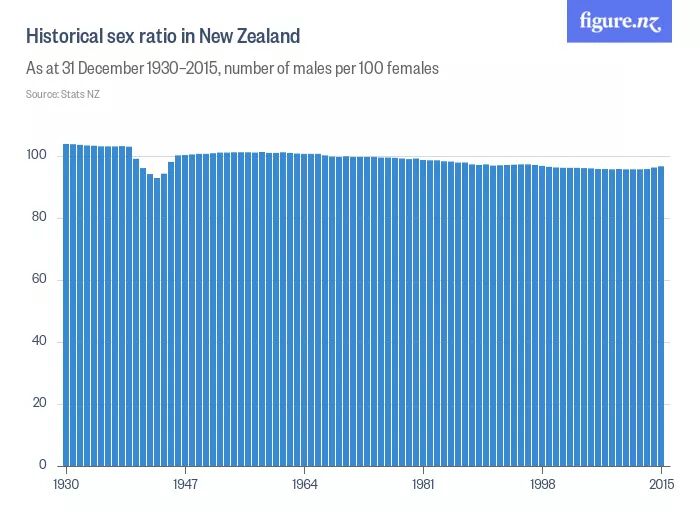
- 12 per cent of the population of New Zealand volunteered to fight; and
- 13 per cent of the male population of Australia volunteered to fight in World War 1.
The people and governments of New Zealand and Australia of that time were British to their boot straps. The Union Jack was in their flags for a reason.
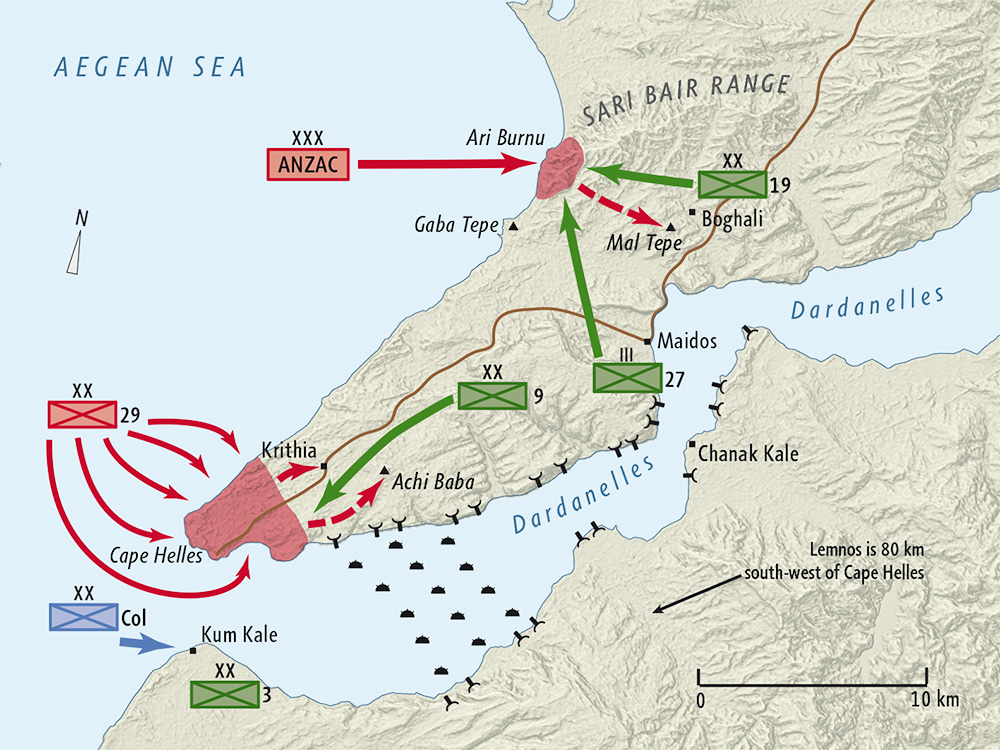
Our specific quarrel with the Ottoman Empire was it joined Germany and others to be at war with the UK, Australia and New Zealand.
Removing the Ottoman Empire from that war would have strengthened Russia. A stronger Russia would have weakened Germany and its allies and brought the war to an earlier end.
The governments of Australian and New Zealand fell over themselves to declare war and pledge troops in 1914.
World War 1 started in the middle of an Australian election campaign in 1914.
In the September 1914 election, both opposition leader Andrew Fisher and Prime Minister Joseph Cook stressed Australia’s unflinching loyalty to Britain, and Australia’s readiness to take its place with the allied countries. Labor Party leader Fisher’s campaign pledge was to:
stand beside the mother country to help and defend her to the last man and the last shilling.
Labor defeated the incumbent government to win majorities in both houses. Billy Hughes and his nationalist party won the 1917 election in a landslide.
New Zealanders had even a better chance to reflect on the war-making choices of their leaders in 1914. Our election was in December of 1914. The passions of the moment had some chance to calm, and the fighting has started for real.
The will of the people at the December 1914 Parliamentary elections was a 90 per cent vote for the war parties. New Zealanders could have voted for the Labour MPs, several of whom were later imprisoned for their anti-conscription activities or for refusing military service.
In New Zealand, after that wartime election, the Prime Minister was an Irish Protestant who formed a coalition with an Irish Catholic as his deputy.
Do you know of a superior mechanism to elections for measuring the will of the people? Are elections inadequate to the task of deciding if the people support a war and that support of the public is based on well-founded reasons?
The reasons for New Zealand and Australia fighting are the just cause of fighting militarism and territorial conquest, empire solidarity, regional security interests such as the growing number of neighbouring German colonies, and long-term national security. A victorious Germany would have imposed a harsh peace.
New Zealand and Australian national security is premised on having a great and powerful friend. That was initially Britain. When the USA arrived in 1941 as a better great and powerful friend, the British were dropped like a stone.
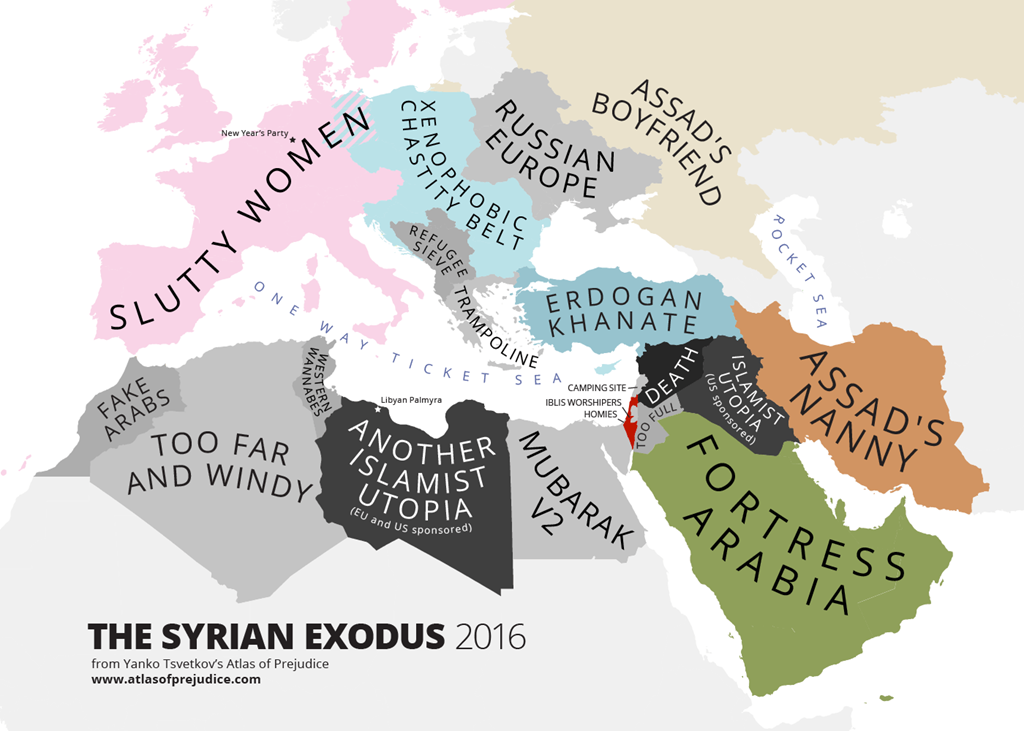
By the Atlas of prejudice
11 Apr 2017 Leave a comment
in defence economics, war and peace Tags: Middle-East politics, Syrian Civil War


Recent Comments