@NZGreens say something sensible on global warming @jamespeshaw @GreenpeaceNZ

It is a stretch to say that New Zealand Greens have accepted that adaptation is the only proper response to the threat of global warming.

Nonetheless, their call for a plan for adaptation is an acceptance that more must be done than hoping for the best that a massively expensive international public good will be provided through a climate change treaty.

It is time for the environmental movement to face up to the fact that there never will be an international treaty to restrain carbon emissions.

The practical way to respond to global warming is healthier is wealthier, richer is safer. Faster economic growth creates more resources for resilience and adaptation to a changing environment.

Source: Energy Policy & the Environment Report | Leading Nowhere: The Futility and Farce of Global Climate Negotiations.

Tom Schelling has been involved with the global warming debate since chairing a commission on the subject for President Carter in 1980.

Schelling is an economist who specialises in strategy so he focuses on climate change as a bargaining problem. Schelling drew in his experiences with the negotiation of the Marshall Plan and NATO.

International agreements rarely work if they talk in terms of results. They work better if signatories promise to supply specific inputs – to perform specific actions now. Individual NATO members did not promise to slow the Soviet invasion by 90 minutes if it happened after 1962. NATO members promised to raise and train troops, procure equipment and supplies, and deploy these assets geographically. All of these actions can be observed, estimated and compared quickly.

The Kyoto Protocol commitments were made not about actions but to results that were to be measured after more than a decade and several elections.

Climate treaties should promise to do certain actions now such as invest in R&D and develop carbon taxes that return the revenue as tax cuts. If the carbon tax revenue is fully refunded as tax cuts, less reliable countries, in particular, have an additional incentive to collect the carbon tax properly to keep their budget deficits under control.

As for the chances of a global treaty, Schelling has said:

The Chinese, Indonesians, or Bangladeshis are not going to divert resources from their own development to reduce the greenhouse effect, which is caused by the presence of carbon-based gases in the earth’s atmosphere. This is a prediction, but it is also sound advice. Their best defence against climate change and vulnerability to weather in general is their own development, reducing their reliance on agriculture and other such outdoor livelihoods. Furthermore, they have immediate environmental problems — air and water pollution, poor sanitation, disease — that demand earlier attention.

The costs of global warming to New Zealand are small. For developing countries, their best protection against global warming is rapid economic development through capitalism and freedom.

The latest report from the Intergovernmental Panel on Climate Change’s (IPCC) Working Group II has concluded that global warming of 2.5˚C would cost the equivalent to losing between 0.2-2.0% of annual income.

The Nuremberg trials began today

Who’s Who at the moment in Syria

Do peace talks have a role in wars of annihilation @jeremycorbyn

Peace activists are utterly clueless about what is discussed at peace talks. The ability to negotiate a credible peaceful settlement between sovereign states depends on:

  • the divisibility of the outcome of the dispute,
  • the effectiveness of the fortifications and counterattacks with which an attacker would expect to have to contend, and
  • on the permanence of the outcome of a potential war.

Central to any peace talks is that any peace agreement is credible – it will hold and not will not be quickly broken:

A state would think that another state’s promise not to start a war is credible only if the other state would be better off by keeping its promise not to start a war than by breaking its promise.

Peace talks occur only when there something to bargain about. As James Fearon explained, there must be

a set of negotiated settlements that both sides prefer to fighting

That need for a bargaining range is the fundamental flaw of peace activists. When they call for peace talks, peace activists never explain what will be discussed in a world where everybody is not like them terms of good intentions. What are the possible negotiated settlements that each both side will prefer to continue fighting? Diplomacy is about one side having some control over something the other side wants and this other side have something you want to exchange. In a war, the attacker thinks he can get what it wants to fighting for it.

There were plenty of peace feelers during World War I. World War I came to an end when Germany preferred surrender and disarmament over conquest. Its armies were in full retreat and disarray – revolution was a threat at home

Previous World War I peace feelers failed because each side thought it could gain more by fighting. German peace feelers when they are advancing were premised on keeping what they are taken. When the Germans were retreating, the Germans wanted to go back to the pre-war borders and keep their capability for relaunching the war once they have recouped. The Allies had nothing to gain from allowing Germans simply to withdraw from the fighting intact and regroup, attack again and perhaps win.

When a war is over territory rather than annihilation of the other side, the challenge is to divide the disputed territory in a way that both are happy to keep the peace settlement rather than come back and fight in a few years. Grossman explains:

If the winner of a war would gain control of the entire territory, and if the whole of a contested territory is sufficiently more valuable than the sum of its parts, then, despite the costs and risks of war, promises not to start a war could be not credible, and a peaceful settlement, or at least a peaceful settlement with unfortified borders, would not be possible.

That point about the need for fortified or unfortified borders after a peaceful settlement over contested territory is the ultimate failure of peace activists.

If peace activists truly want peace, rather than victory for the other side, they must prepare for war including fortified borders so that the other side doesn’t dare cross them and start a war. A peace settlement depends upon the ability to divide the contested territory is with or without fortified borders to make a settlement credible:

…despite the costs and risks of war, if a dispute is existential, or, more generally, if the whole of a contested territory is sufficiently more valuable than the sum of its parts, then a peaceful settlement is not possible. A peaceful settlement of a territorial dispute, and especially a settlement that includes an agreement not to fortify the resulting border, also can be impossible if a state thinks, even if over optimistically, that by starting a war it would be able at a small cost to settle the dispute completely in its favour permanently.

Wars of annihilation have a long history. The first two Punic wars were settled by Rome and Carthage. The third was not because the objective of Rome was to destroy Carthage which it did. Rome is decided it simply did not want to have any further wars with Carthage. The only way to ensure that was to destroy that city – level it to the ground. The Arab Israel conflict is another example:

Over the years the Arabs have rejected every proposal for a peaceful settlement that would divide Palestine into a Jewish state and an Arab state, because for the Arabs allowing a Jewish state would be a defeat, not a compromise. The Israelis, however, demand a Jewish state, and they refuse to turn all of Palestine into a single multinational state in which Jews would not make up a large majority of the population. If the dispute between Arabs and Israelis were about the control of tracts of land or sources of water, then a peaceful settlement might have been possible long ago. But, the dispute is about the existence of a Jewish state, and the outcome is indivisible. Is there or is there not to be a Jewish state in Palestine? The answer is either yes or no.

The key guardian of peace and enforcer of peace settlements is the ability of the other side to mount an effective counter-attack if attacked again. If you want peace, you must prepare for war. The loudest champions of a large military budget should be peace activists. Peace activists know, they should know, that a country with a strong military is less likely to be attacked.

If a country is a democracy, it is less likely to start wars and especially with other democracies. If peace activists want more democracies in the world, they should preach capitalism and free trade because countries that are capitalistic become democracies.

Peace activists think that they can make peace just by talking with people. Peace is made by trading with hostile countries to make them depend on you for their prosperity as well as yours. By growing rich through free trade, training partners have less reasons to go to war or otherwise have poor relations with each other or each other’s friends. Trade increases the opportunity cost of starting a war.

Robert Aumann argued well that the way to peace is like bargaining in a medieval bazaar. Never look too keen, and bargain long and hard. Aumann argues that:

If you are ready for war, you will not need to fight. If you cry ‘peace, peace,’ you will end up fighting… What brings war is that you signal weakness and concessions.

Countries are more likely to cooperate if they have frequent interactions and have a long time horizon. The chances of cooperation increase when it is backed by the threat of punishment.

The ability to threaten to hurt is conducive to peace. Disarmament, Aumann argues, “would do exactly the opposite” and increase the chances of war. He gave the example of the Cold War as an example of how their stockpiles of nuclear weapons and fleets of bombers prevented a hot war from starting:

In the long years of the cold war between the US and the Soviet Union, what prevented “hot” war was that bombers carrying nuclear weapons were in the air 24 hours a day, 365 days a year? Disarming would have led to war.

Aumann has quoted the passage from the biblical Book of Isaiah:

Isaiah is saying that the nations can beat their swords into ploughshares when there is a central government – a Lord, recognized by all. In the absence of that, one can perhaps have peace – no nation lifting up its sword against another. But the swords must continue to be there – they cannot be beaten into ploughshares – and the nations must continue to learn war, in order not to fight!

Civil wars such as those in Syria and Iraq today are grubby affairs in terms of peace talks because of the greater inability to divide what is contested.

Ending civil wars is even more difficult to make binding commitments because new groups such as ISIS can spring up to replace the signatories to the old peace treaty or introduce new agendas:

…if the constituent groups of a polity are deeply divided and, hence, are unwilling to accept meaningful limitations on the prerogatives of winners of constitutional contests, then civil war can be unavoidable.

ISIS is responsible for biggest number of co-ordinated terror attacks, 2000-14

@jeremycorbyn wants to use the #Kurds as a bargaining chip with Assad

Jeremy Corbyn wants to use about the only good guys in the Syrian civil war as a bargaining chip with President Assad.

Corbyn said overnight that he doesn’t want to sit around the negotiating table with ISIS but he wants a political settlement that defeats ISIS and bring an end to the civil war in Syria

by the unity of the people of Syria. That is a good step forward.

Corbyn is a man who claims to have studied Middle East politics all his life:

Jeremy is someone who genuinely understands international political situations, especially those of the Middle East. Not just in a superficial way, but in terms of the history of countries like Syria, Iran and Iraq. He has studies them all of his political life.

Corbyn doesn’t seem to have noticed that the Syrian Kurds do not want to be Syrians – they want their own country.

The Iraqi Kurds don’t want to be Iraqis – they want their own country too. The Kurds already have a fair degree of autonomy in northern Iraq and northern Syria respectively. Much of it achieved in the field of battle.

Any call for a political settlement with Syria that involves a united Syria betrays the aspirations of the Kurdish people for national liberation. Turkey is also waiting on the wings, sternly opposed to any Kurdish autonomy and willing to intervene in the Syrian Civil War with its army and air force to those ends.

Jeremy Corbyn is a seething hypocrite because he was a fanatical supporter of the Irish Republicans despite the fact that they are a tiny violent minority of Irish Catholics.

Corbyn wants peace talks. Political settlements are challenging in wars of annihilation and wars of succession. The American Civil War had to be resolved in the field of battle because the North would not accept succession. The Arab-Israeli conflict is a war of annihilation. Israel expects there always to be two states. Hamas and the other terrorists want to destroy the state of Israel. There is no middle ground.

ISIS is leading a war of annihilation. The Kurds are leading a war of succession. There is little room for compromise.

It’s harder to get out of even the most ordinary of wars than get into them. The problem with peace settlements is credible assurances that the peace is lasting rather than is a chance for the other side to rebuild and come back to attack from a stronger position.

A warring state would think that another state’s promise not to start another war is credible only if the other state would be better off by keeping such promises not to start another war than by breaking its promise once it has rearmed.

For example, in World War I, making sure that Germany and its allies did not restart the war a few years later, fed and rested, is why the peace treaty in 1919 totally disarmed Germany and split-up the other Axis powers.

One side will think that the other’s promise not to re-start a war is credible only if the other state would be better off by keeping its promise not to re-start a war than by breaking its promise.

France fortified its border with Germany in the 1920s because of a lack of trust that the peace would endure. Germany was disarmed after 1918 so that the day which it would be a threat again was well into the future.

Neither side of World War I were interested in peace feelers when they thought they could either prevail in the field of battle or would be in a stronger negotiating position by fighting on for a while.

The same goes for the Syrian and Iraqi civil wars and that is before the fact that the terrorists are highly decentralised. There is no one central party able to make and keep a peace settlement by dealing with renegade elements within their own ranks.


Margaret Thatcher on peacemakers

Jihadists and the Nisei soldiers

Japanese Americans interned during World War II jumped at the chance to volunteer to fight. They saw it as their last chance to prove their undivided loyalty to their country.

One Japanese father, when saying goodbye to his son, stressed that showing his loyalty to his country, if necessary through the last full measure of devotion was far more important that his returning safely to his family.

The 442nd Combat Regiment Team was the most decorated unit in World War II. Its motto was “Go for Broke”. The 4,000 Nisei soldiers in April 1943 had to be replaced nearly 2.5 times. In total, about 14,000 men served, earning 9,486 Purple Hearts.

Migrants are a cut above regarding initiative and judgement. They pass many of these traits on to their children. These Japanese Americans, both migrants and native born knew that counter-signalling was required. They had to go out of their way to show their loyalty no matter how unfair any suspicions of disloyalty among Japanese Americans might have been at the time.

I am reminded of that counter-signalling by Japanese Americans during the darkest days of World War II when I read the remarks of Julie Anne Genter and Jeremy Corbyn. Both focused their pleas on the need to be inclusive and understanding why people join violent, radical groups. They and the rest of the Twitter Left had nothing to contribute regarding strategies to deter the next attack and disrupt those that are in the planning stage, but that is not new.

The notion that bad behaviour towards minority communities leads to more recruitment to the terrorists is overrated. There will be a few wind-bags who say harsh things after each terrorist attack, but if they cross the line, they will be dealt with by the police and courts in a democracy governed by the rule of law.

Acrimony towards your community following the latest terrorist attacks has little to do with the level of recruitment to these terrorist groups either now or in the past. As Alan Krueger explains:

One of the conclusions from the work of Laurence Iannaccone—whose paper, “The Market for Martyrs,” is supported by my own research—is that it is very difficult to effect change on the supply side. People who are willing to sacrifice themselves for a cause have diverse motivations. Some are motivated by nationalism, some by religious fanaticism, some by historical grievances, and so on. If we address one motivation and thus reduce one source on the supply side, there remain other motivations that will incite other people to terror.

Malcontents join the jihadists today for the same reasons they joined the Red Brigade, the Japanese Red Army Faction and Baader-Meinhof gang in the 1970s and 1980s.

Plenty of young people were attracted to communism in previous generations as a way of sticking it to the man. Now as then economic conditions were good as were political freedoms. Italy, Japan and Germany were all at the peak of recoveries from war. Japanese incomes are doubled in the previous decade. Germany and Italy were rich countries. As Alan Krueger explains:

Despite these pronouncements, however, the available evidence is nearly unanimous in rejecting either material deprivation or inadequate education as important causes of support for terrorism or participation in terrorist activities. Such explanations have been embraced almost entirely on faith, not scientific evidence.

Each generation has its defining oppositional identity. Radical Islam is the oppositional identity of choice for today’s angry young men and women. Mind you, they have to buy Islam for dummies to understand what they’re signing up for.

In previous generations, it was communism, weird Christian sects, eco-terrorism, animal liberationist terrorism and a variety of domestic terrorists of the left and right with conspiratorial motivations. Look at the level of diversity of the angry young men and women on the domestic terrorists list of the FBI. One jihadists when interviewed said that 30 years ago he would probably have become a Communist as his vehicle for venting his frustrations.

There is always an ample supply of troubled and angry people so trying to redress their grievances is overrated as Alan Krueger explains:

…it makes sense to focus on the demand side, such as by degrading terrorist organizations’ financial and technical capabilities, and by vigorously protecting and promoting peaceful means of protest, so there is less demand for pursuing grievances through violent means. Policies intended to dampen the flow of people willing to join terrorist organizations, by contrast, strike me as less likely to succeed.

The current appeal of radical Islam rests on what psychologists call personal significance. The quest for personal significance by these angry young men and women is the desire to matter, to be respected, to be somebody in one’s own eyes and in the eyes of others.

A person’s sense of significance may be lost for many reasons, including economic conditions. The anger can grow out of a sense of disparagement and discrimination; it can come from a sense that one’s brethren in faith are being humiliated and disgraced around the world.

Extremist ideologies, be they communism, fascism or extreme religions are effective in such circumstances because it offers a quick-fix to a perceived loss of significance and an assured way to regain it. It accomplishes this by exploiting primordial instincts for aggression, sex and revenge. MI5’s behavioural science unit found that

“far from being religious zealots, a large number of those involved in terrorism do not practise their faith regularly. Many lack religious literacy and could… be regarded as religious novices.” The analysts concluded that “a well-established religious identity actually protects against violent radicalisation”

Most evidence point to moral outrage, disaffection, peer pressure, the search for a new identity, for a sense of belonging and purpose as drivers of radicalisation. Anthropologist Scott Atran pointed out in testimony to the US Senate in March 2010:

“. . . what inspires the most lethal terrorists in the world today is not so much the Quran or religious teachings as a thrilling cause and call to action that promises glory and esteem in the eyes of friends, and through friends, eternal respect and remembrance in the wider world”. He described wannabe jihadists as “bored, underemployed, overqualified and underwhelmed” young men for whom “jihad is an egalitarian, equal-opportunity employer . . . thrilling, glorious and cool”.

Chris Morris, the writer and director of the 2010 black comedy Four Lions – which satirised the ignorance, incompetence and sheer banality of British Muslim jihadists – said “Terrorism is about ideology, but it’s also about berks”.

@jeremycorbyn #Machiavelli on a pitiless war to deter another #Paris

Image

#GeorgeOrwell on @jeremycorbyn #pacifism and #Paris

Source: George Orwell: Pacifism and the War

#Paris Kurdish forces, backed by U.S. airstrikes, launch offensive in Iraq

https://twitter.com/CartogRRaphy/status/648959060427956224

Stunning images of global support for #Paris

https://twitter.com/amygibsn/status/665383809928441856

https://twitter.com/happilyts/status/665368679727669248

https://twitter.com/mikebairdMP/status/665469303815294976

https://twitter.com/Yair_Rosenberg/status/665680270784339968

@jeremycorbyn only combatants are tried for war crimes so they are lawful targets for attack without warning or any attempt to capture

if Jihad John should have been charged as a war criminal, has the Renegade Left is whining about today, rather than taken out by a well-deserved drone, he is a combatant. Only combatants can commit war crimes. The Paris mass terrorist attacks are ongoing as I write this so maybe they will pull their head in for the day.

When the rest of us go around killing people, we are charged with murder. Only lawful combatants have combat immunity: they can lawfully kill people as long as they observe the laws of war. When they break the laws of war, both lawful combatants and unlawful combatants are charged with war crimes:

A war crime is an act that constitutes a serious violation of the law of war that gives rise to individual criminal responsibility. Examples of war crimes include intentionally killing civilians or prisoners, torture, wantonly destroying property, taking hostages, perfidy, rape, using child soldiers, pillaging, declaring that no quarter will be given, and using weapons that cause superfluous injury or unnecessary suffering (Wikipedia).

If Jihad John is eligible to be charged with war crime – he is a combatant. As a combatant, Jihad John can be attacked at any time without warning or any attempt to capture. As an unlawful combatant, Jihad John was liable to a field court-martial and summary execution upon capture.

The purpose of international humanitarian law is to ensure strict differentiation between civilians and combatants and to provide for the detention and treatment of those captured. Humane detention to the end of the armed conflict increases both the incentive to give quarter and to surrender when the military position is hopeless.

The requirement to carry weapons openly, dress in some sort of uniform etc. is to ensure that the enemy is easy to distinguish from afar so that troops do not get trigger happy around civilians and refugees. This is the fundamental purpose of international humanitarian law: trying to save civilians from the fighting.

The most severe punishments are allowed for spies, saboteurs, infiltrators, francs-tireurs and guerrillas so that not carrying their weapons openly and not dressing in some sort of recognisable uniform etc., was a self-inflected death sentence upon capture. Combatants who do not wear a uniform that is clearly distinguishable at the distance and do not carry their weapons openly are war criminals. In the Battle of the Bulge, the Nazi infiltrators in American uniforms lost all interest in their missions once the first few who were captured were court-martialled and shot within 24 hours.

The Hostages Trial at Nuremburg dismissed murder charges against some German commanders because partisan fighters in Southwest Europe could not be considered lawful belligerents under Article 1 of the 1907 Hague convention. The Tribunal stated:

We are obliged to hold that such guerrillas were francs tireurs who, upon capture, could be subjected to the death penalty. Consequently, no criminal responsibility attaches to the defendant List because of the execution of captured partisans…

It is the terrorists who violate the laws of war by hiding themselves and their bases within civilian populations, thereby drawing unwilling and unsuspecting innocents into the fighting.

If civilians directly engage in hostilities, they are considered unlawful or unprivileged combatants or belligerents. They may be prosecuted under the law of the detaining state. The Allies detained 11 million POWs (and captured enemy personnel) without charge or trial by the time World War II ended. None were allowed access to a lawyer or had the right to seek bail.

Because the USA and others are at war with Al-Qaeda, they can use force to conduct hostilities against the enemy and those who harbour them. The Taliban was warned. A Wiki has this nice quote by Stone (1921):

When the territorial sovereign is too weak or is unwilling to enforce respect for international law, a state which is wronged may find it necessary to invade the territory and to chastise the individuals who violate its rights and threaten its security.

When a nation goes to war, it seeks to defeat and subdue its enemy to prevent further attacks. The U.S. and allied military and intelligence services are legally and morally free to target Al-Qaeda for an attack whether they are on the front lines or behind them, with or without warning and without any attempt to capture.

The 9/11 terrorists were air pirates. NATO and allied military entered Afghanistan to subdue the home base of these brigands and those that harboured them:

  • Naval and military deployments against pirate’s lairs date back thousands of years.
  • The first war of the USA was with the Barbary Pirates in 1801 to 1805, with another war in 1815. These pirates waged war against the shipping of other nations, seized cargoes and ships, and sold captives into slavery.
  • Punitive expeditions against bandits were commonplace too, such as chasing Pancho Villa and his gang of bandits back into Mexico in 1916.
  • The U.S. military recently attacked a Somalian maritime pirate camp to rescue hostages. EU naval forces have also attacked these pirate lairs to destroy boats and supplies.

A corollary of the right to kill enemy personnel is that the deaths of civilians that occur in legitimate attacks against military targets are not illegal. It is pious to deny this. It denies the most basic and best understood of moral distinctions: between premeditated murder and unintended killing.

It is the central principle of the international laws of war that innocent civilians should not be targeted. On the other hand, the rules of war accept the death of civilians in or near legitimate military targets.

The terrorists will never follow the rules of war. They gain their only tactical advantages by systematically flouting them and hiding among civilians.

The renegade Left for decades wanted terrorists to be treated as prisoners of war, and thereby held to the end of the war and not otherwise punished. Now, the renegade Left don’t want terrorists to be held as captured combatants to the end of the war. Instead, they want them to have the right to apply for bail.

As part of law-fare, one or two fathers applied to the U.S. courts for injunctions to stop drone attacks on their wayward sons on a best friend basis. They failed and were reminded by the Court that if they were so worried, their sons could pop down to the nearest U.S. embassy and discuss their fears: surrender for extradition.

P.S. All terrorists and members of the Taliban are war criminals because:

  • Article 51 (7) of Protocol I of the Geneva Convention states: “The presence or movements of the civilian population or individual civilians shall not be used to render certain points or areas immune from military operations, in particular attempts to shield military objectives from attacks or to shield, favour or impede military operations”.
  • The Geneva Convention also holds that “The presence of a protected person may not be used to render certain points of areas immune from military operations”. (Geneva Convention Relative to the Protection of Civilian Persons in Time of War, 1949, Laws of Armed Conflicts, 495, 511.)
  • The Rome Statute is clear that “utilizing the presence of civilians or other protected persons to render certain points, areas or military forces immune from military operations is recognized as a war crime by Article 8 (2) (b) (xxiii)”.

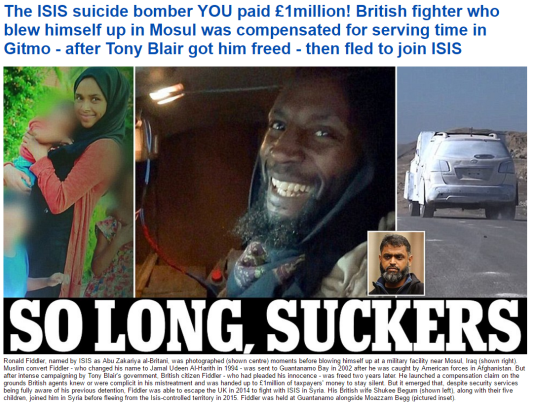
How Jihad John was vaporised. He had the human right to turn himself in at the nearest British Embassy. He didn’t.

Source: Jihadi John dead after being ‘evaporated’ in midnight drone strike | Daily Mail Online

RT “we were not occupiers” letter of @TomTugendhat 2 @jeremycorbyn

Previous Older Entries Next Newer Entries

Bassett, Brash & Hide

Celebrating humanity's flourishing through the spread of capitalism and the rule of law

Truth on the Market

Scholarly commentary on law, economics, and more

The Undercover Historian

Beatrice Cherrier's blog

Matua Kahurangi

Celebrating humanity's flourishing through the spread of capitalism and the rule of law

Temple of Sociology

Celebrating humanity's flourishing through the spread of capitalism and the rule of law

Velvet Glove, Iron Fist

Celebrating humanity's flourishing through the spread of capitalism and the rule of law

Why Evolution Is True

Why Evolution is True is a blog written by Jerry Coyne, centered on evolution and biology but also dealing with diverse topics like politics, culture, and cats.

Down to Earth Kiwi

Celebrating humanity's flourishing through the spread of capitalism and the rule of law

NoTricksZone

Celebrating humanity's flourishing through the spread of capitalism and the rule of law

Homepaddock

A rural perspective with a blue tint by Ele Ludemann

Kiwiblog

DPF's Kiwiblog - Fomenting Happy Mischief since 2003

The Dangerous Economist

Celebrating humanity's flourishing through the spread of capitalism and the rule of law

Watts Up With That?

The world's most viewed site on global warming and climate change

The Logical Place

Tim Harding's writings on rationality, informal logic and skepticism

Doc's Books

A window into Doc Freiberger's library

The Risk-Monger

Let's examine hard decisions!

Uneasy Money

Commentary on monetary policy in the spirit of R. G. Hawtrey

Barrie Saunders

Thoughts on public policy and the media

Liberty Scott

Celebrating humanity's flourishing through the spread of capitalism and the rule of law

Point of Order

Politics and the economy

James Bowden's Blog

A blog (primarily) on Canadian and Commonwealth political history and institutions

Science Matters

Reading between the lines, and underneath the hype.

Peter Winsley

Economics, and such stuff as dreams are made on

A Venerable Puzzle

"The British constitution has always been puzzling, and always will be." --Queen Elizabeth II

The Antiplanner

Celebrating humanity's flourishing through the spread of capitalism and the rule of law

Bet On It

Celebrating humanity's flourishing through the spread of capitalism and the rule of law

History of Sorts

WORLD WAR II, MUSIC, HISTORY, HOLOCAUST

Roger Pielke Jr.

Undisciplined scholar, recovering academic

Offsetting Behaviour

Celebrating humanity's flourishing through the spread of capitalism and the rule of law

JONATHAN TURLEY

Res ipsa loquitur - The thing itself speaks

Conversable Economist

In Hume’s spirit, I will attempt to serve as an ambassador from my world of economics, and help in “finding topics of conversation fit for the entertainment of rational creatures.”

The Victorian Commons

Researching the House of Commons, 1832-1868

The History of Parliament

Articles and research from the History of Parliament Trust

Books & Boots

Reflections on books and art

Legal History Miscellany

Posts on the History of Law, Crime, and Justice

Sex, Drugs and Economics

Celebrating humanity's flourishing through the spread of capitalism and the rule of law

European Royal History

Exploring the Monarchs of Europe

Tallbloke's Talkshop

Cutting edge science you can dice with

Marginal REVOLUTION

Small Steps Toward A Much Better World

NOT A LOT OF PEOPLE KNOW THAT

“We do not believe any group of men adequate enough or wise enough to operate without scrutiny or without criticism. We know that the only way to avoid error is to detect it, that the only way to detect it is to be free to inquire. We know that in secrecy error undetected will flourish and subvert”. - J Robert Oppenheimer.

STOP THESE THINGS

The truth about the great wind power fraud - we're not here to debate the wind industry, we're here to destroy it.

Lindsay Mitchell

Celebrating humanity's flourishing through the spread of capitalism and the rule of law

Alt-M

Celebrating humanity's flourishing through the spread of capitalism and the rule of law

croaking cassandra

Economics, public policy, monetary policy, financial regulation, with a New Zealand perspective

The Grumpy Economist

Celebrating humanity's flourishing through the spread of capitalism and the rule of law

International Liberty

Restraining Government in America and Around the World