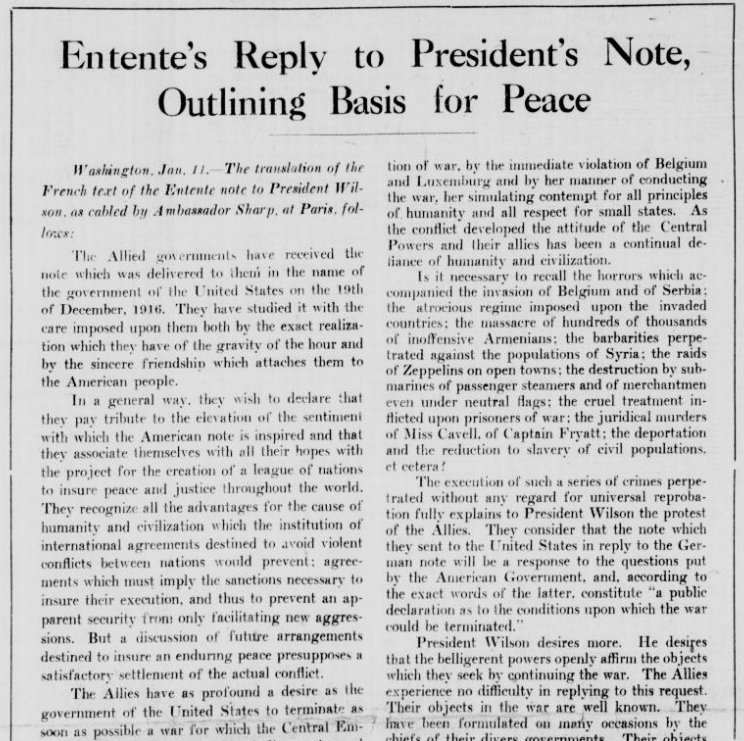


The World at War (Ralph Raico)
17 Dec 2016 Leave a comment
in defence economics, economic history, laws of war, war and peace Tags: World War I

Was it Wrong to Drop the Atom Bomb on Japan?
30 Oct 2016 Leave a comment
in defence economics, laws of war, war and peace Tags: atomic bombigs, Hiroshima, World War II
The mass kidnappings of principled antiwar activists now in its 9th year
28 Oct 2016 Leave a comment
in defence economics, laws of war, politics - USA, war and peace Tags: anti-war movement, Left-wing hypocrisy, Leftover Left
The man who save the world, this day 1962
27 Oct 2016 Leave a comment
in politics - USA, war and peace Tags: Cuban missile crisis
.@DrJillStein wants Assad win #SyrianCivilWar #usefulidiots #peaceoffensive
17 Oct 2016 Leave a comment
in defence economics, politics - USA, war and peace Tags: 2016 presidential election, Leftover Left, Middle-East politics, Syrian Civil War

Source: Stein Opposes Obama’s Troops on the Ground in Syria – Jill2016 via The Strange Sympathy of the Far Left for Putin
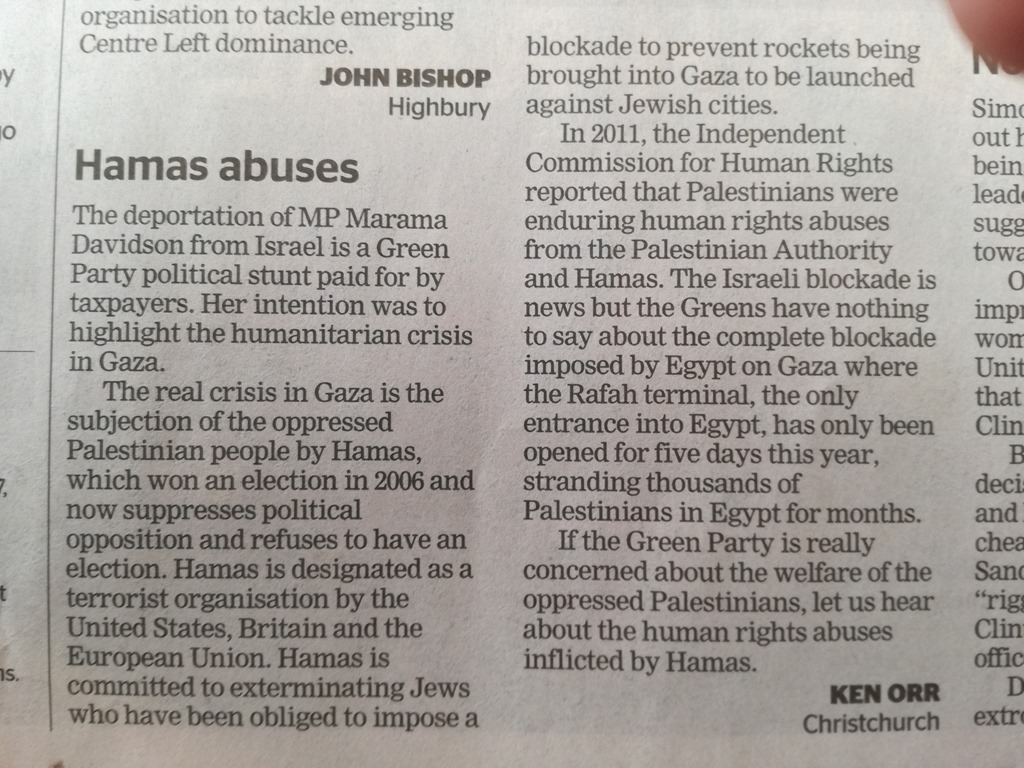
#WomensBoatToGaza @MaramaDavidson silent on Hamas rocket attacks
11 Oct 2016 Leave a comment
in defence economics, laws of war, politics - New Zealand, war and peace Tags: Gaza Strip, Hamas, Israel, Left-wing hypocrisy, Middle-East politics, New Zealand Greens
Referendum defeat proves 50.1% of #Colombia are great negotiators @JuanManSantos
08 Oct 2016 Leave a comment
in defence economics, war and peace
It is a standard negotiating tactic to come back at the last minute for just one more thing before a deal is finalised. Just over half of Colombians seized this opportunity by rejecting the referendum giving the terrorists 10 seats in parliament and immunity and instead daring them to resume fighting.
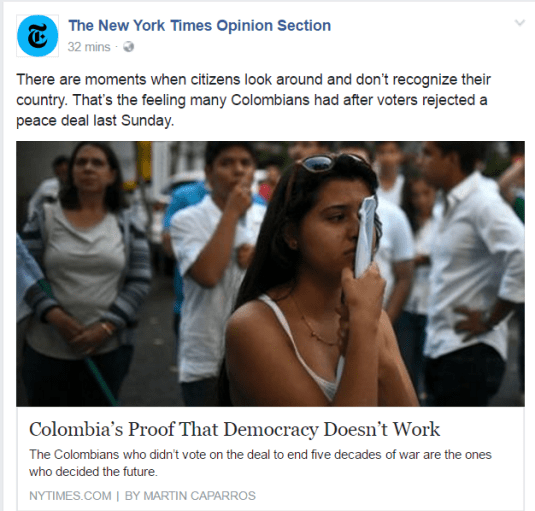
The Colombian electorate, at least the winning side, anticipate that the best alternative to no agreement for the terrorists is something other than going back into the field of battle. The terrorists will have to offer a few more concessions.
Robert Aumann argued well that the way to peace is like bargaining in a medieval bazaar. Never look too keen, and bargain long and hard. Aumann argues that:
If you are ready for war, you will not need to fight. If you cry ‘peace, peace,’ you will end up fighting… What brings war is that you signal weakness and concessions.
#OTD 1944 the Sonderkommandos at Auschwitz staged a revolt
07 Oct 2016 Leave a comment
in war and peace Tags: Nazi Germany, The Holocaust, World War II
Would ceasefires have shortened WWII? The American Civil War? #Syrianconflict
22 Sep 2016 Leave a comment
in defence economics, politics - USA, war and peace Tags: American Civil War, game theory, Middle-East politics, Syrian Civil War, World War II
Edward Luttwak in his essay Give War a Chance speculated that if there was a United Nations in the 1860s, there would still be UN peacekeepers stationed between the warring Union and Confederate troops on the Mason Dixon line as of this day.
If you can work out a way in which ceasefires would have shorten World War II in either the European or Pacific theatres, you have got a better crystal ball than me.
There were long interludes on the Western front; several years in which the Nazis fortified the French beaches while the Allies built up their invasion force in England. For all practical purposes, there is a land-forces ceasefire from Dunkirk to D-Day across the English Channel.
Luttwak wrote that cease-fires permit space for both sides to heal while only intensifying and prolonging the struggle once the cease fire ends — and it almost always ends.
This was true in the Arab-Israeli War of 1948-1949. It is true of the dozen of ceases fires in Gaza negotiated by the Security Council. It was true of all the cease-fires that failed in the fall of Yugoslavia with Serbs, Croats, and Bosnians who negotiated month-long cease fires where
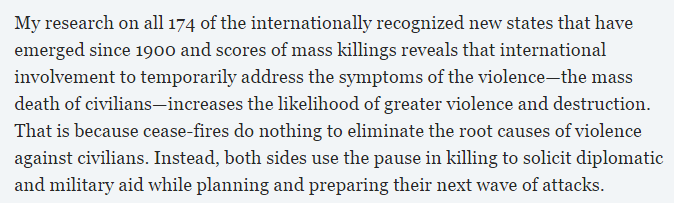
John Stevenson studied 170 ceasefires. He pretty much vindicated the position that each side uses the lull in the fighting to regroup, rebuild and reinforce when for when the fighting starts again.
Ceasefires are perplexing in the many sided civil war in Syria. Aside from the Kurds, it is hard to work out who you want to win.
The Kurds just want to be left alone with their own country.
But Turkey is not happy about that prospect nor is Iraq.
A useful guide to Who's Who in the Syrian Civil War. And how many fighter they have.
Chart by @EP_ThinkTank https://t.co/oGbN4A67w0—
Paul Kirby (@paul1kirby) February 09, 2016
You can work out who you want to lose territory but as for who might replace them, maybe the free Syrian army is a bit of an improvement.
Who's Fighting in Syria
(or: Why more intl focus won't fix this) https://t.co/RLo7kTtyK5—
ian bremmer (@ianbremmer) November 15, 2015
There will be a bloodbath in reprisals if any of the other sides win apart from the Kurds. The Kurds are only willing to fight as far into Syria as they need to defend their own territory.
The World at War 1973 E2 Lightning War
18 Sep 2016 Leave a comment
in defence economics, television, war and peace Tags: World War II


Recent Comments