


The Russians are coming, the Russians are coming – Soviet strategic airpower compared
23 Feb 2015 Leave a comment
in economic history, war and peace

|

|
|
Russian Bear bomber |
American B2 bomber |
Apparently there were 9/11 Pentagon plane crash conspiracy theories too
21 Feb 2015 Leave a comment
in war and peace Tags: 9/11 conspiracy theories, conspiracies theories, conspiracy theorists
Cease-fires and peace talks make it worse
21 Feb 2015 Leave a comment
in laws of war, liberalism, politics - USA, Rawls and Nozick, war and peace Tags: ceasefires, crusader foreign policies, Give war a chance, noninterventionist foreign policy, peace talks

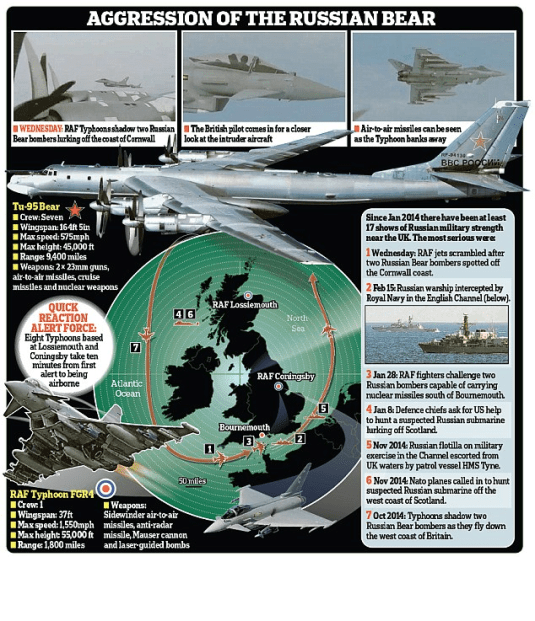
The Russian Bear bombers that intruded into British airspace had propellers on them!! 1940s technology
20 Feb 2015 1 Comment
in war and peace Tags: British politics, European politics, obsolete military technology, Russian politics
The Russian Bear bomber is a reverse engineering job on several B-29 American bombers that ran short of fuel and had to land in Vladivostok in 1945. Obviously, the KGB was hopeless at penetrating the American strategic bombing programs. Spies and traitors were the only way they ever upgraded their aircraft and military technology. The Bear entered service with the Soviet Union in 1956 and is expected to serve the Russian Air Force until at least 2040!

HT: http://www.theguardian.com/uk-news/2015/feb/19/russian-bomber-flew-inland-cornwall-uk-airspace-witness and http://www.dailymail.co.uk/news/article-2959849/Typhoon-fighter-jets-scrambled-intercept-two-Russian-Bear-bombers.html
Danish fishermen ferry Jews to safety in neutral Sweden during Nazi round-up, 1943
20 Feb 2015 Leave a comment
in laws of war, war and peace Tags: Denmark, Nazi Germany, The Holocaust

On September 28, 1943, Georg Ferdinand Duckwitz, a German diplomat, secretly informed the Danish resistance that the Nazis were planning to deport the Danish Jews.
The Danes responded quickly, organizing a nationwide effort to smuggle the Jews by sea to neutral Sweden.
With the help of the Danish people, Jews found hiding places in homes, hospitals, and churches.
Within a two-week period fishermen helped ferry 7,220 Danish Jews and 680 non-Jewish family members to safety across the narrow body of water separating Denmark from Sweden.

70 Years Later, We’re Still Trying To Learn Who Died In The Holocaust | FiveThirtyEight
20 Feb 2015 Leave a comment
in laws of war, war and peace Tags: The Holocaust

Notice how few were victims of the Holocaust in Denmark. Denmark was the only occupied country that actively resisted the Nazi regime’s attempts to deport its Jewish citizens.
via 70 Years Later, We’re Still Trying To Learn Who Died In The Holocaust | FiveThirtyEight.
The Un-discussed Foreign Policy Alternative | Coyote Blog
19 Feb 2015 Leave a comment
in liberalism, politics - New Zealand, politics - USA, war and peace Tags: ISIS, Middle-East politics, non-interventionist foreign policy

Why is there not a third alternative to be at least considered — that there is something really broken in a lot of Islam as practiced today (just as there was a lot of sh*t broken with Christianity in, say, the 14th-16th centuries) and that Islam as practiced in many Middle Eastern countries is wildly illiberal (way more illiberal than any failings of Israel, though you wouldn’t know that if you were living on a college campus). But, that we don’t need to saddle up the troops and try to change things by force…
Yes, I know the first response to all folks like me who advocate for non-intervention is “Munich” and “Czechoslovakia”. So be it. But if we sent in the military every time someone yelled “appeasement” our aircraft would be worn out from moving troops around. And we seem to be totally able to ignore atrocities and awful rulers in Sub-Saharan Africa.
As a minimum, I would like to see a coalition of Arab states coming to us and publicly asking us for help — not this usual Middle East BS we hear that Saudi Ariabi (or whoever) really in private wants us there but publicly they will still lambaste us. Without this support we can win the war but we have no moral authority (as we did after WWII) in the peace. Which is one reason so many of our interventions in the Middle East and North Africa fail.
via The Un-discussed Foreign Policy Alternative | Coyote Blog.
The shadow of a Hiroshima victim
19 Feb 2015 Leave a comment


Recent Comments