
Current areas of control in the Syrian Civil War
27 Mar 2015 Leave a comment
in war and peace Tags: Syria
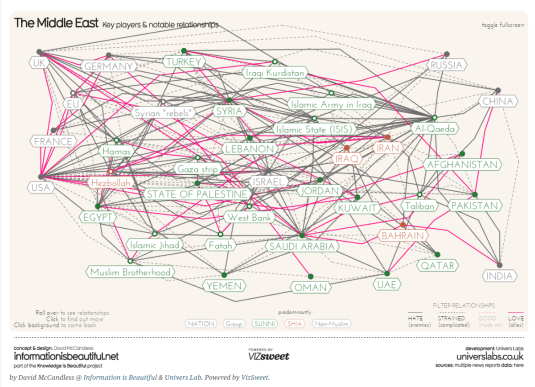
Friends and enemies in the Middle East. Who is connected to whom?
27 Mar 2015 Leave a comment
in economic history, war and peace

Further evidence of the Only Nixon could go to China theorem (and Bibi Netanyahu may be the only man who will make peace in the Middle East)
27 Mar 2015 Leave a comment
in war and peace Tags: Egypt, Israel
Obama’s Plans For Pulling Out Of Afghanistan vs. What Really Happened
26 Mar 2015 Leave a comment
in politics - USA, war and peace Tags: Afghanistan, war against terror

Gentlemen Reading Each Others’ Mail: A Brief History of Diplomatic Spying as a force for peace and nuclear stability
24 Mar 2015 Leave a comment
in politics - New Zealand, politics - USA, war and peace Tags: game theory, mutually assured destruction, nuclear deterrence, nuclear war, Ronald Reagan
At the 2009 G20 meetings in London, GCHQ set up fake internet cafes for delegates to use to log their keystrokes. If you are dumb enough to use an Internet cafe for official business, you deserve to be spied on.
Barack Obama, even with special encryption software, is now allowed to email only some 20 aides, family members and friends whose devices have similar protections.
All this spy v. spy stuff is a force for peace. At the 1921 Naval conference aimed to limit naval capability among the world’s powers as a way of curbing the war-ship arms race at the time, the U.S. wanted Japan to concede to having fewer ships, but Japan wanted slightly more. With code-cracking, the U.S. discovered that it was more important to the Japanese to preserve their relationship with the U.S. than to be able to spend more on their navy.
“We pressed hard, and Japan abandoned its position that it wanted to build more,” Kahn said. “We won a great victory for not just the U.S., but for the whole world because we built fewer war ships and we had more money to build roads and for other infrastructure.”
Richard Posner in a lecture some years ago talked about how useful spying was during the cold war. Each side develop a far more accurate appreciation of the other’s strengths. As a result, it did not overreact nor under react to threats. For example, it was through U-2 spying that the USA learned that there was no missile gap with Russia. In fact, Russia is very weak and much less of a threat.
In 1983, Ronald Reagan learned through secret intelligence that through a series of misinterpretations of routine military manoeuvres in Western Europe, and some bureaucrats at Russian embassies trying to inflate their own importance and knowledge of the workings of their host governments, the Soviet leadership came to the impression that they were a ruse for war and they were under the threat of imminent attack. The Russians started to prepare to counter attack.
At the same time, a Korean airline was shot down by the Russian air force. Privately, Reagan and his advisers are horrified that such a thing could happen through a comedy of errors and that could lead to something far worse through mutual alarm and tests of will.
Historians now regard 1983 as the closest time there was a possibility of a nuclear war since the Cuban missile crisis. It all arose through a series of misunderstandings of a series of routine military manoeuvres against a background of worsening relations with the Soviet union. Robert Gates, Deputy Director for Intelligence in 1983, has published thoughts on the exercise that dispute this conclusion:
Information about the peculiar and remarkably skewed frame of mind of the Soviet leaders during those times that has emerged since the collapse of the Soviet Union makes me think there is a good chance—with all of the other events in 1983—that they really felt a NATO attack was at least possible and that they took a number of measures to enhance their military readiness short of mobilization.
After going through the experience at the time, then through the post-mortems, and now through the documents, I don’t think the Soviets were crying wolf. They may not have believed a NATO attack was imminent in November 1983, but they did seem to believe that the situation was very dangerous. And US intelligence [SNIE 11–9-84 and SNIE 11–10–84] had failed to grasp the true extent of their anxiety.
This secret intelligence led Reagan to both reappraise his attitude to the Russians and put out some peace feelers and take other stabilising measures. The period is known as the Reagan reversal. In his memoirs, Reagan wrote of a 1983 realization:
Three years had taught me something surprising about the Russians: Many people at the top of the Soviet hierarchy were genuinely afraid of America and Americans. Perhaps this shouldn’t have surprised me, but it did…
During my first years in Washington, I think many of us in the administration took it for granted that the Russians, like ourselves, considered it unthinkable that the United States would launch a first strike against them.
But the more experience I had with Soviet leaders and other heads of state who knew them, the more I began to realize that many Soviet officials feared us not only as adversaries but as potential aggressors who might hurl nuclear weapons at them in a first strike…
Well, if that was the case, I was even more anxious to get a top Soviet leader in a room alone and try to convince him we had no designs on the Soviet Union and Russians had nothing to fear from us.
Reagan began seeking a rapprochement with the Kremlin fifteen months before Gorbachev took office. Reagan spoke of common concerns, the mutual desire for peace and the urgent need to address “dangerous misunderstandings” between Moscow and Washington.
via Gentlemen Reading Each Others’ Mail: A Brief History of Diplomatic Spying — The Atlantic, L. Gordon Crovitz: Gentlemen Read Each Other’s Mail – WSJ and Able Archer 83 – Wikipedia, the free encyclopedia.
Why Islam Needs a Reformation – By AYAAN HIRSI ALI
23 Mar 2015 3 Comments
in economics of religion, war and peace
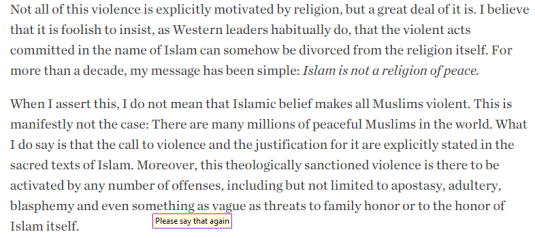
Ali is correct in saying that all religions must put their violence behind them. Christianity work towards that several centuries ago.
Ali is quite true in saying that the violence done in the name of Christianity is always dismissed as by cranks and kooks who represent nobody but themselves and deserve no sympathy from anybody. Her entire essay is well worth reading. It is ungated at least for readers in New Zealand when I looked at it.
What Percentage Of Americans Have Served In The Military? | FiveThirtyEight
20 Mar 2015 Leave a comment
in politics - USA, war and peace Tags: military

The war crimes of Hamas
17 Mar 2015 Leave a comment
There Is No Global Jihadist ‘Movement’ — Atlantic Mobile
13 Mar 2015 Leave a comment
Some nice charts about how ISIS is more a rabble that happens to survive because of the lack of unity among its many enemies which include the Iraqi government government and its army that runaway.


MAP: Russia’s expanding empire in Ukraine and elsewhere – The Washington Post
10 Mar 2015 Leave a comment
in economic history, war and peace Tags: Putin, Russia, Ukraine crisis

Environmental and Urban Economics: The Drought Causes War Hypothesis: Evidence from Syria
09 Mar 2015 Leave a comment
in applied price theory, environmental economics, global warming, politics - USA, war and peace Tags: Syria, water markets

I am an economist so permit me to make one Econ 101 point.
As drought conditions unfolded in Syria, did water prices rise? Is water metered and paid for in Syria? How do farmers and residential water customers access water?
If there had been a market signal of increased scarcity, water prices would have gone up and rational households and firms would reduce their consumption.
In the presence of such well functioning water markets, no “excess conflict” would have resulted. Capitalist markets thus can diffuse violence as increasingly scarce resources are allocated efficiently and water consumers are incentivized to invest in strategies and actions to reduce their water demand.
So, to repeat my point; if the PNAS authors are correct then it is the synergistic effect between increased drought conditions and the absence of water markets that caused the problem. If the nation had well functioning water markets, then I would strongly predict that there would be no extra violence.
via Environmental and Urban Economics: The Drought Causes War Hypothesis: Evidence from Syria.
Darwin awards: The Islamic State was backed by 46,000 accounts on Twitter in 2014
06 Mar 2015 1 Comment
in politics - Australia, politics - New Zealand, politics - USA, war and peace Tags: Darwin awards, ISIS, Middle-East politics, Twitter, war on terror


Every time they tweet they put a well-deserved target on their back.

via Defining and describing the population of ISIS supporters on Twitter | Brookings Institution.


Recent Comments