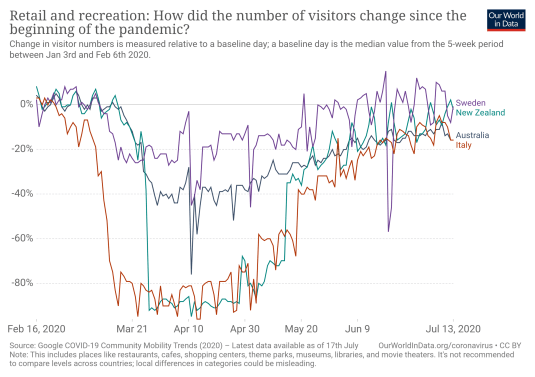
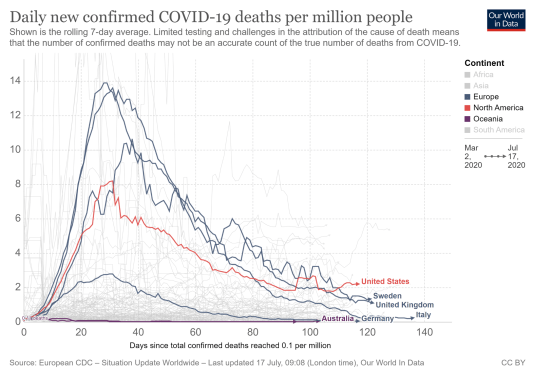
#COVID19 Australian and NZ lockdowns compared
18 Jul 2020 Leave a comment
in health economics, politics - Australia, politics - New Zealand Tags: economics of pandemics
Getting to clarity on single sex services
18 Jul 2020 Leave a comment

“We think there should be guidance providing more clarity on how single-sex services should work in practice to make sure the law is understood by service users and service providers without ambiguity”
Rebecca Hilsenrath, Chief Executive, Equality and Human Rights Commission
Everyone agrees that clear guidance is needed on the law on single and separate sex services. The government is soon to announce what it will do to bring that much needed clarity
Yesterday in the final days before this announcement is expected Rebecca Hilsenrath, CEO of the Equality and Human Rights Commission made a statement, YouGov released polling data and the House of Commons Library published a research briefing.
Do they help us get to clarity?
EHRC: inventing “special circumstances”
Hilsenrath’s statement recognises the need for unambiguous guidance. This is something EHRC could have provided but has refused to.
But she goes further in the wrong direction introducing the…
View original post 1,564 more words
Parliamentary Privilege and Libel, Part II: from Wilkes to 1835
18 Jul 2020 Leave a comment

This is a series of three blogs about Parliament and Libel. The first, Privilege, Libel and the long road to Stockdale v. Hansard, Part I: from Strode’s Case to Article IX,dealt with the earliest encounters, in the seventeenth century, between parliamentarians and the court over the publication of material that the parliamentarians believed was protected by privilege, the most notorious and important of which was the case of Speaker Williams, prosecuted for the publication of Thomas Dangerfield’s Information of 1680 concerning the Popish Plot. The case ultimately led to the introduction of Article IX of the Bill of Rights, which is still the authority text for parliamentary privilege today. However, the guilty verdict against Williams was never rescinded.
The result of the failure to reverse the judgment in R. v. Williams meant that there remained plenty of ambiguity about whether or not Article IX made it possible to publish parliamentary…
View original post 3,440 more words
Life of Edward II, King of England and Lord of Ireland. Part II.
18 Jul 2020 Leave a comment

In 1290, Edward’s father Edward I of England, had confirmed the Treaty of Birgham, in which he promised to marry his six-year-old son to the young Margaret of Norway, who had a potential claim to the crown of Scotland. Margaret was the daughter of King Eric II of Norway and Margaret of Scotland, the firstborn child of King Alexander III of Scotland and Margaret of England (Margaret of England was the daughter the second child of King Henry III of England and his wife, Eleanor of Provence).
Alexander III died in 1286, his posthumous child was stillborn, and Margaret inherited the crown. Owing to her young age, She was finally sent to England in September 1290, but died in Orkney, sparking off the succession dispute between thirteen competitors for the crown of Scotland.
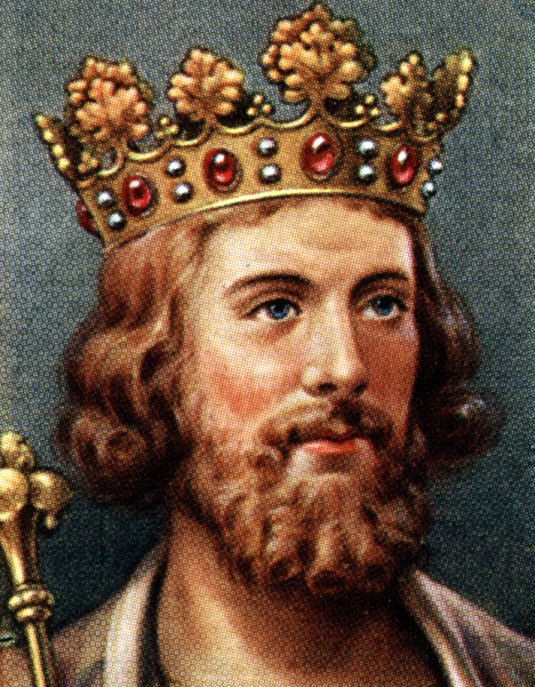
Edward II, King of England and Lord of Ireland, Duke of Aquitaine.
Edward’s mother, Eleanor of Castile…
View original post 1,043 more words
When Equalizers Are Thought To Be Biased
18 Jul 2020 Leave a comment

Writing in the New York Times this past Thursday, Anthony Tomassini called for ending blind auditions for orchestras, because the orchestras are not coming out diverse enough. What strikes me as odd about this is that the whole reason for blind auditions is to encourage diversity, by eliminating unconscious bias. The argument would go something like this: the orchestra is all white men, it’s highly unlikely that no women or POC are talented enough to play enough in the orchestra, therefore it’s probable that there’s bias in the selection process, but if we hold blind auditions, no one will know the gender or ethnicity of the candidate. And sure enough, while women made up around 6% of orchestras in 1970, today “women make up a third of the Boston Symphony Orchestra, and they are half the New York Philharmonic.” However, black and Latino artists hover around 2%. So Tomassini suggests…
View original post 903 more words
“White culture” chart removed from the Smithsonian’s Museum of African American History and Culture site
18 Jul 2020 Leave a comment

Although I’ve heard from friends who have visited Washington, D. C.’s National Museum of African American History and Culture (NMAAHC) that it’s a fantastic place, its online presence suffered from the adoption and proselytizing of Critical Race Theory (CRT), at least on this page about “Whiteness.”
Yesterday I posted two posters from that page about the nature of white culture, which you can see at the preceding link. The posters gave a ridiculous stereotype of white culture, were pretty close to being racist, and, in fact, if you saw the posters as an implicit contrast with black culture, it would be extremely racist towards blacks as well. Since yesterday, those posters have disappeared. Clearly the pushback against them was strong—and rightly so. I doubt that my own criticism had any influence on this, though I haven’t trawled the Internet to see who discussed those graphics. (This incident has already…
View original post 579 more words
More on Google: Peter Singer and David Brooks
18 Jul 2020 Leave a comment
This will be the last I write about the Google memo for a while, as I suspect we’re getting weary of the fracas. But readers recommended two pieces, and they’re worth reading. The first is a summary of research on gender differences published at the Heterodox Academy, and I’ve put it (and its summary) as an addendum at the top of the last post. The second is a piece at Quillette by Heather Heying (an Evergreen State biology professor, wife of Bret Weinstein, and currently demonized along with him); it’s about the evolutionary psychology of gender differences with respect to the Google memo, and it’s called “Should we ‘stop equating science with truth‘”. Heather’s answer is “no!”
I’ll add two pieces here. The first is by renowned moral philosopher Peter Singer, in New York’s Daily News, of all places. Singer has been an advocate for affirmative action…
View original post 1,160 more words
Has science made religion useless?
18 Jul 2020 Leave a comment
The Big Think seems obsessed with the relationship between science and religion. I can’t think of how many posts I’ve done about their interviewees discussing this issue. The 14-minute video below features a number of prominent people weighing in on the question, “Has science made religion useless?” That’s a question different from, “Is there a clash between science and religion?” Religion can still be falsified by science, as it has been, and still be “useful,” though I agree with Sam Harris that finding something useful that’s palpably false is not a good way to live.
The discussants include Frans van de Waal, Reza Aslan, Francis Collins, Robert Sapolsky, Alain de Botton, Penn Jillette, Bill Nye, Rob Bell, and Pete Holmes (I didn’t know Holmes, but guessed he was a believer from his remarks below. It turns out he’s a comedian who not only makes jokes about god and religion, but…
View original post 1,449 more words
Choosing a Prime Minister: their exits and their entrances
18 Jul 2020 Leave a comment


Seventeen of the Prime Ministers to take office since 1900 left office for reasons other than defeat at a general election. In this blogpost, RodneyBrazier, author of the recently published Choosing a Prime Minister, reflects on how those Prime Ministers have secured and surrendered the keys to Number 10, and the Queen’s role in their appointment.
It’s unlikely that Boris Johnson spends much time thinking about the next election. Thanks largely to him the government obtained an 80-seat Commons majority at the polls just over six months ago, and each member of his Cabinet gave pledges of personal loyalty before getting their jobs. What could possibly go wrong? But if any of his close advisers were to read my book Choosing a Prime Ministerthen brows might furrow. The book notes that 17 of the two-dozen individuals who have occupied Number 10 since 1900 were forced to…
View original post 1,881 more words
California Dreamin’: Unreliable Wind & Solar Force Californians to Rely On Diesel Generators
18 Jul 2020 Leave a comment

 California ‘dreaming’ ….
Let renewable energy zealots and rent seekers anywhere near your power system and prepare for deadly chaos.
Wind and solar ‘powered’ South Australians know what it is to do without power for days on end. Having experienced plenty of load shedding lasting for 5 hours or more, South Australians got a real taste of the dark ages in September 2016, when the whole State went black.
A sudden collapse in wind power output during a vigourous spring storm (wind turbines automatically shut down in high winds) delivered what’s known as a ‘system black’.
The response was to set up 276 MW worth of diesel-fuelled jet engines that cost taxpayers a cool $550m. When the sun sets and calm weather sets in, that part of SA’s ‘inevitable transition’ to wind and solar chew up 80,000 litres of diesel every hour, pumping out an extra 216 tonnes of…
View original post 338 more words
Privilege, Libel and the long road to Stockdale v. Hansard, Part I: from Strode’s Case to Article IX
18 Jul 2020 Leave a comment
In 1836 the House of Commons published a series of reports of the new prison inspectors appointed under an Act of Parliament passed the year before. The 1835 Act, one of several interventionist initiatives of the whig government elected in 1832, was designed to drive up standards in the locally-run prison system. That the inspectors’ report was generally available, rather than hidden in decent obscurity, as the result of another praiseworthy new initiative – a decision by the House of Commons in 1835 to allow all of its publications to be sold to the public through agents. The inspectors’ remark concerning a book with explicit plates of human reproductive organs that was found in the possession of one of the prisoners in Newgate jail set off a chain of unintended consequences that led to a series of law suits that are collectively referred to as Stockdale v. Hansard, a…
View original post 2,234 more words


Recent Comments