
#OTD #globalwarming #climateemergency @GreenpeaceAP @Greens
06 Feb 2020 Leave a comment
in economic history, economics of natural disasters, energy economics, environmental economics, global warming, politics - Australia Tags: pessimism bias
The Least Empathic Lot
06 Feb 2020 Leave a comment

On standard tests of empathy, libertarians score very low. Yet, the world’s “well-known libertarian bias” coupled with many people’s unwarranted pessimism makes us seem like starry-eyed optimists (“how could you possibly believe things will just work themselves out?!”).
Under the Moral Foundations framework developed and popularized by Jonathan Haidt, he and his colleagues analyzed thousands of responses through their YourMorals.orgtool. Mostly focused on what distinguishes liberals from conservatives, there are enough self-reported libertarians answering that the questionnaire to draw meaningful conclusions. The results, as presented in TED-talks, podcast interviews and Haidt’s book The Righteous Mind: Why Good People Are Divided by Politics and Religioncontains a whole lot of interesting stuff.
First, some Moral Foundations basics: self-reported liberals attach almost all their moral value to two major categories – “fairness” and “care/harm.” Some examples include striving for equal (“fair”) outcomes…
View original post 1,065 more words
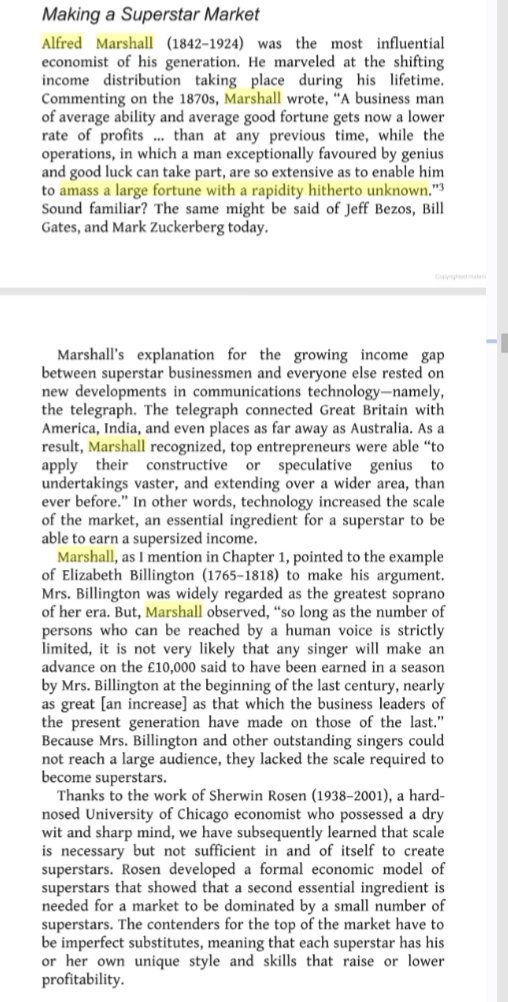
Alfred Marshall on superstar wages – Alan Krueger – Rockonomics
06 Feb 2020 Leave a comment
in Alfred Marshall, applied price theory, economic history, economics of education, economics of information, entrepreneurship, financial economics, history of economic thought, human capital, industrial organisation, international economics, labour economics, labour supply, managerial economics, occupational choice, organisational economics, personnel economics, poverty and inequality, survivor principle, transport economics, urban economics Tags: superstars
Befriend your ideological opposite. It’s fun. | Nadine Strossen
06 Feb 2020 Leave a comment
in law and economics Tags: constitutional law, free speech

Jonathan Pie: A mockumentary
06 Feb 2020 Leave a comment

Here’s a long episode of Jonathan Pie (the alter ego of comedian Tom Walker), playing, as he often does, a reporter. But this time the story is about him, a “documentary” of Pie covering pro- and anti-Brexit marchers. (For Americans: “UKIP” is the UK Independence Party, a prime mover of the Brexit initiative that has, says Matthew, “mutated into a far-right home for Nazis.”)
The conceit is although Pie is a liberal, he’s taken down by social media, who decides to take his words and actions out of context and portray him as both a “Leave-r” and an “alt-righter”. And this is after he extols social media for being a boon to journalism (“journalism for toddlers”), enabling reporters to find just the right quote they want instead of having to interview a bunch of wankers.
In the end, Pie comes a cropper, and the coppers come for him—for perpetrating “hate…
View original post 18 more words


What’s Wrong with EMH?
06 Feb 2020 Leave a comment

Scott Sumner wrote a post commenting on my previous post about Paul Krugman’s column in the New York Times last Friday. I found Krugman’s column really interesting in his ability to pack so much real economic content into an 800-word column written to help non-economists understand recent fluctuations in the stock market. Part of what I was doing in my post was to offer my own criticism of the efficient market hypothesis (EMH) of which Krugman is probably not an enthusiastic adherent either. Nevertheless, both Krugman and I recognize that EMH serves as a useful way to discipline how we think about fluctuating stock prices.
Here is a passage of Krugman’s that I commented on:
But why are long-term interest rates so low? As I argued in my last column, the answer is basically weakness in investment spending, despite low short-term interest rates, which suggests that those rates will…
View original post 1,022 more words
The Uselessness of the Money Multiplier as Brilliantly Elucidated by Nick Rowe
06 Feb 2020 Leave a comment
Not long after I started blogging over two and a half years ago, Nick Rowe and I started a friendly argument about the money multiplier. He likes it; I don’t. In his latest post (“Alpha banks, beta banks, fixed exchange rates, market shares, and the money multiplier”), Nick attempts (well, sort of) to defend the money multiplier. Nick has indeed figured out an ingenious way of making sense out of the concept, but in doing so, he has finally and definitively demonstrated its total uselessness.
How did Nick accomplish this remarkable feat? By explaining that there is no significant difference between a commercial bank that denominates its deposits in terms of a central bank currency, thereby committing itself to make its deposits redeemable on demand into a corresponding amount of central bank currency, and a central bank that commits to maintain a fixed exchange rate between its currency and the…
View original post 1,737 more words
Peak #solarpower #windpower #globalwarming #climateemergency @Greenpeace @Greens @NZGreens
06 Feb 2020 Leave a comment
in energy economics, environmental economics, global warming Tags: nuclear power, solar power, The fatal conceit, wind power

Mapping how railroads built America | Maptastic ep 3
05 Feb 2020 Leave a comment
in economic history, transport economics
As fire risks rise, California limits insurers’ ability to react
05 Feb 2020 Leave a comment

For California, 2019 was a welcome reprieve from recent record-setting wildfire seasons. According to Cal Fire, approximately 260,000 acres burned across the state. A large area to be sure, this pales in comparison to the approximately 2,000,000 acres burned in 2018 and 1,500,000 acres in 2017.
However, state policy may lead to even worse fire seasons in the future. Despite the governor declaring a wildfire emergency last year, thereby lifting some regulatory obstacles to forest and grassland management, the state’s insurance regulator is frustrating efforts by insurers to have rates reflect real risks.
In California, insurance carriers require government permission to adjust their rates, introducing political considerations into what should be an economic decision. Unsurprisingly, rate increases aren’t popular with voters who have to pay them.
Although rates have increased, in some cases substantially, they remain capped. Consequently, the logical response for insurers is to continue offering coverage to customers…
View original post 453 more words
The government’s eco-edict that all new cars be electric in 15 years is doomed to backfire – because old bangers can be greener, says JOHN NAISH
05 Feb 2020 Leave a comment
Will end up like Cuba with 60-year-old cars been driven around because of the lack of replacement


Recent Comments