Why didn’t Vichy France join the Axis?
21 Feb 2023 Leave a comment
in defence economics, war and peace Tags: France, World War II
Why did the world let India annex Goa?
21 Feb 2023 Leave a comment
in defence economics, economic history, International law Tags: India
Wind Turbine Makers Demand Taxpayer Bailout For Mounting Billion-Dollar Losses
20 Feb 2023 Leave a comment


Wind turbine makers are bleeding cash, and several are terminal. Siemens Gamesa has been axing hundreds of jobs in Europe and America. Vestas, Nordex and Enercon are also on the ropes. The cause of all this corporate misery is down to a collapse in wind factory investment, which is down to a collapse in wind power subsidies, and the sudden realisation that the economics of wind power, even with massive subsidies, never stacks up.
In the States, General Electric’s wind turbine manufacturing unit booked a $US2.2 billion loss in 2022.
And, as Thomas Lifson outlines below, the worst is yet to come. Oh dear, how sad, never mind.
Wind power makers suffer huge losses, want to abandon major project
American Thinker
Thomas Lifson
5 February 2023
The greenies’ dream of “clean” (except for millions of dead birds) energy from wind farms is dying in the face of the poor economics (even…
View original post 938 more words
No Current, Viable Alternative To Fossil Fuels
20 Feb 2023 Leave a comment

 By Larry Bell ~
During his State of the Union Address, President Biden blamed high U.S. energy prices on greedy oil companies despite as former presidential candidate Biden having virtually pledged to put them out of business.
During a Democratic primary debate with Sen. Bernie Sanders, Biden said, “No more subsidies for the fossil fuel industry. No more drilling on federal lands. No more drilling, including offshore. No ability for the oil industry to continue to drill — period, [it] ends, number one,” later adding, “No more, no new fracking.”
 Joe has largely kept his promise, evidenced by an aggressive war against fossil energy which has included banning of the Keystone XL pipeline along with myriad other executive orders placing regulatory restrictions on drilling.
It is perhaps forgivable then, that Republican attendees loudly groaned at his ironic SOTU temerity when Biden said, “When I talked to a couple of…
View original post 819 more words
Japan’s largest cat cafe in Kabukicho, Shinjuku, Tokyo was relaxing and cute
20 Feb 2023 Leave a comment
in cats
Christian Denominations Family Tree | Episode 2: Roman Catholic & Eastern Orthodox Churches
20 Feb 2023 Leave a comment
in economic history, economics of media and culture, economics of religion
Review of “The Chief: The Life of William Randolph Hearst” by David Nasaw
19 Feb 2023 Leave a comment

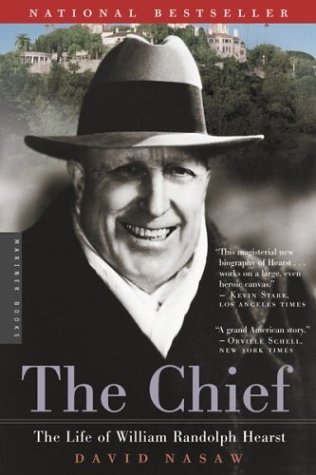 The Chief: The Life of William Randolph Hearst
by David Nasaw
704 pages
Houghton Mifflin
Published: June 2000
Although more recent biographies of Hearst are now available, David Nasaw’s “The Chief: The Life of William Randolph Hearst” remains the standard biography of this idiosyncratic media tycoon. Nasaw is a biographer and Professor of History at City University of New York. His most popular books are biographies of Joseph P. Kennedy (which I liked) and Andrew Carnegie (which I loved).
William Randolph Hearst (1863-1951) is a remarkably fascinating, but often infuriating, biographical subject. He was born with a silver spoon nearby…if not quite in his mouth. But he learned the art of hard work and perseverance from his father – a self-made mining millionaire. Handed a golden goose (the San Francisco Examiner) at the age of twenty-four, he built an enormous media empire which survives to this day.
View original post 465 more words
Review of “The Patriarch: The Remarkable Life and Turbulent Times of Joseph P. Kennedy” by David Nasaw
19 Feb 2023 Leave a comment

The Patriarch: The Remarkable Life and Turbulent Times of Joseph P. Kennedy
by David Nasaw
868 pages
The Penguin Press
Published: November 2012
David Nasaw’s “The Patriarch: The Remarkable Life and Turbulent Times of Joseph P. Kennedy” was published in 2012 and was a Pulitzer Prize nominee in 2013. Nasaw is an author and a professor of American history at City University of New York. Among his most widely-read books are biographies of William Randolph Hearst and Andrew Carnegie (which was a 2007 Pulitzer Prize nominee).
Nasaw began this authorized biography after Kennedy’s two youngest children (Jean and Edward) approached him to assess his interest in the project. Once he was assured unrestricted access to Kennedy’s papers and complete editorial control he spent six years researching his subject’s life – documenting his personal and professional lives and investigating a variety of alleged misdeeds.
It is unusual for a biography…
View original post 449 more words
February 18, 1516: Birth of Mary I, Queen of England and Ireland
19 Feb 2023 Leave a comment

From the Emperor’s Desk: I will not do a complete biography of Queen Mary on the anniversary of her birth, instead I will focus on how she came to marry King Felipe II of Spain.
Mary was born on February 18, 1516 at the Palace of Placentia in Greenwich, England. She was the only child of King Henry VIII and his first wife, Infanta Catherine of Aragon, to survive infancy. Her mother had suffered many miscarriages and stillbirths. Before Mary’s birth, four previous pregnancies had resulted in a stillborn daughter and three short-lived or stillborn sons, including Henry, Duke of Cornwall.
Throughout Mary’s childhood, Henry negotiated potential future marriages for her. When she was only two years old, Mary was promised to François, Dauphin of France, the infant son of King François I, but the contract was repudiated after three years.
In 1522, at the age of six, she…
View original post 807 more words
How Leonardo da Vinci made a “satellite” map in 1502
19 Feb 2023 Leave a comment
in economic history, economics of media and culture Tags: maps
Anurag Deb: Direct Rule in Northern Ireland and the Power to Make Irrational Laws
18 Feb 2023 Leave a comment


The townland of Carrickmore in County Tyrone in Northern Ireland is the ancestral home of legendary Nirvana frontman Kurt Cobain. It is also near an ancient and beautifully preserved Neolithic court tomb, excavated between 1979 and 1982. Carrickmore was at the heart of a different funerary matter when, on 3 February 2023, the Northern Ireland High Court handed down a judgment with potentially wide consequences for many laws which govern everyday life in the jurisdiction. This post examines the judgment in Re Oliver Hughes’ application for judicial review [2023] NIKB 5 in terms of the administration of Northern Ireland after the suspension and abolition of devolution in 1973, until its restoration in 1999 – the longest period of direct rule since the jurisdiction’s birth.
The facts
Oliver Hughes was interested in establishing a crematorium in the area around Carrickmore. The problem is that crematoria are regulated by the…
View original post 2,853 more words


Recent Comments