While Failing to Save the Planet #globalwarming #climateemergency
27 Nov 2022 Leave a comment
in applied welfare economics, energy economics, environmental economics, global warming Tags: climate alarmists
Pride Comes Before The Fall – British Trouble in Mesopotamia I THE GREAT WAR – Week 70
26 Nov 2022 Leave a comment
in defence economics, war and peace Tags: World War I
Future Mining: Fake ‘Green’ Energy Transition Entirely Dependent On Coal, Oil & Gas
25 Nov 2022 Leave a comment

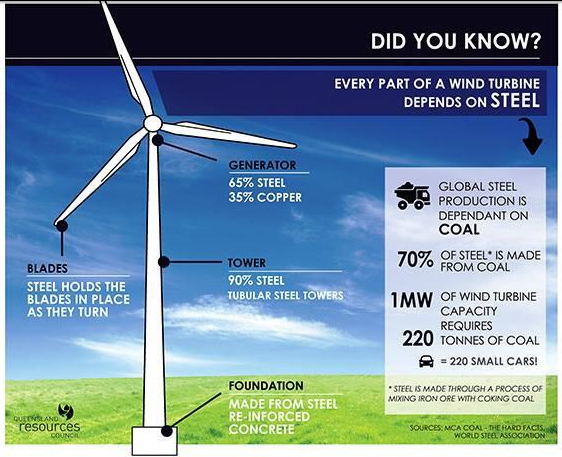
Any enquiring mind has already rumbled the fact that the grand wind and solar reset is a great ‘green’ fraud. Wind turbines, solar panels and mythical mega-batteries require more energy to produce than they’ll ever repay.
Miners love it, of course, with the insatiable demand that’s been generated by delusional autocrats and cynical rent-seekers. Although, perhaps, not so much the kids in the Congo dragging cobalt out of muddy pits with their bare hands.
At the heart of the ‘wind and solar will save us’ myth is a yawning gulf of ignorance concerning the energy and resources required, is the subject dealt with by Frances Menton below.
They Can’t Make Green Energy Using Only Green Energy
Manhattan Contrarian
Francis Menton
17 October 2022
Not being a dope, you likely realized a long time ago that it was going to take a lot of energy to manufacture the components of the…
View original post 786 more words
THOMAS CRANMER: Labour reintroduces blasphemy laws
25 Nov 2022 Leave a comment

The government repealed blasphemous libel laws three years ago but now looks set to re-introduce something remarkably similar. It is an amendment that not even the Royal Commission has recommended. THOMAS CRANMER writes-
As the government was labelled “reckless and irresponsible” on Wednesday for attempting to rush through 24 bills, some without public consultation, the chances of bad law being made is extremely high.
Already this week we have seen the Prime Minister and her Cabinet colleagues so badly exposed on the Water Services Entities Bill, that it has required Minister Mahuta to make an amendment in an effort to quell growing public concern about the scope of the Bill.
That amendment, by the way, is merely a drafting sleight of hand that doesn’t change the substance or scope of the Bill but more on that next week.
Given the speed at which the government is moving we can be sure…
View original post 1,104 more words
Some Thoughts On Counsellors Of State
25 Nov 2022 Leave a comment

The Counsellors of State Bill cleared the House of Lords yesterday. Counsellors of State are members of the Royal Family who carry out the Sovereign’s functions if they are ill or absent from the United Kingdom, and this Bill would add the Earl of Wessex and the Princess Royal to the pool of people who are eligible to serve. [1]
Under the Regency Act 1937, the Queen Consort and the first four people in line for the Throne who are of legal age are eligible to be Counsellors.[2] Because the Prince of Wales’ children are too young, the Duke of York and the Duke of Sussex remain on the roster. This is awkward given that neither one is a ‘working royal’ and Prince Harry also lives in America. While the King can excuse someone if they will be absent from the UK, he can’t substitute anyone in their…
View original post 1,577 more words
The Counsellors of State Bill: an elegant solution, but a temporary one
25 Nov 2022 Leave a comment


The House of Lords yesterday debated the merits of the Counsellors of State Bill, which seeks to add Princess Anne and Prince Edward to the list of people that can act when the monarch is unable to do so. As Craig Prescott explains, this is a neat solution, but a temporary one.
The start of a new reign inevitably brings change to the monarchy. One specific change is that the monarch will once again travel overseas, including visits to some of the 14 other countries that also have a new head of state.
But what about the monarch’s constitutional and legal role while they are away? This role includes the granting of royal assent to legislation, appointment of ministers, ratification of treaties, and appointment of judges and diplomats. Many of these functions require the personal signature of the monarch (the royal sign manual), or in the case of holding Privy…
View original post 1,948 more words
Kenneth Williams, Desperately Funny (Part 5 of 7)
25 Nov 2022 Leave a comment
in movies, television, TV shows
Is the CO2 battery for long-duration energy storage any good?
24 Nov 2022 Leave a comment

The makers say: ‘To charge the battery, we take CO2 at near atmospheric temperature and pressure and we compress it. The heat that is generated during compression is stored. When we exchange the thermal energy with the atmosphere, the CO2 gas becomes liquid.
To generate and dispatch electricity, the liquid CO2 is heated up and converted back into a gas that powers a turbine, which generates power. The CO2 gas is always contained and the entire system is sealed. We don’t use any exotic materials.’
— Looks like another net user of power.
– – –
Italian startup Energy Dome, maker of the world’s first CO2 battery, is officially entering the US market, says Electrek.
Energy Dome’s battery uses carbon dioxide to store energy from wind and solar on the grid.
View original post 353 more words
The Treasury should look again at a simple option to save on debt interest
24 Nov 2022 Leave a comment

The latest monthly data on the UK’s public finances included the first of many payments from the Treasury to cover losses made by the Bank of England’s Asset Purchase Facility (APF). This may seem like an arcane subject, but the sums are huge and at least partly avoidable, so bear with me.
First, the technical details. This is yet another unwelcome hangover from Quantitative Easing. Under QE, the Bank’s APF bought government bonds, or gilts, by crediting the accounts that commercial banks hold at the central bank, using newly-created money. These accounts, known as central bank reserves, pay interest at the Bank Rate, which is currently 3%.
The APF also receives interest on these gilts from the government, like any other bondholder, in the form of coupon payments. When these payments are higher than the cost of the reserves, the Bank has been making a profit which it has paid…
View original post 794 more words


Recent Comments