Five Genetic Diseases that Plague Royalty
01 Dec 2022 Leave a comment
in economic history, economics of media and culture
Subsidised Suicide: Wind & Solar Power Chaos Driving Britain’s Rocketing Power Prices
30 Nov 2022 Leave a comment


Britain’s power consumers are paying a heavy price for its maniacal obsession with intermittent wind and solar. Trashing its coal-fired power fleet and failing to keep up its nuclear plants now looks positively suicidal.
However, of late, the MSM has been dishing up an alternative reality, peddling a line that power prices would be a pittance if only we’d thrown even more subsidies, even sooner, at unreliable wind and solar; with that failure meaning that we lost an inevitable opportunity to enjoy loads more ‘free’ electricity harnessed from mother nature.
Paul Homewood tackles an effort to run that very meme, by renewables cheer squad, Britain’s BBC.
Would We Be Better Off Now, If We Had More Renewables?
Not A Lot of People Know That
Paul Homewood
6 November 2022
For a change, a slightly more objective analysis of our energy policy from the BBC:
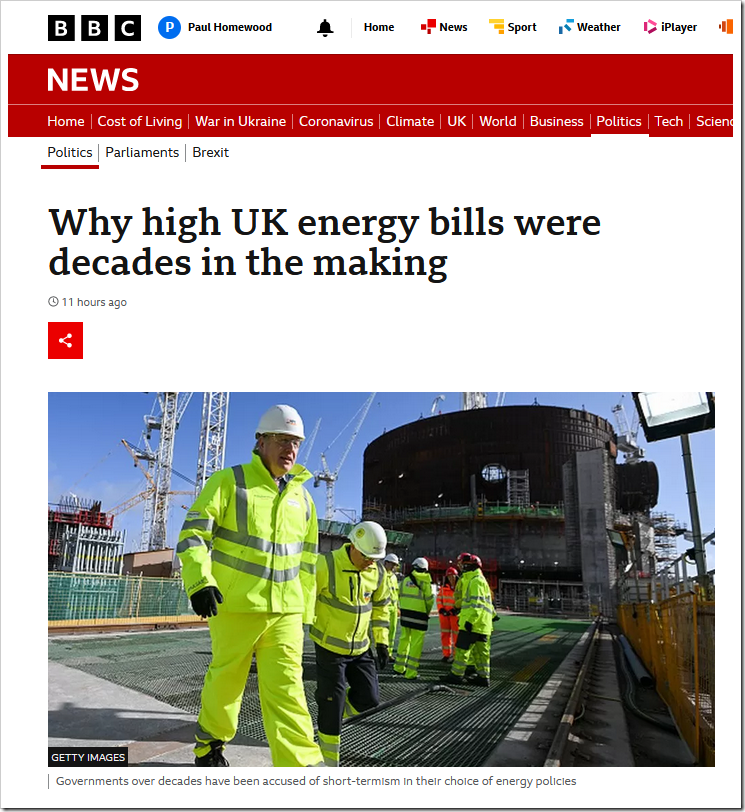
It covers some of the…
View original post 1,300 more words
During a brief window in 1950-51, children could get the Gilbert U-238 Atomic Energy Lab—a kit allowing them to make nuclear reactions at home using ACTUAL RADIOACTIVE MATERIAL. It was removed from shelves in 1951.
30 Nov 2022 Leave a comment
in economic history, economics of media and culture Tags: atomic energy

The Animals “Don’t Let Me Be Misunderstood” on The Ed Sullivan Show
30 Nov 2022 Leave a comment
in Music, television, TV shows
Bilateral bargaining in multiparty coalitions
29 Nov 2022 Leave a comment

This is just a follow up to the previous planting. As I noted there, the incoming Israeli PM’s party (Likud) will sign separate coalition agreements with each of five partner parties (three of whom ran on a joint list in the election but maintain their separate “faction” status in the Knesset).
I believe this is typical of multiparty coalitions in parliamentary democracies: that when there are multiple partners, each one signs its own bilateral deal with the incoming cabinet head. I know it is the way it has been done in Israel for as long as I have been paying attention. It is also how it has been done in recent bargaining in New Zealand. I actually do not know if other counties with coalitions uniformly do this, or if there are cases where coalition agreements are joint among all the parties entering government. (There are some cases with no…
View original post 279 more words
Not that way
29 Nov 2022 Leave a comment

A consistent theme of this blog over the 3.5 years since the Monetary Policy Committee was established has been the severe inadequacies in the way the MPC was designed, and in the way it has been staffed. Last Tuesday, Stuff journalist Tom Pullar-Strecker had an article that reported on a variety of similar concerns, informed by extensive comments from former Reserve Bank chief economist John McDermott. A particular focus was on the role of the non-executive members (“the externals”).
At the press conference for the Monetary Policy Statement asked the Governor about the externals, and if he didn’t get far (the awkward questions at that press conference were mostly left completely unaddressed), he did get from Orr an observation that of course externals were free to talk, subject to (his interpretation of) the MPC Charter provisions (agreed by Orr and the Minister) under which for the first 24 hours after…
View original post 2,114 more words
Stacking vs. checking: Otzma Yehudit in the emerging Israeli coalition
29 Nov 2022 Leave a comment
In a recent publication (details below), Reut Itzkovitch-Malka and I investigate when parties “check” partners in coalition governments and when they “stack” via the committee overseeing a ministry. Here’s a clear case of stacking in the incoming Israeli coalition: Otzma Yehudit reportedly will get both the ministry it most wanted as well as the chair of the parliamentary committee overseeing that ministry as part of the new Israeli government.
Broadly put, when coalitions are bargained, the parties forming the government have a choice of “stacking” whereby they agree to give one party full control over certain policy portfolios, or “checking” whereby two parties are given organizational bases from which to check one another in a given portfolio. There is considerable literature in political science on questions such as these, mostly focused on the degree of authority delegated to cabinet ministers. For instance, Laver and Shepsle (1996) famously developed a model…
View original post 1,200 more words
Russian Uniforms of WW1 I THE GREAT WAR Special
29 Nov 2022 Leave a comment
in defence economics, war and peace Tags: World War I


Recent Comments