Walmart, Katrina, and Disaster Response | Steven Horwitz
09 Sep 2021 Leave a comment
in Austrian economics, comparative institutional analysis, economics of natural disasters, entrepreneurship
Charles Murray – Human Diversity: The Biology of Gender, Race, and Class
09 Sep 2021 Leave a comment
in discrimination, economics of education, human capital, labour economics, labour supply, liberalism, Marxist economics, occupational choice, poverty and inequality Tags: personality psychology
Thomas Sowell, Cost-Benefit Analysis, and the Limits of Regulation
09 Sep 2021 Leave a comment

Thomas Sowell is a great economist, but his expertise extends to other fields of study. Everything from history to education.
But he’s also famous for being a great communicator, with dozens of well-known quotes.
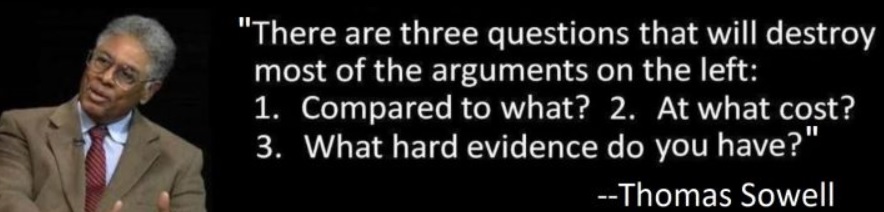 I use one of them on my rotating banner because it succinctly summarizes why the left has to rely on emotional appeals rather than rigorous evidence.
For purposes of today’s column, I want to cite one of his other quotes, this one dealing with the fact that tradeoffs are an inevitable reality.
 Simply stated, if you want more of one thing, you have to accept less of another thing.
And this has important implications for regulatory policy – especially about the value of cost-benefit analysis.
Let’s look at two examples.
First, here’s the abstract from a study by Jordan Nickerson from MIT and David Solomon from Boston College.
Since 1977, U.S. states have…
View original post 654 more words
Let freedom reign
09 Sep 2021 Leave a comment
in liberalism, libertarianism, Marxist economics Tags: free speech, political correctness, regressive left

William I the Conqueror as King of the English and his death on September 8, 1087.
09 Sep 2021 Leave a comment

At Christmas 1085, William ordered the compilation of a survey of the landholdings held by himself and by his vassals throughout his kingdom, organised by counties. It resulted in a work now known as the Domesday Book. The listing for each county gives the holdings of each landholder, grouped by owners. The listings describe the holding, who owned the land before the Conquest, its value, what the tax assessment was, and usually the number of peasants, ploughs, and any other resources the holding had. Towns were listed separately.
All the English counties south of the River Tees and River Ribble are included, and the whole work seems to have been mostly completed by August 1, 1086, when the Anglo-Saxon Chronicle records that William received the results and that all the chief magnates swore the Salisbury Oath, a renewal of their oaths of allegiance. William’s exact motivation in ordering the survey…
View original post 576 more words
Facts of Economic Growth
09 Sep 2021 Leave a comment
in development economics, economic growth, economic history, growth disasters, growth miracles, macroeconomics Tags: The Great Enrichment
PC cheat sheet
09 Sep 2021 Leave a comment
in economics of bureaucracy, economics of education, liberalism, libertarianism, Marxist economics, Public Choice Tags: free speech, political correctness, regressive left

De Havilland Mosquito: The wooden fighter-bomber that could do it all
09 Sep 2021 Leave a comment
in defence economics, war and peace Tags: World War II
Competition and Entrepreneurship | Israel Kirzner
09 Sep 2021 Leave a comment
in applied price theory, Austrian economics, comparative institutional analysis, economic history, economics of information, entrepreneurship, history of economic thought, industrial organisation, Israel Kirzner, market efficiency, survivor principle Tags: entrepreneurial alertness
Hayek on Competition and Discovery
09 Sep 2021 Leave a comment
in applied price theory, applied welfare economics, Austrian economics, comparative institutional analysis, economics of information, entrepreneurship, F.A. Hayek, history of economic thought, industrial organisation, survivor principle
South Africa in WW1 I THE GREAT WAR Special feat
09 Sep 2021 Leave a comment
in defence economics, war and peace Tags: World War I


Recent Comments