How Taliban Expanded in Afghanistan During America’s Longest War
10 Aug 2021 Leave a comment
in defence economics, war and peace Tags: Afghanistan, war against terror
Chilly blast bares the harsh realities – and shortcomings – around Ardern govt’s renewable energy ambitions
10 Aug 2021 Leave a comment

The headlines said it all.
“High power demand forces blackouts in some areas”: Radio NZ.
“Things are running tight this morning: Transpower boss’ warning to Kiwis”: NZ Herald.
“’So Third World’ : Government faces pressure after power blackout” : Stuff
But doesn’t NZ have plenty of energy? After all, the Ardern government – in 2018 – could rule out any further offshore exploration for oil and gas.
And Energy Minister Megan Woods, more recently, has been complaining that wholesale power prices are too high.
It all hit home with dismaying force this week when – for the first time in several decades – NZ experienced enforced power blackouts.
As Stuff reported:
“The government is facing serious pressure after rolling power blackouts on one of the coldest nights of the year, with National saying the situation is ‘third world’.”
View original post 377 more words
Stacked
09 Aug 2021 Leave a comment

While his competitors continue to fumble around with much delayed, modest successes like getting spaceships into sub-orbital flights, Elon Musk’s SpaceX corporation continues to power ahead with stuff that’s at least a decade in front of them, not to mention national space agencies like China’s and NASA.
Following the successful atmospheric test flight of Starship SN15 – after a few catastrophic landings for earlier models – the next test ship, SN16, was simply scrapped while work moved ahead on a sub-orbital / orbital test vehicle.
This is entirely in keeping with SpaceX’s iterative development process of rapid design-build-test prototyping.
Only a few days ago, it was observed that the Super Heavy Booster (formerly called the BFR), the 1st stage of the Starship system, had been moved to its launchpad in Texas.
But just the other day, it was seen that an actual Starship sub-orbital/orbital model, SN20, was lifted…
View original post 401 more words
What do finance academics/professionals think about climate finance?
09 Aug 2021 Leave a comment
They should found a hedge fund then to prove John Cochrane wrong when he testified that “But climate change poses no measurable risk to the financial system. This emperor has no clothes. “Risk” means unforeseen events. We know exactly where the climate is going over the horizon that financial regulation can contemplate. Weather is risky, but even the biggest floods, hurricanes, and heat waves have essentially no impact on our financial system.
Moreover, the financial system is only at risk when banks as a whole lose so much, and so suddenly, that they blow through their loan-loss reserves and capital, and a run on their short-term debt erupts. That climate may cause a sudden, unexpected and enormous economic effect, in the next decade, which could endanger the financial system, is an even more fantastic fantasy.
Sure, we don’t know what will happen in 100 years. But banks did not fail in 2008 because they bet on radios not TV in the 1920s. Banks failed over mortgage investments made in 2006. Trouble in 2100 will come from investments made in 2095. Financial regulation does not and cannot pretend to look past 5 years or so, and there is just no climate risk to the financial system at this horizon.”

We survey 861 finance academics, professionals, and public sector regulators and policy economists about climate finance topics.
They identify regulatory risk as the top climate risk to businesses and investors over the next five years, but they view physical risks as the top risk over the next 30 years.
By an overwhelming margin, respondents believe that asset prices underestimate climate risks.
We also tabulate opinions about the correlation between growth and climate change; social discount rates appropriate for projects that mitigate the effects of climate change; most influential forces for reducing climate risks; and, most important research topics.
Wind & Solar Storage ‘Fires Up’: Giant Battery Burns For Days After Terrifying Explosion
09 Aug 2021 Leave a comment

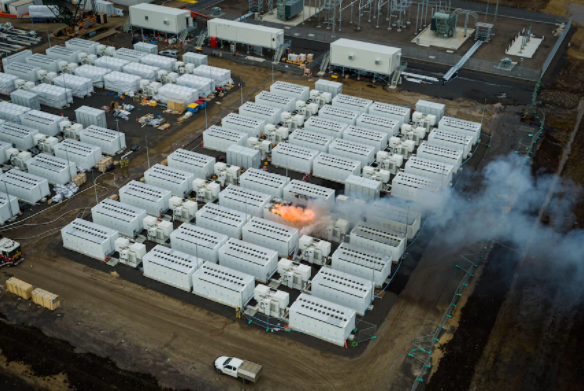
Giant lithium-ion batteries have an alarming habit of exploding and, when they do, literally burning for days.
Following up on our recent post concerning just such a case – where a Tesla mega-battery exploded in a toxic fireball in southwest Victoria – here’s a couple from the team at Jo Nova and Watts Up With That? that detail the aftermath.
The Tesla battery fire burned for longer than it operated for
Jo Nova Blog
Jo Nova
3 August 2021
We all heard about the Tesla Megabattery fire in Victoria last Friday, but you may not know it only started operating on Thursday night. Or that 30 fire trucks and 150 firefighters took 76 hours to get the blazing battery under control.
So it burned for three times longer than it operated.
When they burn, Tesla batteries produce smoke with aluminum, cadmium, arsenic, mercury, lead, selenium, manganese and chromium.
Luckily no…
View original post 798 more words
Thomas Sowell – Landmark Speech at AEI with President Gerald Ford
09 Aug 2021 Leave a comment
in applied price theory, applied welfare economics, comparative institutional analysis, development economics, discrimination, economic history, economics of education, human capital, labour economics, labour supply, minimum wage, occupational choice, poverty and inequality Tags: racial discrimination, The fatal conceit
Perspectives on New Zealand immigration policy
09 Aug 2021 Leave a comment

Several years ago the Law and Economics Association hosted an event in Wellington in which the New Zealand Initiative’s Eric Crampton and I each told our stories about New Zealand immigration policy. My account is here, and a link to the talk I gave is here.
A few months ago a couple of Victoria University of Wellington academics responsible for a Masters class (in a programme I didn’t even know existed (Masters in Philosophy, Politics and Economics)) invited us to do something similar for their class. We did that today.
My text is here (if Eric chooses to link to his slides on his blog I will include a link) (UPDATE: link here). My focus was solely on the economic dimensions of immigration policy, and in particular on the implications for economywide productivity (as the best proxy for whether large-scale policy-led non-citizen immigration has been beneficial for…
View original post 1,306 more words
Why the US Women’s National Soccer Team Lost its wage gap Lawsuit
09 Aug 2021 Leave a comment
in discrimination, gender, labour economics, labour supply, law and economics, occupational choice, poverty and inequality, sports economics Tags: gender wage gap, sex discrimination
The Socialist Calculation Debate — Dr. Peter Boettke, 9/23/2013
09 Aug 2021 Leave a comment
in applied price theory, applied welfare economics, Austrian economics, entrepreneurship, industrial organisation, law and economics, Marxist economics, property rights, survivor principle
Spam: A History of Phishing
09 Aug 2021 Leave a comment
in economic history, economics of crime, law and economics
David Friedman talks about possible futures on The Marketplace of Ideas (10/21/2008)
09 Aug 2021 Leave a comment
in applied price theory, applied welfare economics, comparative institutional analysis, David Friedman, economics of crime, economics of information, economics of regulation, financial economics, industrial organisation, law and economics, property rights


Recent Comments