Juice: How Electricity Explains The World – Documentary Trailer #1
14 Sep 2020 Leave a comment
in development economics, economic history, economics of bureaucracy, energy economics, environmental economics, environmentalism, global warming, growth disasters, growth miracles, income redistribution, Marxist economics, politics - Australia, politics - New Zealand, politics - USA, Public Choice, rentseeking, technological progress Tags: climate alarmists, extreme poverty, pessimism bias, regressive left, The Great Escape
Angus Deaton: «lDevelopment aid is cynical» – Swiss Television SRF
14 Sep 2020 Leave a comment
in Bill Easterly, comparative institutional analysis, constitutional political economy, development economics, economic history, economics of bureaucracy, economics of crime, growth disasters, growth miracles, international economics, law and economics, P.T. Bauer, property rights, Public Choice, public economics, rentseeking Tags: overseas aid
If anecdotes are evidence, why aren’t you drinking paint thinner?
13 Sep 2020 1 Comment

 I want to begin this post by doing something atypical for me. I want to tell you about an amazing cure-all that I that was recently introduced to: turpentine (aka paint thinner). According to the vast wealth of knowledge available on the internet, most (if not all) diseases are actually caused by parasites, fungal infections (particularly Candida), and even modern medicine itself. Don’t worry, however, because all of these can be cured by drinking turpentine (or sometimes kerosene or even gasoline). Now, you may think that sounds crazy, but have no fear, because this treatment is totally natural (turpentine is made from distilled tree resin). Also, it has been used for nearly two centuries, and several brave doctors have bucked the medical establishment and are promoting it (e.g., Jennifer Daniels). You may think that is pretty flimsy evidence, but don’t worry, I also have multiple blogs, alternative health…
View original post 1,626 more words
Why We Still Need to Read Hayek?
13 Sep 2020 Leave a comment

John Taylor in the Hayek Lecture 2012 organised by Manhattan Institute looks at this question.
Most figure Hayek with liberty and anti-planning. Taylor says we need to read Hayek for a different cause.
He says we need to still read Hayek as latter believed in rules:
View original post 618 more words
Hayek taught freedom and the rule of law drive prosperity….
13 Sep 2020 Leave a comment
Manhattan Institute organises annual Hayek Lecture.
The 2012 winner was John Taylor. Here is his speech on the occasion titled as Road to recovery (based on Hayek’s famed book – road to serfdom).
Taylor connects his rule based policies to Hayek’s freedomm ideas which also relied on consistent rules:
View original post 620 more words
Why we should read David Hume and why is he even more relevant today?
13 Sep 2020 Leave a comment
Superb piece by Julian Baggini (writer and founding editor of The Philosophers’ Magazine).
He revisits the legacy of David Hume and tells us two things. First, despite his insights why Hume is not considered in the league of say Socrates or Kant. Second, why his thoughts and ideas matter even more today:
In his own lifetime Hume’s reputation was mainly as a historian. His career as a philosopher started rather inauspiciously. His first precocious attempt at setting out his comprehensive new system of philosophy, A Treatise of Human Nature (1739-40), published when he was 26, ‘fell dead-born from the press, without reaching such distinction as even to excite a murmur among the zealots’, as he later recalled, with self-deprecating exaggeration.
Over time, however, his standing has grown to the highest level. A few years ago, thousands of academic philosophers were asked which non-living philosopher they most identified with. Hume came a clear first…
View original post 991 more words
Internalised ageism and ableism to expect others to remember politically correct pronouns
13 Sep 2020 Leave a comment

The price of NIMBYs
13 Sep 2020 Leave a comment
in economic growth, economics of regulation, macroeconomics, politics - USA, property rights, Public Choice, rentseeking, urban economics

Stunning volcanic eruptions filmed in real time
13 Sep 2020 Leave a comment

Here we have some pretty amazing shots of the Ecuadorian volcano Reventador erupting between January 5 and 7 of this year, and filmed by Martin Rietze. It’s quite active, and there are two sites reporting the activity (here, and a better one here). The curious thing is that, as the second site reports, January 2020 wasn’t a particularly active time—even though there were daily explosions! From the second site:
Volcanism in January 2020 was relatively low compared to the other months of this reporting period. Explosions continued on a nearly daily basis early in the month, ranging from 20 to 51. During 5-7 January incandescent material ejected from the summit vent moved as block avalanches downslope and multiple gas-and-steam and ash plumes were produced (figures 120, 121, and 122). After 9 January the number of explosions decreased to 0-16 per day. Ash plumes rose between 4.6…
View original post 138 more words
Book Review: ‘The Conquering Tide: War in the Pacific Islands, 1942-1944 (Volume II of the Pacific War Trilogy)
13 Sep 2020 Leave a comment

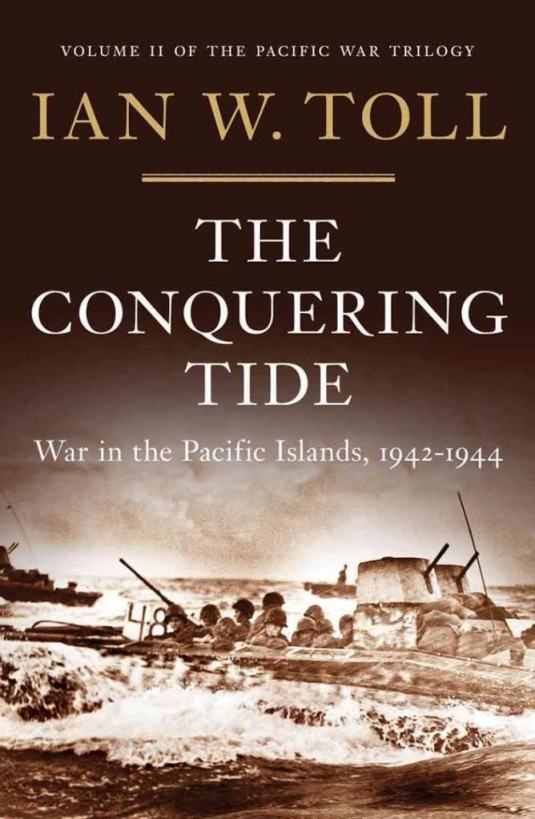
On September 21, 2015, W,W. Norton & Company – an independent, employee-owned publishing company based in New York City – published Ian W. Toll’s The Conquering Tide: War in the Pacific Islands, 1942-1944. This is the second book in Toll’s Pacific War Trilogy, which begins with Pacific Crucible: War at Sea in the Pacific, 1941-1942 (2011) and ends with the recently-published Twilight of the Gods: War in the Western Pacific, 1944-1945.
As the subtitle clearly indicates, The Conquering Tide covers the war between the Japanese Empire and the Allies (the United States, Great Britain, Australia, and New Zealand) during the “island-hopping” campaigns of the American-dominated twin drives across the vast expanses of the South and Central Pacific to drive the Japanese out of their conquered island holdings and build a network of bases from which Admiral Chester W. Nimitz’s…
View original post 2,475 more words


Recent Comments