How they resolved spats before Twitter existed
thepoke.co.uk/2015/07/26/res… http://t.co/a04CTYT2aX—
The Poke (@ThePoke) July 27, 2015
There is an economic literature on feuds and duelling
07 Aug 2015 Leave a comment
in applied price theory, comparative institutional analysis, economic history, economics of media and culture Tags: adverse selection, asymmetric information, competition as a discovery procedure, duals, feuds, game theory, moral hazard, screening, signalling
I thought America’s poor never had health insurance cover!? I’ve watched too much American TV?
26 Jul 2015 1 Comment
in applied welfare economics, economic history, economics of media and culture, health economics, industrial organisation, politics - USA, Public Choice, rentseeking, survivor principle Tags: adverse selection, expressive voting, health insurance, Leftover Left, media bias, medicaid, Medicare, moral hazard, Obamacare, rational ignorance, rational irrationality
#Medicaid expands access to health coverage and supports work: bit.ly/1RKHQ2x #Medicaidat50 http://t.co/mydZMggcXg—
Center on Budget (@CenterOnBudget) July 20, 2015
6.4 million seniors get the vital support & care they need thanks to Medicaid: bit.ly/1HqYvNG #Medicaidat50 http://t.co/onWMiYj301—
Center on Budget (@CenterOnBudget) July 23, 2015
Reminder: #Medicaid helps millions of babies: bit.ly/1RS7ME5 #Medicaidat50 http://t.co/SeJ7MFPGWE—
Center on Budget (@CenterOnBudget) July 20, 2015
#Medicaid help millions of children across the country live healthier lives. #Medicaidat50: bit.ly/1RS7ME5 http://t.co/LT6rXhNzUg—
Center on Budget (@CenterOnBudget) July 16, 2015
50 years of coverage that every American deserves. #Medicare http://t.co/uRtERV2k9K—
American Progress (@amprog) July 30, 2015
Mann: Celebrating historic gains in coverage for kids CCF#2015 http://t.co/g7CYQ7DuwN—
Georgetown CCF (@GeorgetownCCF) July 22, 2015
#Medicare has been keeping seniors insured and healthy for 50 years. http://t.co/mXW4x12Rhi—
American Progress (@amprog) July 30, 2015
The majority of Americans of all ages don't recognize that gov subsidizes their health care: vox.com/2015/3/1/81257… http://t.co/ivq5eLThsi—
(@SocImages) April 22, 2015
The entrepreneurial alertness of the Apollo 11 astronauts
22 Jun 2015 Leave a comment
in economic history, economics of media and culture, entrepreneurship, health and safety, labour economics, labour supply, occupational choice Tags: adverse selection, Apollo 11, economics of insurance, entrepreneurial alertness, moon landings, space
Many doubts have been raised about all types of ultrasonic pest repellers
02 Oct 2014 Leave a comment

At least 20% of New Zealand workers are subject to occupational regulation
08 Jul 2014 Leave a comment
in applied price theory, applied welfare economics, comparative institutional analysis, David Friedman, economics of information, economics of regulation, entrepreneurship, industrial organisation, labour economics, law and economics, managerial economics, market efficiency, Milton Friedman, personnel economics, politics - New Zealand, Ronald Coase Tags: adverse selection, asymmetric information, blackboard economics, moral hazard, occupational regulation, screening, signalling
There are at least 98 regulated occupations in New Zealand covering about 20% of the workforce. In 2011, this amounts to 440,371 workers. The skills that are regulated range across all skill sets and many occupations:
- 49% of regulation is in the form of a licence;
- 18% of regulated work is in the form of licensing of tasks;
- 31% of regulated workers require a certificate; and
- 4% of regulated workers require registration.
There are 32 different governing Acts that regulated occupations in New Zealand with 55% of the workers subject to occupational regulation are employed in just five occupations:
- 98,000 teachers;
- 48,500 nurses;
- 42,730 bar managers;
- 32,733 chartered accountants; and
- 22,749 electricians.
The Health Practitioners Competency Assurance Act 2003 regulates 22 occupations and a total of 89,807 workers. The next best is the 10 occupations regulated by the Health and Safety in Employment Act 2002 which regulates an unknown number of occupations. The Civil Aviation Act 1990 regulates eight occupations and 19,095 workers, the Building Act 2004 regulates seven occupations and 21,101 workers and the Maritime Transport Act 1994 regulates six occupations and 20,500 workers. 12 of the regulated occupations are regulated under laws passed since 2007.
The purpose of occupational regulation is to protect buyers from quacks and lemons – to overcome asymmetric information about the quality of the provider of the service.
Adverse selection occurs when the seller knows more than the buyer about the true quality of the product or service on offer. This can make it difficult for the two people to do business together. Buyers cannot tell the good from the bad products on offer so many they do not buy to all and withdraw from the market.
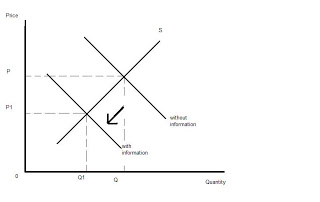
Goods and services divide into inspection, experience and credence goods.
- Inspection goods are goods or services was quality can be determined before purchase price inspecting them;
- Experience goods are goods whose quality is determined after purchase in the course of consuming them; and
- Credence goods are goods whose quality may never be known for sure as to whether the good or service actually worked – was that car repair or medical procedure really necessary?
The problem of adverse selection over experience and credence goods present many potentially profitable but as yet unconsummated wealth-creating transactions because of the uncertainty about quality and reliability.
Buyers are reluctant to buy if they are unsure of quality, but if such assurances can be given in a credible manner, a significant increase in demand is possible.
Any entrepreneur who finds ways of providing credible assurances of the quality of this service or work stands to profit handsomely. Brand names and warranties are examples of market generated institutions that overcome these information gaps through screening and signalling.
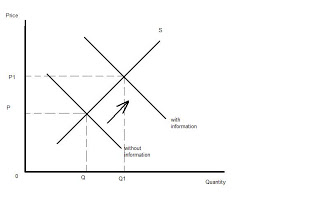
Screening is the less informed party’s effort, usually the buyer, to learn the information that the more informed party has. Successful screens have the characteristic that it is unprofitable for bad types of sellers to mimic the behaviour of good types.
Signalling is an informed party’s effort, usually the seller, to communicate information to the less informed party.
The main issue with quacks in the labour market is whether there are a large cost of less than average quality service, and is there a sub-market who will buy less than average quality products in the presence of competing sellers competing on the basis of quality assurance. This demand for assurance creates opportunities for entrepreneurs to profit by providing assurance.
David Friedman wrote a paper about contract enforcement in cyberspace where the buyer and seller is in different countries so conventional mechanisms such as the courts are futile in cases where the quality of the good is not as promised or there is a failure to deliver at all:
Public enforcement of contracts between parties in different countries is more costly and uncertain than public enforcement within a single jurisdiction.
Furthermore, in a world where geographical lines are invisible, parties to publicly enforced contracts will frequently not know what law those contracts are likely to fall under. Hence public enforcement, while still possible for future online contracts, will be less workable than for the realspace contracts of the past.
A second and perhaps more serious problem may arise in the future as a result of technological developments that already exist and are now going into common use. These technologies, of which the most fundamental is public key encryption, make possible an online world where many people do business anonymously, with reputations attached to their cyberspace, not their realspace, identities
Online auction and sales sites address adverse selection with authentication and escrow services, insurance, and on-line reputations through the rating of sellers by buyers.
E-commerce is flourishing despite been supposedly plagued by adverse selection and weak contract enforcement against overseas venders.
In the labour market, screening and signalling take the form of probationary periods, promotion ladders, promotion tournaments, incentive pay and the back loading of pay in the form of pension investing and other prizes and bonds for good performance over a long period.
In the case of the labour force, there are good arguments that a major reason for investments in education is as a to signal quality, reliability, diligence as well as investment in a credential that is of no value the case of misconduct or incompetence. Lower quality workers will find it very difficult if not impossible to fake quality and reliability in this way – through investing in higher education.
In the case of teacher registration, for example, does a teacher registration system screen out any more low quality candidates for recruitment than do proper reference checks and a police check for a criminal record.
Mostly disciplinary investigations and deregistrations under the auspices of occupational regulation is for gross misconduct and criminal convictions rather than just shading of quality.
Much of personnel and organisational economics is about the screening and sorting of applicants, recruits and workers by quality and the assurance of performance.
Alert entrepreneurs have every incentive to find more profitable ways to manage the quality of their workforce and sort their recruitment pools.
Baron and Kreps (1999) developed the recruitment taxonomy made up of stars, guardians and foot-soldiers.
Stars hold jobs with limited downside risk but high performance is very good for the firm – the costs of hiring errors for stars such as an R&D worker are small: mostly their salary. Foot-soldiers are employees with narrow ranges of good and bad possible outcomes.
Guardians have jobs where bad performance can be a calamity but good job performance is only slightly better than an average performance.
Airline pilots and safety, compliance, finance and controller jobs are all examples of guardian jobs where risk is all downside. Bad performance of these jobs can bring the company down. Dual control is common in guardian jobs.
The employer’s focus when recruiting and supervising guardians is low job performance and not associating rewards and promotions with risky behaviours. Employers will closely screen applicants for guardian jobs, impose long apprenticeships and may limit recruiting to port-of-entry jobs.
The private sector has ample experience in handling risk in recruitment for guardian jobs. Firms and entrepreneurs are subject to a hard budget constraints that apply immediately if they hire quacks and duds.
Blackboard economics says that governments may be able to improve on market performance but as Coase warned that actually implement regulatory changes in real life is another matter:
The policy under consideration is one which is implemented on the blackboard.
All the information needed is assumed to be available and the teacher plays all the parts. He fixes prices, imposes taxes, and distributes subsidies (on the blackboard) to promote the general welfare.
But there is no counterpart to the teacher within the real economic system
Occupational regulation comes with the real risk of the regulation turning into an anti-competitive barrier to entry as Milton Friedman (1962) warned:
The most obvious social cost is that any one of these measures, whether it be registration, certification, or licensure, almost inevitably becomes a tool in the hands of a special producer group to obtain a monopoly position at the expense of the rest of the public.
There is no way to avoid this result. One can devise one or another set of procedural controls designed to avert this outcome, but none is likely to overcome the problem that arises out of the greater concentration of producer than of consumer interest.
The people who are most concerned with any such arrangement, who will press most for its enforcement and be most concerned with its administration, will be the people in the particular occupation or trade involved.
They will inevitably press for the extension of registration to certification and of certification to licensure. Once licensure is attained, the people who might develop an interest in undermining the regulations are kept from exerting their influence. They don’t get a license, must therefore go into other occupations, and will lose interest.
The result is invariably control over entry by members of the occupation itself and hence the establishment of a monopoly position.
Friedman’s PhD was published in 1945 as Income from Independent Professional Practice. With co-author Simon Kuznets, he argued that licensing procedures limited entry into the medical profession allowing doctors to charge higher fees than if competition were more open.
Data Source: Martin Jenkins 2012, Review of Occupational Regulation, released by the Ministry of Business, Innovation and Employment under the Official Information Act.
Why are there so few workers’ co-ops?
19 Mar 2014 6 Comments
in Austrian economics, industrial organisation, labour economics, managerial economics, organisational economics, theory of the firm Tags: adverse selection, cooperative ownership, Jon Elster, kibbutzim, moral hazard, Ran Abramitzky, Robert Nozick, worker ownership
If workers’ cooperatives are so efficient, why are there so few cooperatives? Workers’ cooperatives should be able to slowly undercut other firms on price because they do not have to pay a profit to the capitalists.
Building societies, credit unions and some life insurance companies were mutually owned by their customers for a long time, but recently fell out of favour because of a growing lack of competitiveness and under-capitalisation.
Cooperatives are not economically viable because of intrinsic difficulties of entrepreneurship and management. And most workers prefer to work in firms for a wage rather than wait for the co-op to start up and hopefully break even before they get their first pay cheque. That could be a slow train coming.
The kibbutzim are Israeli agricultural communities initially organized on socialist lines, mostly between the 1910s and 1950s. The kibbutz is an example of voluntary socialism. The founders of kibbutzim were socialist idealists wanting to create a new human being.
Robert Nozick pointed out that few people actually join a kibbutz. Six per cent is the maximum proportion of any population who would voluntarily choose to live in these socialist communities. More recently, 2.6% of the Israeli population live on a kibbutz.
Originally, most kibbutzim followed strict socialist policies forbidding private property; they also required near-total equality of income regardless of differences in productivity, and in some cases, even abandoned the specialisation of labour. Kibbutzim are communities whose aim is equal sharing.
Kibbutzim were expected to fail because of moral hazard and adverse selection. Other organisations subject to adverse selection and moral hazard are professional partnerships, co-operatives, and labour-managed firms because they are all based on revenue sharing.
Kibbutzim have persisted for most of the twentieth century and are one of the largest communal movements in history. About 40% are still run on communist principles. Why is this so?
The kibbutz movement was founded by individuals who can be regarded as ex-ante homogeneous in their ability and potential income, and who came to a new land full of uncertainties. They were young unattached individuals who share a comparatively long period of social, ideological, and vocational training.
An even more durable example of voluntary collectivist living is Catholic monasteries and convents, but notice that these too were founded on a realization that close family ties are inimical to communal order.
Kibbutz founders wanted insurance, but their founders realised that members who would turn out to have high abilities might leave the Kibbutz.
- The founders of the kibbutzim decided to abolish all private property and to own all wealth commonly, which served as a lock-in device.
- Like monasteries and convents, kibbutzim deter members from fleeing through this communal ownership of property. You leave with the shirt on your back!
Kibbutzim also put prospective members through lengthy trial periods to make sure they are made of the right stuff. Those raised on a kibbutz tend to have learned kibbutz-specific skills, such as agronomy, which also makes exit to the outside world even more difficult.
Kibbutzim are similar to law firms, medical and business partnerships that pool income for risk sharing purposes.
Mutual monitoring and peer pressure replace direct monetary incentives in mitigating moral hazard in a kibbutz (and in monasteries and convents) in the same way as in professional partnerships, cooperatives, and labour-managed firms with pooled assets and the option of exit.
The trade-off between insurance and adverse selection determines the level of equality within a kibbutz and its size, as with any other professional partnership:
- Kibbutz vary in size from less than a hundred to over a thousand, but most have between 400 and 600 members, with an average of 441 members.
- Kibbutz size is limited by the savings on income insurance no longer offsetting the costs of moral hazard and other transaction costs as the Coasian firm grows in size.
Ran Abramitzky writes with great insight on the economics of the kibbutzim. He is writing a book The Mystery of the Kibbutz: How Socialism Succeeded. He found that high-ability individuals are more likely to leave a kibbutz. The brain drain would be worse if kibbutzim didn’t make it so costly to exit. Is this a familiar theme of socialism?
Many hybrid organisations exist in the market, ranging from joint ventures and agricultural seller and supermarket buyer co-ops to labour-owned firms such as in most of the professions.
But rarely do we find real life existing cooperatives with all workers and only workers having equal ownership rights. As Jon Elster noted, there are often non-working owners, non-owning workers and unequal distribution of shares in real life workers’ co-ops. All other types of co-ops and professional partnership share this feature.
 Utopia, you are standing in it!
Recent Comments