
@James_ARobins yet another @MaxRashbrooke #inequality fact check
17 Mar 2016 Leave a comment
in applied welfare economics, economic growth, economic history, labour economics, poverty and inequality, unemployment Tags: antimarket bias, pessimism bias, rational irrationality, The Great Enrichment, top 1%

Source: Do inequality and poverty matter? | Pundit – Brian Easton (2016) .
I will outsource to Brian Easton, the CTU, the CTU’s Bill Rosenberg and Closer Together Whakatata Mai – reducing inequalities because the continual correction of Max Rashbrooke on poverty and inequality is becoming tiring.
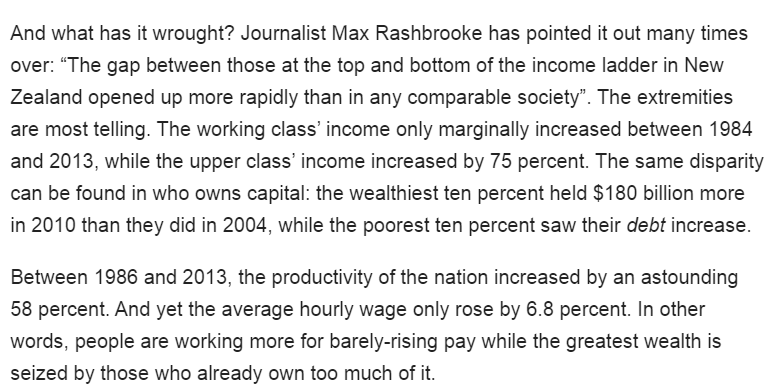
Source: Love in the time of crisis, James Robins, Wednesday, 16 March 2016, Newstalk NZ.
A brief history of inequality-from Treasury paper Fig4. Note Employment Contracts Act,GST,income tax,benefit cuts,WFF http://t.co/y4w3cUsgjD—
Bill Rosenberg (@WJRosenbergCTU) June 27, 2015
Inequality has not risen for at least 20 years as Bill Rosenberg tweeted. The rise in inequality in the late 1980s and early 1990s was followed by an employment boom that lasted to 2009.
Unemployment was as low as 3 1/2% for several years despite a large increase in labour force participation. Furthermore, the gender wage gap in New Zealand fell rapidly to now be the smallest in any industrialised country.
As the Facebook photos show, there has been strong income and wage growth despite the grizzling of the left. The return of income growth and wages growth after 20 years of real wage stagnation followed the economic reforms of the 1980s and the passage of the Employment Contracts Act in 1991.
As the CTU shows below, the economic reforms in the 1980s put an end to a sharp decline in the relative economic performance of the New Zealand economy.
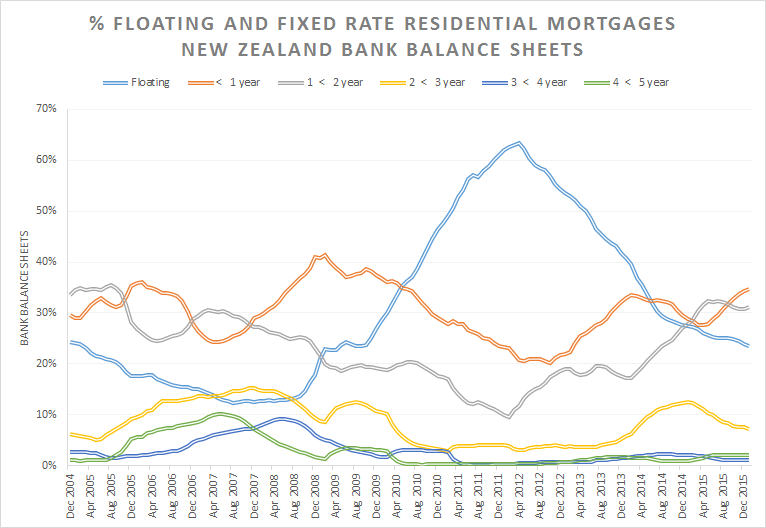
% of New Zealand mortgages that were fixed and floating since 2004
16 Mar 2016 Leave a comment
in economic history, economics of information, economics of regulation, monetary economics, politics - USA Tags: antimarket bias, libertarian paternalism, monetary policy, mortgage interest rates, New Zealand Labour Party, Other people are stupid fallacy, rational irrationality, The fatal conceit, The pretence to knowledge
Despite the best efforts of the libertarian paternalists to sell the other people are stupid fallacy, ordinary New Zealanders are quite nimble at moving between fixed and floating rates depending upon their forecasts of the future of interest rates. Price controls on floating rate mortgages, as suggested by the New Zealand Labour Party, would make this more difficult, not easier.
Source: S8 Banks: Mortgage lending ($m) – Reserve Bank of New Zealand.
Percentage of fixed and floating mortgages in New Zealand
16 Mar 2016 Leave a comment
in economics of regulation, industrial organisation, monetary economics, politics - New Zealand Tags: antimarket bias, mortgage interest rates, New Zealand Greens, New Zealand Labour Party, price controls, rational irrationality
I did not know so many people were on a fixed rate mortgage. Labour is risking its economic credibility on regulating the rates for a minority of mortgages.

Source: S8 Banks: Mortgage lending ($m) – Reserve Bank of New Zealand.
Capped mortgages cannot be linked to the current official cash rate of the Reserve Bank of New Zealand because they are based on expected future interest rates over an up to 5 year span, not current interest rates.
An important motivation for going onto a floating rate is you can repay faster. Fixed rate mortgages have penalties for early repayment.

Source: Price Controls: Price Floors and Ceilings, Illustrated.
In consequence, price controls linking floating rate mortgages to the official cash rate of the Reserve Bank would benefit better off mortgagees expecting to repay quickly. A typical policy of the modern Labour Party.
Note from @paulkrugman to @BernieSanders @JeremyCorbyn and their supporters
23 Feb 2016 Leave a comment
in applied price theory, comparative institutional analysis, constitutional political economy, economic history, economics of media and culture, economics of regulation, labour economics, macroeconomics, Marxist economics, politics - USA Tags: 2016 presidential election, antiforeign bias, antimarket bias, British politics, Leftover Left, make-work bias, rational ignorance, rational irrationality, renegade Left, Twitter left

@BernieSanders @realDonaldTrump have the same trade policies
20 Feb 2016 Leave a comment
in international economics, politics - USA Tags: antiforeign bias, antimarket bias, left-wing populism 2016 presidential election, rational irrationality, right-wing populism
@realdonaldtrump @BernieSanders are equally ignorant and unfit for office
09 Feb 2016 Leave a comment
in applied welfare economics, economic history, labour economics, macroeconomics, politics - USA Tags: 2016 presidential election, antiforeign bias, antimarket bias, Leftover cab left, pessimism bias, rational rationality, The Great Enrichment, Twitter left
@BernieSanders @HillaryClinton an average American works 11% less than in 1950, but earns 246% more
05 Nov 2015 Leave a comment
in economic history, politics - USA Tags: 2016 presidential elections, antimarket bias, good old days, Leftover Left, living standards, pessimism bias, rational ignorance, rational rationality, The Great Enrichment, Twitter left

Fair Trade: Does It Help Poor Workers?
01 Sep 2015 Leave a comment
in applied price theory, applied welfare economics, development economics, growth disasters, growth miracles, labour economics, poverty and inequality Tags: antimarket bias, expressive voting, fair trade, rational irrationality
The art of economic analysis
29 Aug 2015 Leave a comment
in applied price theory, applied welfare economics, Milton Friedman Tags: antiforeign bias, antimarket bias, economic fallacies, makework bias
@NZGreens @GreenpeaceNZ @PeakOil and peak #coal are in the past
25 Aug 2015 Leave a comment
in economic history, energy economics, environmental economics Tags: antimarket bias, devastate prophecies, entrepreneurial alertness, peak coal, peak oil, rational ignorance
The evolution of American energy consumption since 1776 businessinsider.com/evolution-of-a… http://t.co/APT8NQZfmg—
Elena Holodny (@elenaholodny) August 21, 2015
Why @NZGreens @nzlabour @GreenpeaceNZ hate applied welfare economics
21 Aug 2015 Leave a comment
in applied welfare economics, economics of regulation, energy economics, environmental economics, health economics, international economics, labour economics, law and economics, politics - New Zealand, Public Choice Tags: antiforeign bias, antimarket bias, expressive voting, Greenpeace, Leftover Left, make-work bias, methodology of economics, New Zealand Greens, New Zealand Labour Party, rational ignorance, rational irrationality
Quotation of the Day from French Economist Frederic Bastiat in the 1850s http://t.co/2ECWtb6m9u—
Mark J. Perry (@Mark_J_Perry) August 14, 2015
Best 2 Minimum Wage Cartoons
21 Aug 2015 Leave a comment
in labour economics, minimum wage, politics - Australia, politics - New Zealand, politics - USA Tags: antimarket bias, expressive voting, Leftover Left, offsetting behaviour, rational ignorance, rational irrationality, The fatal conceit, The pretense to knowledge, unintended consequences
Best 2 Minimum Wage Cartoons Ever, from Henry Payne, Updated for Seattle's $15 "Economic Death Wish" @HenryEPayne http://t.co/vatUzkHMss—
Mark J. Perry (@Mark_J_Perry) August 18, 2015
 Utopia, you are standing in it!
Recent Comments