

Celebrating humanity's flourishing through the spread of capitalism and the rule of law
09 Sep 2015 Leave a comment
in discrimination, economic history, gender, human capital, labour economics, labour supply, occupational choice Tags: asymmetric marriage premium, gender wage gap
31 Aug 2015 Leave a comment
in discrimination, economics of love and marriage, gender, labour economics, labour supply, politics - USA, poverty and inequality, welfare reform Tags: asymmetric marriage premium, child poverty, economics and fertility, engines of liberation, family poverty, marriage and divorce, marriage premium, single mothers, single parents
43.1% of single mothers are living in poverty this #MothersDay statusofwomendata.org http://t.co/OgWcmvLnDZ—
IWPR (@IWPResearch) May 10, 2015
16 Jul 2015 Leave a comment
in discrimination, gender, human capital, labour economics, labour supply, occupational choice Tags: asymmetric marriage premium, economics of families, gender wage gap, motherhood penalty
#Women's earnings drop 20% after 1st child & gap remains the same even 20 years later @LSEEcon bit.ly/1M60KfJ http://t.co/UpoqLkhbl2—
STICERD (@STICERD_LSE) July 15, 2015
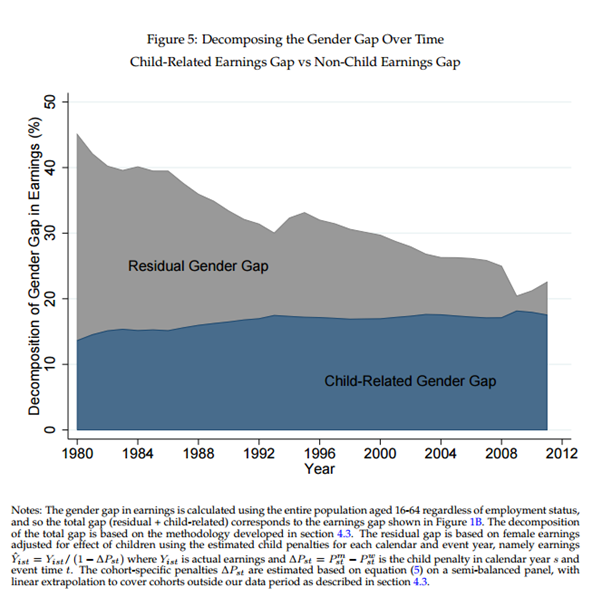
Source: Parenthood and the Gender Gap: Evidence from Denmark by Henrik Jacobsen Kleven, Camille Landais and Jakob Egholt Søgaard, University of Copenhagen January 2015 at http://eml.berkeley.edu/~webfac/auerbach/Landais2015.pdf
12 Jul 2015 Leave a comment
in discrimination, economics of love and marriage, gender, labour economics, labour supply, law and economics, occupational choice, politics - USA, poverty and inequality Tags: asymmetric marriage premium, British economy, Canada, gender wage gap, marriage and divorce, motherhood penalty
Figure 1: Female/male earnings ratio by partner status and motherhood, 2004 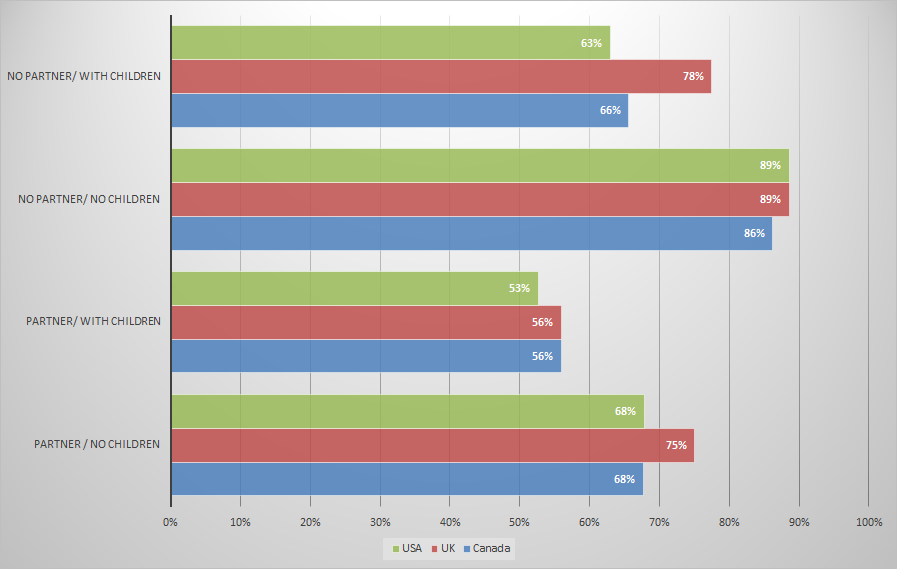 Source: LIS Cross-National Data Center in Luxembourg – Wave VI; individuals with positive earnings only. .
05 Jul 2015 Leave a comment
in economics of love and marriage, labour economics, labour supply, politics - USA, poverty and inequality Tags: asymmetric marriage premium, dual income couples, economics of families, reversing gender gap
13 Jun 2015 Leave a comment
in discrimination, gender, human capital, labour economics, labour supply, occupational choice, politics - Australia, politics - New Zealand, politics - USA, poverty and inequality Tags: asymmetric marriage premium, Australia, British economy, Canada, gender wage gap, Ireland, labour demographics, maternal labour supply
In another blow for the inherent inequality of bargaining power between workers and employers, and for the patriarchy, the wage gap is larger for tertiary educated female full-time workers aged 35-44 than it is for female full-time workers who just finished high school.
Figure 1: gender wage gap for mean full-time, full-year earnings for tertiary educated workers aged 35 – 44, 2012
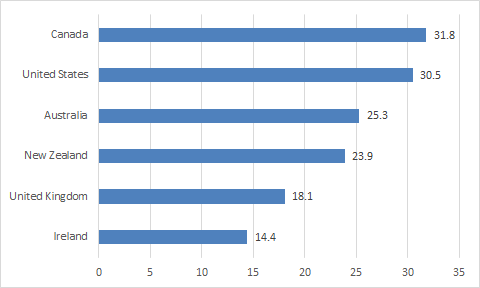
Source: OECD family database.
To add insult to injury, the gender wage gap further tertiary educated female workers is quite large in the USA but quite small for high school graduates.
Figure 2: gender wage gap for mean full-time, full-year earnings for below upper secondary educated workers aged 35 – 44, 2012
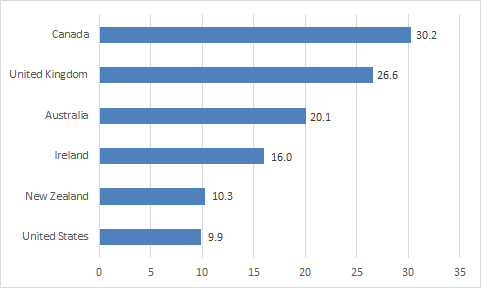
Source: OECD family database.
Canada seems to be a bit of a patriarchal hellhole while New Zealand does pretty well in gender wage gaps.
The gender gap in figure 1 and in figure 2 are unadjusted and calculated as the difference between mean average annual full-time, full-year earnings of men and of women as a percentage of men’s earnings.
08 Jun 2015 Leave a comment
in economics of love and marriage, law and economics, population economics Tags: assortative mating, asymmetric marriage premium
Spouses’ personalities affect employees’ work outcomes s.hbr.org/1HlhQVX http://t.co/P0rWgN8OEd—
Harvard Biz Review (@HarvardBiz) May 16, 2015
06 Jun 2015 Leave a comment
in discrimination, gender, human capital, labour economics, labour supply, occupational choice Tags: asymmetric marriage premium, gender pay gap, motherhood penalty
14 May 2015 1 Comment
in discrimination, economics of love and marriage, gender, human capital, labour economics, occupational choice, politics - USA Tags: asymmetric marriage premium, do gooders, economics of families, gender wage gap, maternity leave, Sweden, The fatal conceit, unintended consequences
The gender wage gap is no better than the OECD average, despite generous maternity and paternity leave. What gives?
America: one day a year celebrating mothers, fathers.
Sweden: 480 days paid leave per child. vox.com/2014/5/12/5708… http://t.co/weFDrTj7Jb—
Ezra Klein (@ezraklein) May 11, 2015
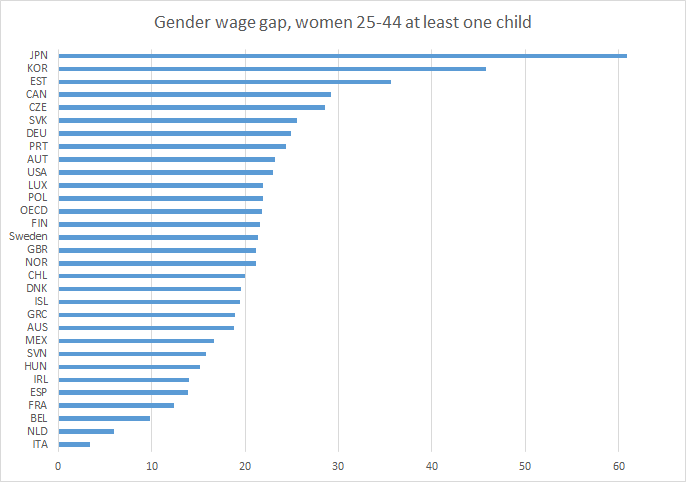
Source: Closing the gender gap: Act now – http://dx.doi.org/10.1787/9789264179370-en
How big is the wage gap in your country? bit.ly/18o8icV #IWD2015 http://t.co/XTdntCRfDQ—
(@OECD) March 08, 2015
One important question is whether government policies are effective in reducing the gap. One such policy is family leave legislation designed to subsidize parents to stay home with new-born or newly adopted children.
One of the RLE articles shows that for high earners in Sweden there is a large difference between the wages earned by men and women (the so-called “glass ceiling”), which is present even before the first child is born. It increases after having children, even more so if parental leave taking is spread out.
These findings suggest that the availability of very long parental leave in Sweden may be responsible for the glass ceiling because of lower levels of human capital investment among women and employers’ responses by placing relatively few women in fast-track career positions. Thus, while this policy makes holding a job easier and more family-friendly, it may not be as effective as some might think in eradicating the gender gap.
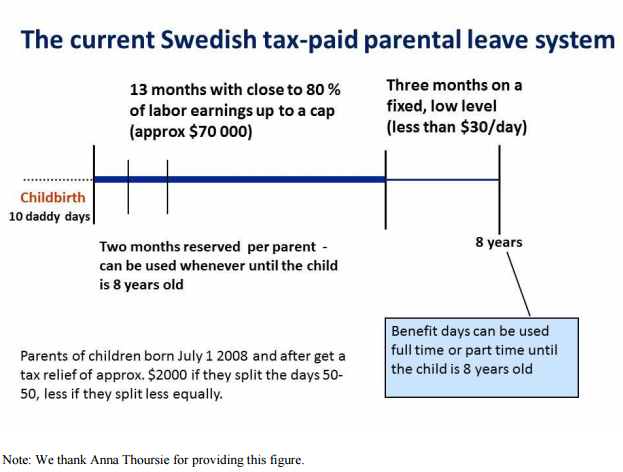
via New volume on gender convergence in the labour market | IZA Newsroom.
14 Apr 2015 Leave a comment
in discrimination, economics of love and marriage, gender, labour economics, law and economics, occupational choice Tags: asymmetric marriage premium, gender wage gap
19 Mar 2015 Leave a comment
in discrimination, gender, labour economics, labour supply, occupational choice Tags: asymmetric marriage premium, childcare, gender wage gap, household production


25 Feb 2015 Leave a comment
in discrimination, gender, human capital, labour economics, labour supply, occupational choice Tags: asymmetric marriage premium, gender wage gap
23 Dec 2014 Leave a comment

19 Nov 2014 Leave a comment
in discrimination, economics of love and marriage, gender, human capital, labour economics, labour supply, occupational choice Tags: asymmetric marriage premium, Claudia Goldin, gender wage gap, motherhood penalty, power couples


Women are increasingly putting their husband’s career before their own, a controversial new study of Harvard Business School graduates has found.
It canvassed over 25,000 male and female students, and found 40 percent of Gen X and boomer women said their spouses’ careers took priority over theirs.
The researchers also said only about 20 percent of them had planned on their careers taking a back seat when they graduated.
This gender gap found by Robin Ely, Colleen Ammerman and Pamela Stone can be better explained by the marriage market combined with assortative mating.
1. Harvard business graduates are likely to marry each other and form power couples.
2. There tends to be an age gap between men and women in long-term relationships and marriages of say two years.
This two year age gap means that the husband as two additional years of work experience and career advancement. This is highly likely to translate into higher pay and more immediate promotional prospects.
Maximising household income would imply that the member of the household with a higher income, and greater immediate promotional prospects stay in the workforce.
It is entirely possible that women to anticipate this situation both in their subject choices and career ambitions.
Claudia Goldin found that the wage gap between male and female Harvard graduates disappears in the presence of one confounding factor.
That confounding factor is obvious: the male in the relationship earns less. When this is so, Goldin found that the female in the relationship earns pretty much as do similar male Harvard graduates, except for the fact that they work less hours per week:
We identify three proximate factors that can explain the large and rising gender gap in earnings: a modest male advantage in training prior to MBA graduation combined with rising labour market returns to such training with post-MBA experience; gender differences in career interruptions combined with large earnings losses associated with any career interruption (of six or more months); and growing gender differences in weekly hours worked with years since MBA.
Differential changes by sex in labour market activity in the period surrounding a first birth play a key role in this process. The presence of children is associated with less accumulated job experience, more career interruptions, shorter work hours, and substantial earnings declines for female but not for male MBAs.
The one exception is that an adverse impact of children on employment and earnings is not found for female MBAs with lower-earning husbands.
This sociological evidence reported in the Daily Mail is entirely consistent with the choice hypothesis and equalising differentials as the explanation for the gender wage gap. As Solomon Polachek explains:
At least in the past, getting married and having children meant one thing for men and another thing for women. Because women typically bear the brunt of child-rearing, married men with children work more over their lives than married women.
This division of labour is exacerbated by the extent to which married women are, on average, younger and less educated than their husbands.
This pattern of earnings behaviour and human capital and career investment will persist until women start pairing off with men who are the same age or younger than them.
Celebrating humanity's flourishing through the spread of capitalism and the rule of law
Scholarly commentary on law, economics, and more
Beatrice Cherrier's blog
Celebrating humanity's flourishing through the spread of capitalism and the rule of law
Celebrating humanity's flourishing through the spread of capitalism and the rule of law
Celebrating humanity's flourishing through the spread of capitalism and the rule of law
Why Evolution is True is a blog written by Jerry Coyne, centered on evolution and biology but also dealing with diverse topics like politics, culture, and cats.
Celebrating humanity's flourishing through the spread of capitalism and the rule of law
Celebrating humanity's flourishing through the spread of capitalism and the rule of law
A rural perspective with a blue tint by Ele Ludemann
DPF's Kiwiblog - Fomenting Happy Mischief since 2003
Celebrating humanity's flourishing through the spread of capitalism and the rule of law
The world's most viewed site on global warming and climate change
Tim Harding's writings on rationality, informal logic and skepticism
A window into Doc Freiberger's library
Let's examine hard decisions!
Commentary on monetary policy in the spirit of R. G. Hawtrey
Thoughts on public policy and the media
Celebrating humanity's flourishing through the spread of capitalism and the rule of law
Politics and the economy
A blog (primarily) on Canadian and Commonwealth political history and institutions
Reading between the lines, and underneath the hype.
Economics, and such stuff as dreams are made on
"The British constitution has always been puzzling, and always will be." --Queen Elizabeth II
Celebrating humanity's flourishing through the spread of capitalism and the rule of law
Celebrating humanity's flourishing through the spread of capitalism and the rule of law
WORLD WAR II, MUSIC, HISTORY, HOLOCAUST
Undisciplined scholar, recovering academic
Celebrating humanity's flourishing through the spread of capitalism and the rule of law
Res ipsa loquitur - The thing itself speaks
Celebrating humanity's flourishing through the spread of capitalism and the rule of law
Researching the House of Commons, 1832-1868
Articles and research from the History of Parliament Trust
Reflections on books and art
Posts on the History of Law, Crime, and Justice
Celebrating humanity's flourishing through the spread of capitalism and the rule of law
Exploring the Monarchs of Europe
Cutting edge science you can dice with
Small Steps Toward A Much Better World
“We do not believe any group of men adequate enough or wise enough to operate without scrutiny or without criticism. We know that the only way to avoid error is to detect it, that the only way to detect it is to be free to inquire. We know that in secrecy error undetected will flourish and subvert”. - J Robert Oppenheimer.
The truth about the great wind power fraud - we're not here to debate the wind industry, we're here to destroy it.
Celebrating humanity's flourishing through the spread of capitalism and the rule of law
Celebrating humanity's flourishing through the spread of capitalism and the rule of law
Economics, public policy, monetary policy, financial regulation, with a New Zealand perspective
Celebrating humanity's flourishing through the spread of capitalism and the rule of law
Restraining Government in America and Around the World


 Utopia, you are standing in it!

Recent Comments