

Richard Posner on behavioural economics and its real-world applications
19 Nov 2014 Leave a comment
in applied price theory, behavioural economics, comparative institutional analysis, labour economics, occupational choice, Richard Posner Tags: behavioural economics, experimental economics, Richard Posner


Is Behavioral Economics Doomed? | Cheap Talk
04 Nov 2014 Leave a comment
in applied price theory, behavioural economics Tags: behavioural economics, David I. Levine

The real reason why behavioural economics is so popular among politicians and bureaucrats
03 Nov 2014 Leave a comment
in applied price theory, applied welfare economics, behavioural economics, Public Choice, rentseeking Tags: behavioural economics, do gooders, The fatal conceit, The pretence to knowledge
 \
\
HT: David-k-Levine
Private versus Public Nudging
03 Nov 2014 Leave a comment
in applied price theory, behavioural economics Tags: behavioural economics, Nudging

Here is Mark Pennington in his second post as our guest-blogger this week.
“Private versus Public Nudging” by Mark Pennington
Last week I attended a speech by Richard Thaler, of ‘Nudge’ fame.
Professor Thaler is an engaging speaker. His assertion that ‘libertarian paternalism’ is merely an extension of methods widely adopted in daily life is a beguilingly simple, yet ultimately dangerous one. According to Thaler since good mothers constantly attempt to ‘nudge’ their offspring in the ‘right direction’ then we should not worry about governmental nudging. Whether it is ‘fat taxes’ to discourage unhealthy eating induced by ‘weakness of will’ or compulsory enrolment in savings schemes to induce less ‘short-sighted’ and more thrifty conduct, people should learn to love a government that coaxes them towards what they themselves would recognise is in their own best interests.
The classical liberal tradition is not, and never has been suspicious of the idea…
View original post 981 more words
George Stigler’s (1963) critique of behavioural economics
09 Oct 2014 Leave a comment
in applied price theory, George Stigler Tags: behavioural economics, methodology of economics, philosophy of the social sciences

Cass Sunstein finally admits that regulators are people too, and like the rest of us, they are just as fallible
03 Oct 2014 Leave a comment


The rationality postulate is under attack from the other people are stupid fallacy-updated
14 Apr 2014 Leave a comment
in applied price theory, behavioural economics, economics of crime, entrepreneurship, experimental economics, industrial organisation, market efficiency, survivor principle Tags: behavioural economics, crime and punishment, criminal deterrence, experimental economics, Gordon Tullock, token economies, Vernon Smith
The rationality postulate is under attack from the other people are stupid fallacy: not you, not me, not present company, of course, but the nameless them over there; the perpetually baffled, every man jack of them.
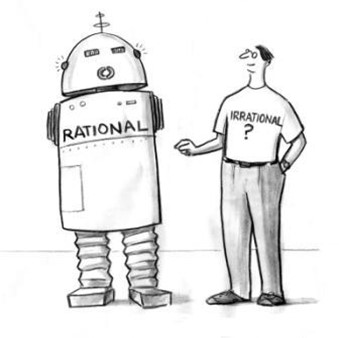
These no-hopers are deemed competent to vote and DRIVE CARS, but they cannot get their head around a credit card. How the them over there find their way to work every morning must be a mystery to behavioural economists. One summary of behavioural labour economics is this:
The key empirical findings from field research in behavioural economics imply that individuals can make systematic errors or be put off by complexity, that they procrastinate, and that they hold non-standard preferences and non-standard beliefs
I found the chapter in Tullock and McKenzie’s book on token economies in mental hospitals to be most enlightening.
The tokens were for spending money at the hospital canteen and trips to town and other privileges. They were earned by keeping you and your area clean and helping out with chores.
The first token economies were for chronic, treatment-resistant psychotic inpatients.
In 1977, a major study, still considered a landmark, successfully showed the superiority of a token economy compared to the standard treatments. Despite this success, token economies disappeared from the 1980s on.
Experiments which would now be unethical showed that the occupational choices and labour supply of certified lunatics responded to incentives in the normal, predictable way.
For example, tokens were withdrawn for helping clean halls and common areas. The changes in occupational choice and reductions in labour supply was immediate and as predicted by standard economics.
Some patients would steal the tokens for other patients, so the token individually marked, and the thefts almost stopped. Crime must pay even for criminally insane inpatients.
Kagel reported that:
The results have not varied with any identifiable trait or characteristic of the subjects of the token economy – age, IQ, educational level, length of hospitalization, or type of diagnosis.

Behavioural economics is an excellent example of how engaging in John S. Mill’s truth that engaging with people who are partly or totally wrong sharpens your arguments, improves their presentation and deepens your analysis.
People have a better understanding of rationality such as through the work of Vernon Smith on ecological and constructivist rationality and of how people deal with human frailties and correct error through specialisation, exchange and learning.
- George Stigler in his Existence of X-inefficiency paper opposed attributing behaviour to errors because error can explain everything so it explains nothing until we have a theory of error.
- Kirzner in “X–Inefficiency, Error and the Scope for Entrepreneurship” wrote that error is pervasive in economic processes. Rational Misesian human actors are human enough to err.
What is inefficient about the world, said Kirzner, is at each instant, an opportunity for improvements, in one way or another and is yet simply not yet noticed. The lure of pure entrepreneurial profits harnesses the systematic elimination of errors and points the way to the market generated institutions necessary for steady social improvements to emerge. Brand names are an obvious example of an institution to overcome doubts about product quality. Middle-men and brokers specialise in performing much of the calculation burdens in their markets.
Many still compare real-world marketplaces to idealised regulation overseen by bureaucrats free of the very biases they are nudging us along to overcome. There are real constraints that limit the options available to fix what are seen as problems to be solved.
Vernon Smith when asked about behavioural economics, wondered how so cognitively flawed a creature made it out of the caves. Vernon Smith argued that the answer had a lot to do with the institutions that emerged to overcome human limitations:
Markets are about recognizing that information is dispersed in all social systems and that the problem of society is to find, devise, and discover institutions that incentivize and enable people to make the right decisions without anyone having to tell them what to do.
Smith and Hayek both posit that market institutions rather than individuals bear the primary cognitive burden in coordinating economic activity. To quote Vernon Smith:
What we learn from experiments is that any group of people can walk into a room, be incentivized with a well-defined private economic environment, have the rules of the oral double auction explained to them for the first time, and they can make a market that usually converges to a competitive equilibrium, and is 100 per cent efficient—they maximize the gains from exchange—within two or three repetitions of a trading period.
Yet knowledge is dispersed, with no participant informed of market supply and demand, or even understanding what that means.
This strikingly demonstrates what Adam Smith called ”a certain propensity in human nature . . . to truck, barter, and exchange one thing for another”
These double oral auctions converged to the competitive price even with as few as three or four sellers with neither the buyers nor sellers knowing anything of the values or costs of others in the market. Price-taking behaviour was not necessary to reach these competitive outcomes.
Behavioural economics is a clumsy way of discussing the pervasiveness of errors because insufficient attention is paid to decentralised, emergent market processes that correct them, often long ago.
Whatever is, is efficient – part 1
27 Mar 2014 Leave a comment
in Armen Alchian, behavioural economics, industrial organisation, labour economics, market efficiency Tags: Armen Alchian, behavioural economics, rational behaviour, rational choice economics, Richard Posner
Armen Alchian would ask “If something is so optimal, why don’t we see it then?”
The best way Alchian related this discipline on thinking was to point to something like the question of optimal taxes. If optimal taxes are so optimal, why don’t we see more of these optimal taxes in practice?
There must be other costs left out of your optimal tax analysis. There might be less obvious costs in the political system in organising support or other changes that are required that are overlooked, making optimal taxes such a ‘low-cost’ option. Most objectives look better than they are if you ignore some of the costs of achieving those objectives.
Alchian asserted that “whatever is, is efficient.”
- If the status quo was not efficient, something else would eventuate;
- Of course, if you try to change anything that is – that too is efficient because otherwise you would not try to do so.
The key point is why are we weighing only some costs and not others? Why are these costs (involved in minimizing particular dead-weight losses that would be involved in setting a particular optimal tax) less important than other types of costs (those involved in informing people of what the options are or of organizing them to go and try to adopt the alternative option)? Optimal taxes are also decidedly less optimal if they allow governments to raise more revenue, and the extra revenue is not spent wisely.

Alchian’s analysis of institutions and processes spent a lot of time showing that many often puzzling institutions and practices arose to lower various costs of decision making and transacting in the market and within organisations and groups. Many of these costs are far from obvious and must be teased out through difficult, time-consuming analysis.
Alchian was a great teacher. He taught in the Socratic Method. He posed countless questions to force his students to think harder and deeper.
Behavioural economics is an example of a whole field that expanded not by thinking harder and deeper using standard economic tools. It explains anomalous behaviour and seemingly irrational choices as the result of cognitive quirks or short-sightedness and a range of people’s other shortcomings. That is easier than spending a few more decades getting to the bottom of the matter.
George Stigler in the 1960s made a marvellous critique of what became behavioural economics back in the early 1960s by saying that in every decade for the last 150 years, economists dabbled in psychology.
Stigler said that they missed the point of economics as a method. He argued that the simple hypothesis of rational behaviour is so powerful because it can account for so much of human behaviour. Stigler adds this in his Tanner Lectures in 1981:
Members of other social sciences often remark, in fact I must say complain, at the peculiar fascination that the logic of rational decision-making exerts upon economists.
It is such an interesting logic: it has answers to so many and varied questions, often answers that are simultaneously reasonable to economists and absurd to others. The paradoxes are not diminished by the delight with which economists present them…
The power of self-interest, and its almost unbelievable delicacy and subtlety in complex decision areas, has led economists to seek a large role for explicit or implicit prices in the solution of many social problems.
Richard Posner went further and argued that behavioural economics may not be a science in Popper’s sense of falsifiability.
Posner referred to Cardinal Bellarmine’s famous description of what he saw in Galileo’s telescope which was pointing to the moons rotating around Saturn. Cardinal Bellarmine explained it as a trick of the devil.
Behavioural economics, in Richard Posner’s view, is close to Cardinal Bellarmine’s trick of the devil methodology because it explains anomalies away either as cognitive quirks or as rational behaviour. Nothing is an anomaly for behavioural economics so nothing can falsify it. Instead of the devil making me do it, a cognitive quirk made me do it.
Posner’s key point was:
Rational-choice economics makes the analyst think hard. Faced with anomalous behaviour, the rational-choice economist, unlike the behavioural economist, doesn’t respond, “Of course, what do you expect?” Troubled, puzzled, challenged; he wracks his brains for some theoretical extension or modification that will accommodate the seeming anomaly to the assumption of rationality.
Rather than attribute odd behaviour to cognitive quirks or short-sightedness, the better explanation is the behaviour is not fully understood.
 Utopia, you are standing in it!
Recent Comments