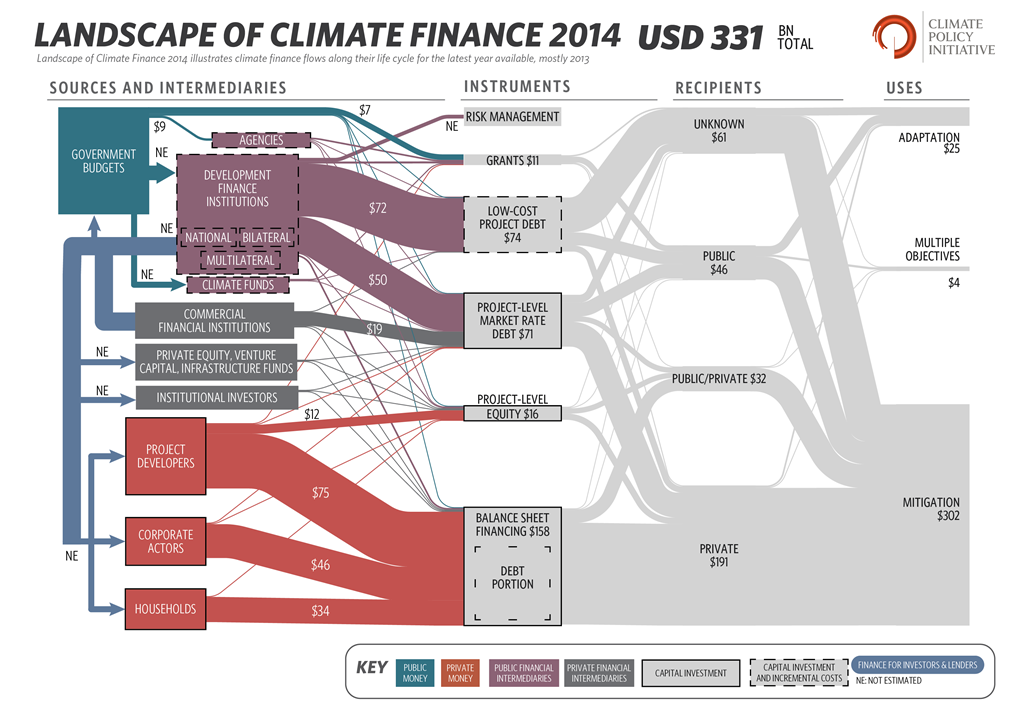
In 2013, annual global climate finance flows totalled approximately USD 331 billion, falling USD 28 billion below 2012 levels.
Public actors and intermediaries contributed USD 137 billion (USD 134-140 billion) largely unchanged from last year. Private investment totalled USD 193 billion, falling by USD 31 billion or 14% from 2012, see Figure ES1. The actual decrease in total flows may be even larger as, for the first time, Landscape 2014 captures public finance flowing to large hydro and research and development (USD 4 billion and USD 3 billion respectively).
Climate finance flows were split almost equally between developed (OECD) and developing (non-OECD) countries, USD 164 billion and USD 165 billion respectively. The amount we tracked flowing from developed to developing countries fell by USD 8 billion from 2012, to USD 34 billion, with multilateral DFI contributions falling by USD 5 billion and private investment contracting by USD 2 billion.
Almost three-quarters of total flows were invested in their country of origin. Private actors had an especially strong domestic investment focus with USD 174 billion or 90% of their investments remaining in the country of origin. This demonstrates that investment environments that are more familiar and perceived to be less risky are key to investment decisions, highlighting the importance of domestic policy frameworks in unlocking scaled up climate finance flows.
Follow the money – The Global Landscape of Climate Finance 2014 CPI Report Climate Policy Initiative
09 Mar 2015 Leave a comment
in environmental economics, global warming, Public Choice, rentseeking Tags: bootleggers and baptists, climate alarmism, global warming, green rent seeking
The role of regulation in raising rivals’ costs
02 Mar 2015 Leave a comment
in economics of regulation, Public Choice, rentseeking Tags: bootleggers and baptists, demand and supply for regulation, interest group politics, raising rivals costs
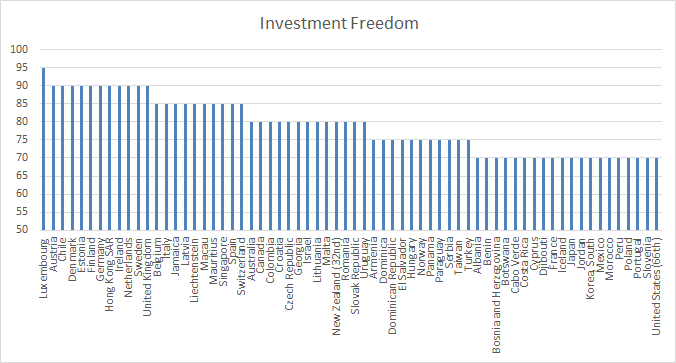
Why is NZ so hostile to foreign investment, 32nd in the Index of Economic Freedom 2015? USA is 66th!
02 Feb 2015 Leave a comment
in applied price theory, applied welfare economics, economics of media and culture, economics of regulation, international economics, politics - New Zealand Tags: bootleggers and baptists, foreign direct investment, foreign investment, free trade, Index of Economic Freedom
Source: 2015 Index of Economic Freedom
According to the Index of Economic Freedom 2015, in New Zealand
Foreign investment is welcomed, but the government may screen some large investments.
There was a major review of New Zealand foreign investment regulations about 10 years ago. The purpose of that review commissioned by the Labour government’s Minister of Finance, Dr Michael Cullen, was to deregulate the regulation of foreign investment in New Zealand.
At the time,under the Overseas Investment Act, the Minister of Finance could refuse permission to any investment. Australia’s current overseas investment regulations are the same. The federal treasurer may reject foreign investment proposals on the basis of an open-ended definition of national interest.
The last time that foreign investors had been refused permission to invest in New Zealand was in the early 1980s under then National Party Government Prime Minister Robert Muldoon. In a fit of pique, he refused permission to an Australian investor.
The revised foreign investment regulations limits the ability of government to reject foreign investors to narrow criteria such as the acquisition of sensitive land and large New Zealand companies. As part of this theme that foreign acquisitions of land was the main policy concern regarding foreign investment, the administration of the foreign investment regulations was moved out of a Overseas Investment Commission housed at the Reserve Bank of New Zealand to the very low key Land Information Office:
The Overseas Investment Office (OIO) assesses applications from overseas investors seeking to invest in sensitive New Zealand assets – being ‘sensitive’ land, high value businesses (worth more than $100 million) and fishing quota.
Naturally, subsequent to this genuine attempt by the Labour government of 10 years ago to deregulate foreign investment regulation, a number of investments have been refused since then often on the pretext that some part of the investment acquired sensitive coastal land door or rural land. The criteria for regulating foreign investment is as follows:
As regards the criteria relating to the relevant “overseas person”, the OIO needs to be satisfied that:
- the “overseas person” has demonstrated financial commitment to the investment; and
- the “overseas person” or (if that person is not an individual) the individuals with ownership and control of the overseas person (such as the shareholders and directors of the overseas purchaser):
- have the business experience and acumen relevant to that investment;
- are of good character; and
- are not prohibited from entering New Zealand by reason of sections 15 or 16 of the Immigration Act 2009 (e.g. persons who have been imprisoned for certain periods of time).
As regards the criteria relating to the particular investment, the OIO needs to be satisfied that the overseas investment will, or is likely to, benefit New Zealand (or any part of it or group of New Zealanders). When considering this, the OIO has a range of factors that it must consider (including, for example, whether the investment will create new job opportunities, introduce new technology or business skills, advance a significant Government policy or strategy, or bring other consequential benefits to New Zealand).
The New Zealand Initiative recently reviewed this criteria for regulating overseas investment into New Zealand and found that:
the report finds that the criteria for approval do not test the economic benefit to New Zealanders, where sensitive land is sold to an overseas person not intending to live in New Zealand indefinitely.
Indeed, the criteria are unambiguously hostile, even excluding the gain to a New Zealand vendor. This opens the way for the imposition of approval conditions that could impose net costs on New Zealanders given the regime’s potentially adverse effects on land values
The regulation of foreign investment in other countries is much more specific about what it is trying to achieve,as New Zealand Initiative also noted in its recent review:
New Zealand’s comprehensive screening regime accounts for our poor international ranking in the OECD’s FDI Regulatory Restrictiveness Index.
Most other countries focus their regimes more narrowly on national security considerations, often relating to particularly sensitive industries or sectors.
The main reason the public supports foreign investment regulation is because the public doesn’t like foreigners, and politicians pander to that xenophobia. If foreign investment is reduced, more of total investment spending has to be funded from domestic saving.

Access to foreign savings – trade in savings – allows investment to be made sooner, consumption to be smoothed over hiatuses such as recessions, and consumption to be bought forward in the light of better times such higher output and higher future incomes as because of foreign investment.The

The large national gains from foreign capital inflows is not part of that debate. A recent review of the gains from foreign capital inflows to New Zealanders found access to foreign saving led to national income per head, net of the servicing cost of foreign capital:
- average income gains of $2,600 per worker arising on a cumulative basis from capital inflow over the period 1996 – 2006; and
- growth in the value of New Zealand’s assets has greatly exceeded the rise in external liabilities to the extent that national wealth per head has risen by $14,000 in 2007 prices between 1996 and 2006.
You can’t let facts bugger a good story.
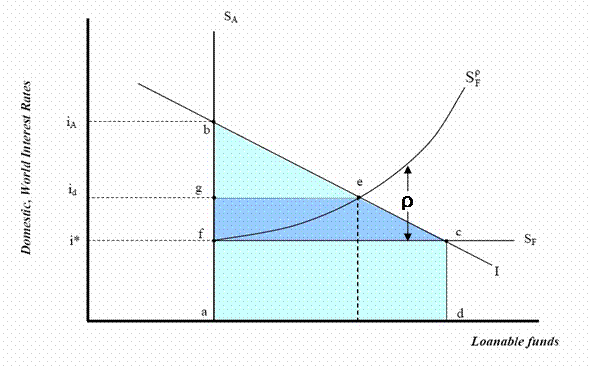
The foreign investment is in response to the high returns in the local market and the inflow of foreign capital will continue until local rates of return match those in other countries. Equalisation of risk-adjusted rate of returns is central to the operation of capital markets.
Stopping this process of equalisation of returns on capital through regulation only benefits the capitalists inside the country because the curbing of foreign investment stops rates of return falling to those overseas. Foreign investment regulation reduces the wages of New Zealand workers because they have less capital and fewer modern technologies to work with.
Fortunately, local capitalists can work in league with economic populists on the left and the right and the anti-foreign bias of the voting public to make it more difficult for foreign investors to come to New Zealand and drive down the profits of New Zealand capitalists. Who gains from that? As Paul Krugman said:
The conflict among nations that so many policy intellectuals imagine prevails is an illusion; but it is an illusion that can destroy the reality of mutual gains from trade.
Milton Friedman on the drug war and who wins from it
06 Jan 2015 Leave a comment
in applied price theory, applied welfare economics, economics of regulation, liberalism, Milton Friedman Tags: bootleggers and baptists, drug legalisation, marijuana legalisation, Milton Friedman, war on drugs
Managerial Econ: Make the rules or your rivals will: use anti-growth activists to erect entry barriers
08 Sep 2014 Leave a comment
in comparative institutional analysis, constitutional political economy, economics of regulation, environmental economics, Public Choice, rentseeking Tags: bootleggers and baptists, rent seeking
The courts have sanctioned the right to organize community opposition that urges government officials and agencies to deny land use permits to applicants, even when the underlying motive of the opposition is protecting market share and eliminating competition.
What’s more, the courts are protecting third-party funding sources, in many cases anonymous funding sources, which support the opposition efforts in order to block potential competition.
Bootleggers and Baptists alert: Mexican cannabis output falls in wake of legalisation
19 Aug 2014 Leave a comment
in applied price theory, comparative institutional analysis, development economics, economics of regulation Tags: black markets, bootleggers and baptists, decriminalisation of marijuana
Farmers in the storied “Golden Triangle” region of Mexico’s Sinaloa state, which has produced the country’s most notorious gangsters and biggest marijuana harvests, say they are no longer planting the crop.
Its wholesale price has collapsed in the past five years, from $100 per kilogram to less than $25.
“It’s not worth it anymore,” said Rodrigo Silla, 50, a lifelong cannabis farmer who said he couldn’t remember the last time his family and others in their tiny hamlet gave up growing mota. “I wish the Americans would stop with this legalization.”

What is a useful idiot?
06 Aug 2014 Leave a comment
in environmentalism, liberalism, political change, politics, war and peace Tags: bootleggers and baptists, environmentalists, Leftover Left, New Left, Old Left, political manipulation, propaganda, useful idiots
Useful idiot is a term for people perceived as propagandists, initially Lenin, for a cause whose goals they are not fully aware of, and who are used cynically by the leaders of the cause.
Many confused and misguided sympathisers will unwittingly support a malignant cause which they naïvely believe to be a force for good.
The poor carbon footprint of wind and solar
01 Aug 2014 Leave a comment
in economics of climate change, energy economics, environmental economics, environmentalism, global warming Tags: bootleggers and baptists, global warming, green rent seeking, solar power, wind power

Paul Joskow pointed out that these costs do not take account of the costs of intermittency: wind power is not generated on a calm day, nor solar power at night. Conventional power plants must be kept on standby. Electricity demand also varies during the day in ways that the supply from wind and solar generation may not match.
HT: The Economist via Sinclair Davidson
The best discussions on green interest group coalitions
26 Jul 2014 Leave a comment
in economics of regulation, environmental economics, global warming, Public Choice, rentseeking Tags: bootleggers and baptists, Bruce Yandle, environmental interest groups, global warming, green rent seeking, Todd Zywicki
Bootleggers, Baptists, and the Global Warming Battle By Bruce Yandle and Stuart Buck:
The theory’s name is meant to evoke 19th century laws banning alcohol sales.
- Baptists supported Sunday closing laws for moral and religious reasons, while bootleggers were eager to stifle their legal competition.
- Politicians were able to pose as acting in the interests of public morality, even while taking contributions from bootleggers.
Yandle and Buck argue that during the battle over the Kyoto Protocol, he “Baptist” environmental groups provided moral support while “bootlegger” corporations and nations worked in the background to seek economic advantages over their rivals.

BAPTISTS? THE POLITICAL ECONOMY OF POLITICAL ENVIRONMENTAL INTEREST GROUPS By Todd J. Zywicki who specifies three testable implications of a public interest model of the activities of environmental interest groups:
(1) a desire to base policy on the best-available science;
(2) a willingness to engage in deliberation and compromise to balance environmental protection against other compelling social and economic interests; and,
(3) a willingness to consider alternative regulatory strategies that can deliver environmental protection at lower-cost than traditional command-and-control regulation.
Zywicki concludes that It has been argued that environmental regulation can be best understood as the product of an unlikely alliance of “Baptists and Bootleggers” – public-interested environmental activist groups and private-interested firms and industries seeking to use regulation for competitive advantage.
Warren Buffett: I Build Wind Turbines To Lower My Taxes
22 May 2014 Leave a comment
in entrepreneurship, environmental economics, taxation Tags: bootleggers and baptists, rentseeking, wind power
“I will do anything that is basically covered by the law to reduce Berkshire’s tax rate,” Buffett told an audience in Omaha, Nebraska this weekend. “For example, on wind energy, we get a tax credit if we build a lot of wind farms. That’s the only reason to build them. They don’t make sense without the tax credit.”

Buffett has invested billions into wind power to get federal subsidies.
via Warren Buffett: I Build Wind Turbines To Lower My Taxes | The Daily Caller.
Who gains from anti-imperialism and opposition to foreign investment?
21 May 2014 Leave a comment
in applied price theory, David Friedman, development economics, Public Choice Tags: bootleggers and baptists, expressive voting, foreign investment, imperialism, marxist fallacies
Much more commonly, [economic imperialism] is used by Marxists to describe–and attack–foreign investment in “developing” (i.e., poor) nations.
The implication of the term is that such investment is only a subtler equivalent of military imperialism–a way by which capitalists in rich and powerful countries control and exploit the inhabitants of poor and weak countries.
There is one interesting feature of such “economic imperialism” that seems to have escaped the notice of most of those who use the term.
Developing countries are generally labour rich and capital poor; developed countries are, relatively, capital rich and labour poor. One result is that in developing countries, the return on labour is low and the return on capital is high–wages are low and profits high. That is why they are attractive to foreign investors.
To the extent that foreign investment occurs, it raises the amount of capital in the country, driving wages up and profits down.
The effect is exactly analogous to the effect of free migration. If people move from labour-rich countries to labour-poor ones, they drive wages down and rents and profits up in the countries they go to, while having the opposite effect in the countries they come from.
If capital moves from capital-rich countries to capital-poor ones, it drives profits down and wages up in the countries it goes to and has the opposite effect in the countries it comes from.
The people who attack “economic imperialism” generally regard themselves as champions of the poor and oppressed.
To the extent that they succeed in preventing foreign investment in poor countries, they are benefiting the capitalists of those countries by holding up profits and injuring the workers by holding down wages.
It would be interesting to know how much of the clamour against foreign investment in such countries is due to Marxist ideologues who do not understand this and how much is financed by local capitalists who do.
David D. Friedman

Opposition to immigration might protect the wages of local workers. Opposition to foreign investment might increase the profits of local capitalists.
How does more competition help the local capitalists? The foreign investment is in response to the high returns in the local market and that inflow of foreign capital will continue until local rates of return match those in other countries.
Equalisation of risk-adjusted rate of returns is central to the operation of capital markets.
Stopping this process of equalisation through regulation only benefits the capitalists inside the country. It reduces the wages of workers because they have less capital and fewer modern technologies to work with.


Recent Comments