Prince Albert spent his early life in the shadow of his elder brother, Prince Edward, the heir apparent. Albert attended naval college as a teenager and served in the Royal Navy and Royal Air Force during the First World War. In 1920, he was made Duke of York. He married Lady Elizabeth Bowes-Lyon in 1923. […]
February 6, Death of King George VI of the United Kingdom of Great Britain and Ireland. Part II.
February 6, Death of King George VI of the United Kingdom of Great Britain and Ireland. Part II.
08 Feb 2024 Leave a comment
in comparative institutional analysis, constitutional political economy, economic history Tags: British constitutional law, British history
Some Thoughts On The Dissolution And Calling Of Parliament Bill
30 Jan 2024 Leave a comment
in constitutional political economy, law and economics Tags: British constitutional law
The House of Lords is now considering the Dissolution and Calling of Parliament Bill that was passed by the Commons back in September. It would repeal the Fixed-term Parliaments Act 2011 and restore the pre-2011 status quo whereby the Sovereign dissolved Parliament at the request of the Prime Minister. Regular readers of my blog will […]
Some Thoughts On The Dissolution And Calling Of Parliament Bill
Counsellors Of State In The Age Of Remote Work
03 Dec 2023 Leave a comment
in comparative institutional analysis, constitutional political economy, law and economics Tags: British constitutional law
There’s an interesting detail tucked away near the end of the Letters Patent signifying Royal Assent to the Patient Safety Commissioner for Scotland Bill. The final clause reads “WITNESS Ourself at Kenya on the second day of November in the second year of Our Reign,” meaning the King signed the document while on a state […]
Counsellors Of State In The Age Of Remote Work
How to expel an MP from Parliament: The ejection of John Wilkes in 1764
15 Jan 2023 Leave a comment
in constitutional political economy, economic history, Public Choice Tags: British constitutional law, British history, constitutional law

John Wilkes is one of the more scandalous figures in the 18th-century. His publication of North Briton Number 45, and Essay on Woman, had both the Commons and the Lords denounce him. Parliament began to build a case against Wilkes. Dr Robin Eagles, editor of our House of Lords 1715-1790 project, reflects on how Parliament […]
How to expel an MP from Parliament: The ejection of John Wilkes in 1764
#OTD 1979 The Night The Government Fell
29 Mar 2018 Leave a comment
in Public Choice Tags: British constitutional law, British history, British politics

The life and reign of English kings and queens visualised
14 Apr 2015 Leave a comment
in economic history Tags: British constitutional law
The life and reign of English kings and queens visualised gu.com/p/435fz/stw via @GuardianData @grbarnett http://t.co/f5twjrKntG—
Guardian Visuals (@GraphicGuardian) November 07, 2014
Priests could first stand for the House of Commons in 2001
01 Mar 2015 Leave a comment
in constitutional political economy, law and economics, Public Choice Tags: British constitutional law, Catholic Emancipation, equality before the wall, House of Commons, religious discrimination
The House of Commons (Removal of Clergy Disqualification) Act 2001 removed the disqualifications for clergy in standing for election and sit in the House of Commons. Through the interaction of different anti-Catholic legislation in the 18th and 19th century, Roman Catholic priests were still barred from sitting in the House of Commons until 2001. This included ex-priests.
The issue first came to a head when Bruce Kent came third in a seat in the 1997 election. The bill was drafted, but lapsed until the Labour Party endorsed an ex-priest for a safe seat. Without legislative action, he would not have been able to take his place in the House of Commons.
James MacManaway was the first priest to win a House of Commons seat in 150 years when he won a Belfast seat in 1950. The advice of the Attorney-General prior to his standing was there was no bar from standing because the Church of Ireland had been disestablished in 1869.
When he moved to take his seat, a select committee looked into the matter and then referred it to the Judicial Committee of the Privy Council.
The Judicial Committee of the Privy Council held that the Irish Church Act 1869 did disestablish the Church of Ireland, but since there was no express provision in that Act permitting its clergymen to sit as MPs, the House of Commons (Clergy Disqualification) Act 1801 still debarred any person
ordained to the office of priest or deacon’ from sitting or voting in the House of Commons. Roman Catholic Relief Act 1829 specifically barred ‘person[s] in holy orders in the Church of Rome.
Although MacManaway was disqualified from its seat after sitting for 238 days, and he did not stand for the by-election, no legislative action was taken to correct this blot on British democracy.
Parliament passed up the opportunity to remedy the matter when passing the House of Commons (Disqualification) Act 1975. This Act disqualifies a large number of public office holders from sitting in the House of Commons.
Likewise, when the Lord Chancellor (Tenure of Office and Discharge of Ecclesiastical Functions) Act 1974 was passed, the issue of Catholic priests in the House of Commons was left to one side. This Act may provision for the exercise of Church of England ecclesiastical functions during any tenure of the office of Lord Chancellor, of horror of horrors, by Roman Catholics. The Lord Chancellor makes many appointments within the Church of England.
The Clergy Disqualification Act 1870 provided a procedure which enabled Church of England clergy to relinquish their clerical positions and, after a period of six months, be freed from the parliamentary disqualification. There is no equivalent statutory procedure for clergy of other churches.

And here ends my constitutional curio of the day.
Is it treason to advocate for a republic?
16 Feb 2015 Leave a comment
in constitutional political economy, law and economics Tags: British constitutional law, British justice, British politics, republicanism, treason
Under the Treason Felony Act (1848), it is treason felony to “compass, imagine, invent, devise, or intend”:
- to deprive the Queen of her crown,
- to levy war against the Queen, or
- to “move or stir” any foreigner to invade the United Kingdom or any other country belonging to the Queen.
The act was passed in 1848, a year of revolutionary fervour across Europe. Its express purpose was to punish those who called for the establishment of a republic in Britain.
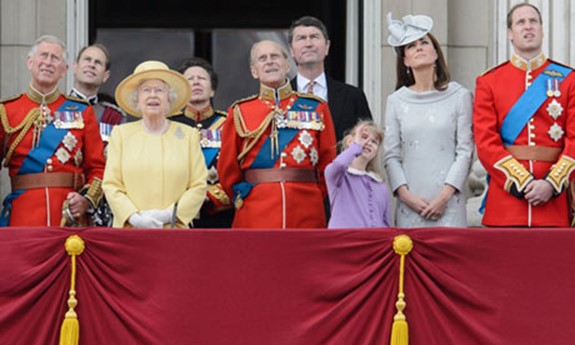
The act makes it a criminal offence, punishable by life imprisonment, to advocate abolition of the monarchy even by peaceful means. In 2013, the Ministry of Justice said:
Section 3 of the Treason Felony Act 1848 has not been repealed.
The last reported prosecution under the Act in the United Kingdom was in 1883, although the Act was used in Australia in 1916 to prosecute the “Sydney Twelve“.
In 2001, the Guardian initiated a legal challenge against the antique statute on the grounds that it prevented freedom of expression as guaranteed by the Human Rights Act 1998.
The law lords dismissed the newspaper’s case on the grounds that it was unnecessary. Lord Steyn explained:
“The part of section 3 of the 1848 Act which appears to criminalise the advocacy of republicanism is a relic of a bygone age, and does not fit into the fabric of our modern legal system. The idea that s3 could survive scrutiny under the Human Rights Act is unreal.” But, he added, courts should not be used as “an instrument … [to] chivvy parliament into spring-cleaning the statute book”.
The Guardian then noted that 327 other obscure offences had been subsequently spring cleaned from the British statute books including being an incorrigible rogue under the Vagrancy Act of 1824.
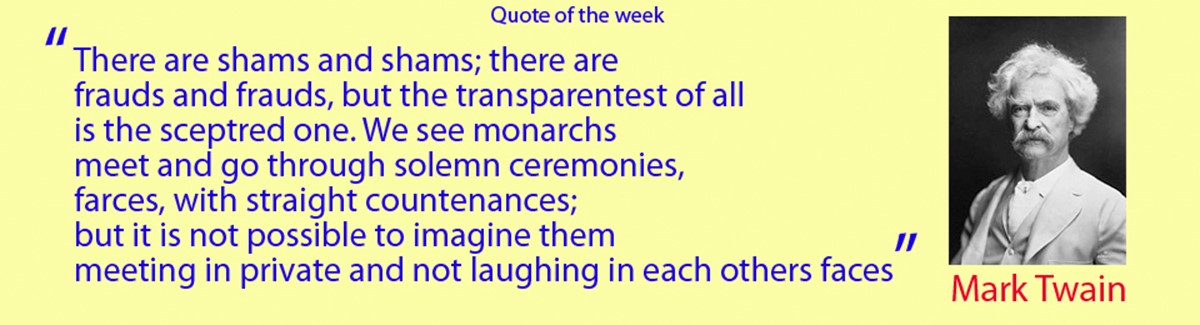
Her Majesty’s Attorney General for England and Wales made no submission on his prosecution policy to the House of Lords when the legal challenge was heard. But the Law Lords said if he had:
It could only have been to accept that, at least since October 2 2000 when the Human Rights Act 1998 came into force, no one who advocates the abolition of the monarchy by peaceful and constitutional means has been at any risk of prosecution (other than a private prosecution) or of conviction.
Lord Hutton said:
It is not the function of the courts to decide hypothetical questions which do not impact on the parties before them,
Lord Scott of Foscote said:
No one who advocates the peaceful abolition of the monarchy and its replacement by a republican form of government is at any risk of prosecution. No attorney general or director of public prosecutions would or could authorise a prosecution for such advocacy without becoming a laughing stock. To do so would be an unlawful act under s6 (1) of the 1998 Act.
Lord Walker of Gestingthorpe said:
It is most undesirable that obsolete statutes should remain unrepealed. Quaint language and interesting historical associations are no justification for preserving obsolete statutes in a mummified state. But … it is still the role of the legislature, rather than that of the courts, to decide whether to repeal or retain legislation.
Lord Styen also said
…counsel for the Attorney General accepted that the 1848 Act must be construed as an always speaking statute in a modern democracy. In this context it may well be that the strong operative words “deprive or depose” import the idea of changing our form of government by unlawful force. If this interpretation is correct, the reason for the present litigation collapses at the threshold.
His Lordship added that the passage of the Human Rights Act in 1998 had significant relevance to the interpretation of prior legislation:
Freedom of political speech is a core value of our legal system. Without it the rule of law cannot be maintained. Whatever may have been the position before the Human Rights Act came into operation, it is difficult to think of any rational argument justifying the criminalisation of the conduct of citizens who wish to argue for a different form of government… The idea that section 3 could survive scrutiny under the Human Rights Act is unreal. The fears of the editor of The Guardian were more than a trifle alarmist. In my view the courts ought not to be troubled further with this unnecessary litigation.
The only risk under the Treason Felony Act 1848 is a rogue prosecution. The director of public prosecutions would take over such a prosecution immediately and offer no evidence. He has an absolute right to take over private prosecutions. As Lord Rogers said:
Nor is the threat of a rogue private prosecution any more substantial, since the reality is that, having regard to the public interest, the Director of Public Prosecutions would take it over and discontinue it or the Attorney-General would enter a nolle prosequi.


 Utopia, you are standing in it!
Recent Comments