One in five support a military coup to stop Boris Johnson becoming prime minister
16 Nov 2015 Leave a comment
in constitutional political economy, Public Choice Tags: British politics, expressive voting, military coups, rational ignorance, rational rationality, voter demographics
#GeorgeOrwell on @jeremycorbyn #pacifism and #Paris
14 Nov 2015 Leave a comment
in defence economics, politics - Australia, politics - New Zealand, politics - USA, war and peace Tags: British politics, France, game theory, George Orwell, pacifism, Paris, war on terror

Who spends more than half their income on housing in the UK?
12 Nov 2015 Leave a comment
in population economics, urban economics Tags: British economy, British politics, housing affordability
@jeremycorbyn @BernieSanders oppose the one path to peace
04 Nov 2015 Leave a comment
in international economics, liberalism, politics - USA, war and peace Tags: British politics, capitalism and freedom, China, expressive voting, free trade, game theory, populists, rational ignorance, rational irrationality, Richard Cobden, World War I

Jeremy Corbyn is in trouble again, this time for describing World War I as pointless.
Corbyn has, for all his life, opposed the only means of securing peace either in Europe or anywhere else. He is against trade agreements, the European Union and NATO. Bernie Sanders is equally as misguided.
Corbyn and Sanders thinks you can make peace just by talking with people. Peace is made by trading with hostile countries to make them depend on you for their prosperity as well as yours. By growing rich through free trade, it’s in no ones interest to go to war or have poor relations with each other or each other’s friends.
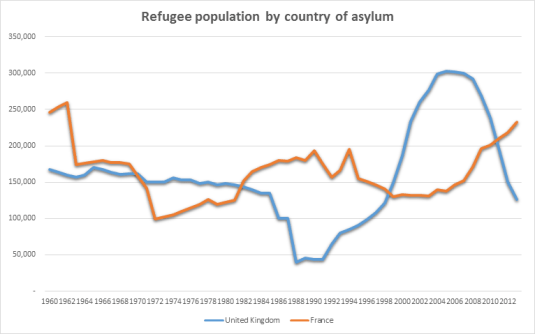
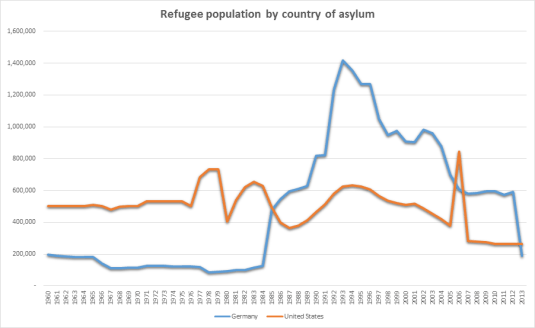
Refugee populations by country of asylum – UK, USA, France and Germany since 1960
03 Nov 2015 Leave a comment
in International law Tags: British politics, economics of migration, refugees

I had to use two charts because Germany hosted so many refugees after in the early 1990s that it made the reading the remaining data not possible because of the scale of the axis.
 UNHCR – UNHCR Statistical Online Population Database.
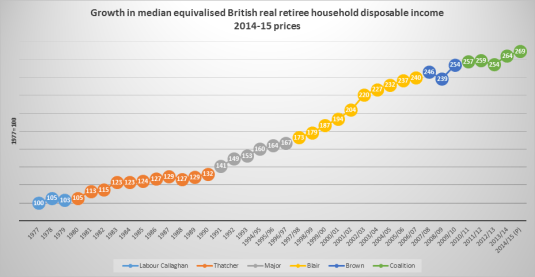
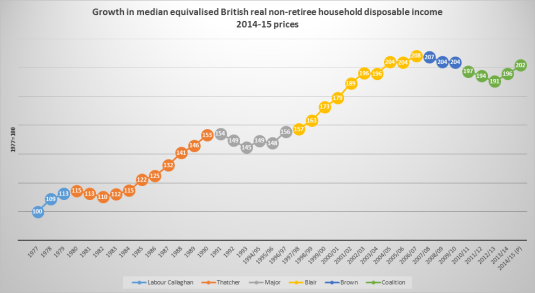
Did the British disease pass retirees by? British retiree and non-retiree median real household income by Prime Minister since 1977
03 Nov 2015 Leave a comment
in applied welfare economics, economic growth, economic history, macroeconomics, poverty and inequality Tags: British economy, British politics, Margaret Thatcher, Tony Blair
The British disease and the horrors of Thatchernomics past British retirees by as did pretty much the Global Financial Crisis. Slow and steady as she goes under every Prime Minister since 1977 has been year in year out result for the real disposable median incomes of British retired households. Despite it all, British retiree household incomes increased by 170% since the winter of discontent. The fastest growth in retiree incomes was under Tony Blair.
Source: Release Edition Reference Tables – ONS.
Notes:
1 Households are ranked by their equivalised disposable incomes, using the modified-OECD scale.
2 1994/95 represents the financial year ending 1995, and similarly through to 2014/15, which represents the financial year ending 2015.
3 Income figures have been deflated to 2014/15 prices using an implied deflator for the household sector.
It has been a much rockier ride for British households yet to retire. Once again, the only time a sustained real income increases for non-retired households was under Thatcher and Blair. Despite it all, household real incomes have doubled since the winter of discontent. The majority of that doubling was under the dead hand of Tony Blair. British Labour now spends a considerable amount of time repudiating that time of unusually rapid household income growth across all of British society.
Source: Release Edition Reference Tables – ONS.
Notes:
1 Households are ranked by their equivalised disposable incomes, using the modified-OECD scale.
2 1994/95 represents the financial year ending 1995, and similarly through to 2014/15, which represents the financial year ending 2015.
3 Income figures have been deflated to 2014/15 prices using an implied deflator for the household sector.
Cuts in spending less costly than tax increases @jeremycorbyn @johnmcdonnellMP
01 Nov 2015 Leave a comment
Last British Gitmo prisoner released
30 Oct 2015 Leave a comment
in International law, war and peace Tags: British politics, war on terror
Why this Bozo wanted to be put on trial is beyond me.

The usual sentence for a terrorist offence in a US court is life without parole. He had a much better deal being detained until either the end of hostilities or until the combatant status review tribunal determined he was no longer likely to rejoin the fight. The combatant status review tribunals have made a number of errors and up to 100 Gitmo detainees have rejoined their battle to destroy Western civilisation.
If he had been put on trial and convicted, that meant the rest of his life in prison in maximum-security. If found not guilty, he would have remained in Gitmo until the end of hostilities or until a combatant status review tribunal released him early.
@SeumasMilne could @jeremycorbyn win?
23 Oct 2015 Leave a comment
in constitutional political economy, Joseph Schumpeter, Public Choice Tags: British Labour Party, British politics, expressive voting, Leftover Left, rational ignorance, rational irrationality, Twitter left, voter demographics
Catch-Up Service: the popularity and unpopularity of Jeremy Corbyn's policies @IndyVoices independent.co.uk/voices/comment… http://t.co/9c9gmHzKFg—
John Rentoul (@JohnRentoul) October 16, 2015
While standard British Labour Party populist policies resonate with the electorate, all the policies that Jeremy Corbyn brings as a socialist, peacenik and renegade Liberal are deeply unpopular and will be used against him as wedge issues by the Tories.
The popularity of individual policies in the Labour Party manifesto didn’t do them any good at the 2015 general election.
Public don't think Corbyn will succeed – y-g.co/1MspFMb http://t.co/4jjHbfsktC—
(@YouGov) September 17, 2015
What matters to the voters at the last British general election was that brand Labour was down on the nose. It was not a credible alternative government.
Peter Kellner: Measuring the gap between Corbyn’s supporters and Labour’s target voters – y-g.co/1izSpph http://t.co/f1NaNL4xgt—
(@YouGov) September 25, 2015
Jeremy Corbyn makes that gap into a chasm because of the vast difference between what his supporters on the left of the Labour Party want and what the voters who must be persuaded to switch their vote for Labour to win in 2020 want as government policies.
Jeremy Corbyn 'twice as left-wing' as Ed Miliband – y-g.co/1LLWUsG http://t.co/no9euWcM2X—
(@YouGov) September 29, 2015
Jeremy Corbyn is much further to the left than Ed Miliband, who lost the election in 2015 rather badly because he was too far to the left for the taste of the British electorate.
Fascinating. Yawning chasm between why Labour members think they lost and why voters think they did. From @thetimes http://t.co/MvhZYI2CTr—
Joe Watts (@JoeWatts_) July 23, 2015
Ed Miliband was rejected in the 2015 British election because he was not a fiscal conservative nor a credible economic manager. The anti-austerity message loses votes.
The heaviest suicide note in history http://t.co/1xDQlnnWU7—
Phil Rodgers (@PhilRodgers) May 03, 2015
There is a yawning chasm between the reasons why the left of the Labour Party thinks their party lost the 2015 British general election and why Labour voters thought they lost the election.
Peter Mandelson in the New York Times on why Labour lost: nytimes.com/2015/05/20/opi… http://t.co/pzbIXOmwpX—
Alex Wickham (@WikiGuido) May 19, 2015
The anti-austerity message was one of the reasons why Labour lost in the eyes of its own voters and would-be voters in the centre of politics
Peter Kellner on Jeremy Corbyn as Britain’s least popular new opposition leader – y-g.co/1LdnNoP http://t.co/Ygyo8gV1uZ—
(@YouGov) October 05, 2015
The deep unpopularity of Jeremy Corbyn cannot be understated as a barrier to British Labour winning the next election.
That deep unpopularity of Jeremy Corbyn sacrifices the one winning advantage that British Labour has under Jeremy Corbyn. That advantage is governments tend to lose elections rather than oppositions win them.
Schumpeter disputed the widely held view that democracy was a process by which the electorate identified the common good, and a particular party was then elected by the voters because it was the most suited to carrying out this agreed common good:
- The people’s ignorance and superficiality meant that they were manipulated by politicians who set the agenda.
- Although periodic votes legitimise governments and keep them accountable, their policy programmes are very much seen as their own and not that of the people, and the participatory role for individuals is limited.
Schumpeter’s theory of democratic participation is voters have the ability to replace political leaders through periodic elections.
Citizens do have sufficient knowledge and sophistication to vote out leaders who are performing poorly or contrary to their wishes. The power of the electorate to turn elected officials out of office at the next election gives elected officials an incentive to adopt policies that do not outrage public opinion and administer the policies with some minimum honesty and competence.
Denis Healey's speech to Labour conference after 1959 defeat. http://t.co/BTdbfJj147—
Stephen Bush (@stephenkb) October 03, 2015
Power rotates in the Schumpeterian sense. Governments were voted out when they disappointed voters with the replacement not necessarily having very different policies.
Here is the Commons motion slamming Corbyn as a threat when the IRA bomber row broke in 1987: sunnation.co.uk/jeremy-corbyn-… http://t.co/KiOEUkqi9a—
Harry Cole (@MrHarryCole) September 19, 2015
The challenge for British Labour is Corbyn cannot win unless he projects minimal competence and stops having policies on defence, foreign affairs and terrorism that outrage public opinion.
Jeremy Corbyn has plenty of outrageous opinions and is yet to show even the most basic competence in running the office of opposition leader, working 24/7 as opposition leader, and showing some ability to win support from members of the Parliamentary Labour Party. If Jeremy Corbyn cannot win votes of his own MPs, what chance do he have with the British people whose interests he claims to champion.

Results of past EU referenda
23 Oct 2015 Leave a comment
in currency unions, economic history, Euro crisis Tags: British economy, British politics, EU
Britain will vote to decide on its EU membership. But referendum results are unpredictable
econ.st/1G7Up3b http://t.co/HsXhe8HoDZ—
The Economist (@TheEconomist) October 18, 2015
@jeremycorbyn left-wing wedge issues are all deeply unpopular
20 Oct 2015 2 Comments
in Public Choice Tags: British politics
Catch-Up Service: the popularity and unpopularity of Jeremy Corbyn's policies @IndyVoices independent.co.uk/voices/comment… http://t.co/9c9gmHzKFg—
John Rentoul (@JohnRentoul) October 16, 2015
British and Irish real housing prices since 1975
18 Oct 2015 Leave a comment
in applied price theory, applied welfare economics, economic history, economics of regulation, urban economics Tags: British politics, housing prices, Ireland, land supply, land use planning, zoning
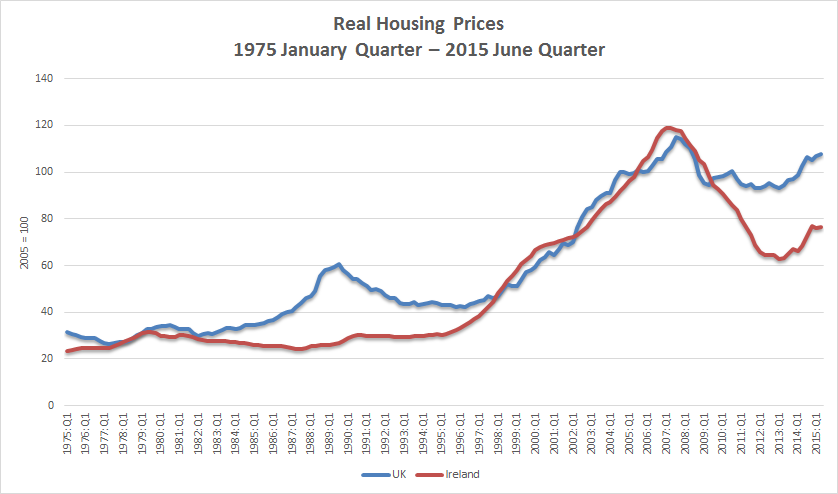
Source and notes: International House Price Database – Dallas Fed June 2015; nominal housing prices for each country is deflated by the personal consumption deflator for that country.
Margaret Thatcher was born #OnThisDay in 1925.
14 Oct 2015 Leave a comment
in economic history Tags: British economy, British politics, Margaret Thatcher
Margaret Thatcher was born #OnThisDay in 1925. What Britain looked like under her tenure econ.trib.al/oWL5m7a http://t.co/TtFuexIFdM—
The Economist (@EconBritain) October 13, 2015
@NZNationalParty @nzlabour @NZGreens inflow of asylum seekers into #UK #Canada, #Australia and #NewZealand since 1980
08 Oct 2015 Leave a comment
in economic history, Economics of international refugee law, International law, politics - Australia, politics - New Zealand, population economics Tags: Australia, British politics, economics of migration, refugees
New Zealand’s intake of asylum seekers has been embarrassingly low. The left-wing parties in New Zealand should be ashamed of themselves given the way they wear their international consciences on their sleeves about New Zealand being above it all morally, nuclear free, and can lecture the rest about war, peace and compassion from on high.

Data extracted on 08 Oct 2015 09:06 UTC (GMT) from OECD.Stat; Dataset: International Migration Database.
The UK absorbed an immense number of asylum seekers in the 1990 as did Canada. The data stops in 2013.
 Utopia, you are standing in it!
Recent Comments