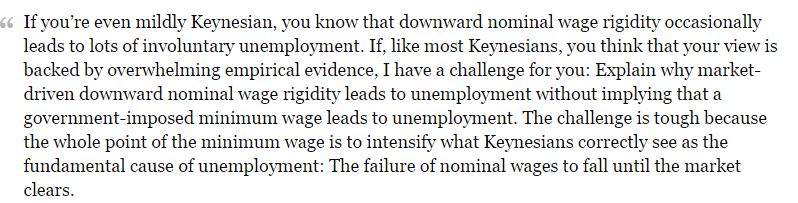
Via If You’re A Keynesian Then You Must Believe The Minimum Wage Increases Unemployment and The Myopic Empiricism of the Minimum Wage, Bryan Caplan | EconLog | Library of Economics and Liberty.
Celebrating humanity's flourishing through the spread of capitalism and the rule of law
14 Jun 2015 Leave a comment
in business cycles, fiscal policy, labour economics, macroeconomics, minimum wage Tags: Bryan Caplan, economic fallacies, involuntary unemployment, Keynesian macroeconomics, methodology of economics, wage rigidity
Via If You’re A Keynesian Then You Must Believe The Minimum Wage Increases Unemployment and The Myopic Empiricism of the Minimum Wage, Bryan Caplan | EconLog | Library of Economics and Liberty.
03 Apr 2015 Leave a comment
in Public Choice Tags: Bryan Caplan, expressive voting, Geoffrey Brennan, Mike Munger, rational ignorance, rational irrationality
https://youtu.be/k1pZHPIS8og?t=10
Recorded at Public Choice Society Meeting, March 7, 2008, San Antonio, TX.
03 Mar 2015 Leave a comment
in labour economics, labour supply, technological progress, unemployment Tags: artificial intelligence, Bryan Caplan, creative destruction, demand for labour, star trek, Star Trek replicators, supply of labour, technological unemployment

Bryan Caplan wrote a blog a few years ago, explaining the labour economics of artificial intelligence, using an exam question he poses to his graduate students:
Suppose artificial intelligence researchers produce and patent a perfect substitute for human labour at zero MC.
Use general equilibrium theory to predict the overall economic effects on human welfare before AND after the Artificial Intelligence software patent expires.
He then gave the answer about a week later:
While the patent lasts, the patent-holder will produce a monopoly quantity of AIs. As a result, the effective labour supply increases, and wages for human beings fall – but not to 0 because the patent-holder keeps P>MC.
The overall effect on human welfare, however, is still positive! Since the AIs produce more stuff, and only humans get to consume, GDP per human goes up. How is this possible if wages fall?
Simple: Earnings for NON-labour assets (land, capital, patents, etc.) must go up. Humans who only own labour are worse off, but anyone who owns a home, stocks, etc. experiences offsetting gains.
When the patent expires, this effect becomes even more extreme. With 0 fixed costs, wages fall to MC=0, but total output – and GDP per human – skyrockets.
Human owners of land, capital, and other non-labour assets capture 100% of all output. Humans who only have labour to sell, however, will starve without charity or tax-funded redistribution.
His logic is quite good. Caplan drew attention in the responses to his blog of Capt J Parker and Alex Godofsky in the comments section of his blog.

My comments at the time were as follows:
10 Jan 2015 Leave a comment
in applied price theory, economics of media and culture, environmental economics, Public Choice Tags: Bryan Caplan, do gooders, environmentalism, expressive voting
“Caring about the environment” is probably one of the biggest expressive issues of our time but most environmental issues are expressive voting issues:
1. Recycling
2. Preserving wild lands
3. Endangered species
4. Conservation
5. Logging
Even for the more instrumental-looking problems, green voters are bizarrely hostile to efficient solutions:
1. Emissions trading, domestic and international
2. Planting trees as carbon sinks
3. Liming lakes to counter acid rain
4. Privatizing common resources
via Prof.
11 Dec 2014 Leave a comment
in economics of education, human capital, international economics, labour supply, occupational choice, poverty and inequality Tags: Bryan Caplan, Charles Murray, IQ and education, poverty and inequality, signalling
Charles Murray has been cooking with gas lately – on fire. One of his points is too many go to college. Murray points out that succeeded at college requires an IQ of at least 115 but 84% of the population don’t have this:
Historically, an IQ of 115 or higher was deemed to make someone “prime college material.”
That range comprises about 16 per cent of the population.
Since 28 per cent of all adults have BAs, the IQ required to get a degree these days is obviously a lot lower than 115.
Those on the margins of this IQ are getting poor advice to go to college. Murray argues that other occupational and educational choices would serve them better in light of their abilities and likelihood of succeeding at college. Moreover, Murray is keen on replacing college degrees with certification after shorter periods of study such as in the certified public accountants exam.
Murray believes a lot of students make poor investments by going on to College, in part, because many of them don’t complete their degrees:
…even though college has been dumbed down, it is still too intellectually demanding for a large majority of students, in an age when about 50 per cent of all high school graduates are heading to four-year colleges the next fall.
The result is lots of failure. Of those who entered a four-year college in 1995, only 58 per cent had gotten their BA five academic years later.
Murray does not want to abandon these teenagers:
Recognizing the fact that most young people do not have ability and/or the interest to succeed on the conventional academic track does not mean spending less effort on the education of some children than of others.
…Too few counsellors tell work-bound high-school students how much money crane operators or master stonemasons make (a lot).
Too few tell them about the well-paying technical specialties that are being produced by a changing job market.
Too few assess the non-academic abilities of work-bound students and direct them toward occupations in which they can reasonably expect to succeed.
Worst of all: As these students approach the age at which they can legally drop out of school, they are urged to take more courses in mathematics, literature, history and science so that they can pursue the college fantasy. Is it any wonder that so many of them drop out?
To add to that, he is in the Bryan Caplan School: education is often an elaborate former of signalling for many degrees. Murray says that college is a waste of time because:
Outside a handful of majors — engineering and some of the sciences — a bachelor’s degree tells an employer nothing except that the applicant has a certain amount of intellectual ability and perseverance.
Even a degree in a vocational major like business administration can mean anything from a solid base of knowledge to four years of barely remembered gut courses.
If the OECD is to be believed, that not enough people are going to college from lower middle class families, obviously IQ is not one of the constraints on access to college Charles Murray suggested it to be.

The growing strength of the case that education is a form of signalling is a literature that the now famous OECD paper reviewed, found wanting, but did not have time to discuss in the working paper.

Another contemporary theme the OECD paper reviewed, found wanting, but did not have time to discuss is a large number of graduates who end up holding jobs that do not require a university education – going to college:
About 48 per cent of employed U.S. college graduates are in jobs that the Bureau of Labor Statistics (BLS) suggests requires less than a four-year college education.
Eleven per cent of employed college graduates are in occupations requiring more than a high-school diploma but less than a bachelor’s, and 37 per cent are in occupations requiring no more than a high-school diploma.
The proportion of overeducated workers in occupations appears to have grown substantially; in 1970, fewer than one per cent of taxi drivers and two per cent of fire-fighters had college degrees, while now more than 15 per cent do in both jobs
All in all, the OECD has gone into the dragons den by backing the accumulation of human capital as its mechanism to link inequality with lower growth. No matter how you spin it, this linking of lower economic growth to greater inequality through financial constraints on the accumulation of human capital by the lower middle class was a bold hypothesis.

The case for investing more in education is not a slam dunk. Higher education – university or polytechnic – is a rat race that many don’t need to join.The case for the government paying a great many more to join that rat race is rather weak.
21 Nov 2014 Leave a comment
in economics of education, human capital, labour economics Tags: behavioural genetics, Bryan Caplan, nature versus nurture
05 Nov 2014 Leave a comment
in labour economics, poverty and inequality, welfare reform Tags: Bryan Caplan, do gooders, Occupy Wall Street, poverty and inequality, top 1%

Bryan Caplan drew up a nice list of factors that contribute to poverty
Caplan argues that there is an undeserving poor if they fail to follow the following reasonable steps to avoid poverty and hardship:
23 May 2014 Leave a comment
in applied price theory, applied welfare economics, economic growth, economics, international economics, Public Choice, rentseeking Tags: anti-foreign bias, Bryan Caplan, free trade, protectionism
22 May 2014 Leave a comment
in applied welfare economics, economic growth, technological progress Tags: Bryan Caplan, pessimism
12 Apr 2014 2 Comments
in applied welfare economics, economics of education, human capital, labour economics, personnel economics Tags: Bryan Caplan, credentialism, human capital, signaling and screening, signalling
Bryan Caplan says that:
When you actually experience education, though, it’s hard not to notice that most classes teach no job skills.
The labour market heavily rewards educational credentials even though academic curriculum is seriously disconnected from the jobs people actually do.
The best explanation for this strange fact is that education is a strong signal of pre-existing worker productivity.
Caplan argues with annoying persuasiveness that education signals desirable employee traits such as intelligence, conscientiousness, conformity and a willingness to learn boring things:
His particular focus is the educational psychology literature on the transfer of learning. That literature started long ago with the question did learning Latin give you muscle to learn other subjects. The educational psychology literature has been looked at the transfer of learning for 100 years.
Educational psychologist found that Latin does not help much in studying other languages and other subjects. No significant differences were found in deductive and inductive reasoning or text comprehension among students with 4 years of Latin, 2 years of Latin, and no Latin at all.
The trouble is you do this in a race and many try to win the race by lengthening the race by going to and spending more time at university such as taking honours and master’s degrees etc.
Grades do not signal anything in Japan because everyone graduates with an A. It is the lecturer’s fault if you fail.
Japanese universities and employers make up for this everyone gets a A with strict entrance exams.
Getting into a top university signals intelligence and conscientiousness in preparing for their entrance exam. Few go to graduate school in Japan, preferring to learn more on the job.
Japanese students are lazy because everyone passes and therefore grades signal little in the way of intelligence, conscientiousness, conformity to employers.
I had great trouble getting my Japanese students to come to class. Other lecturers got around this by giving marks for attendance and replacing final exams with a pop quiz at the start of every class.
Nonetheless, something of value is acquired through 4-years at a Japanese university because otherwise why not skip straight from passing a university entrance exam to the employer exams.
The crucial objection to Caplan is that if most education expenditures are primarily about signalling, it should be possible to find other, cheaper ways to signal desirable traits to employers. As Bill Dickens noted:
For one thing I find it very hard to believe that we would waste so many resources on a nearly unproductive enterprise.
There are plenty of entrepreneurs out there trying to make money by selling cheaper, in time and money, versions of education and they aren’t very successful.
Mainstream schools have experimented with programmed learning, lectures on video, self-paced learning, etc. and none of the methods have caught on. Why wouldn’t they if they worked?
The spread of charter schools is an example of the rapid diffusion of an educational innovation valued by parents.
A major driver of the doubling of college tuition fees in the U.S. is demand for greater quality. As Becker and Murphy explain:
Indeed, it appears that the increases in tuition were partly induced by the greater return to college education. Pablo Peña, in a Ph.D. dissertation in progress at the University of Chicago, argues convincingly that tuition rose in part because students want to invest more in the quality of their education, and increased spending per student by colleges is partly financed by higher tuition levels
What specific and general skills are learnt at school and at university matters too, as Bill Dickens explains:
Education isn’t mainly about learning specific subject matter.
Rather education is mainly about practicing the sort of self-discipline that is necessary to be productive in a modern work environment.
High school allows you to practice showing up on time and doing what you are told.
College allows you to practice and work out techniques that work for you that allow you to take on and complete on time complicated multi-part tasks in an environment where you have considerable freedom about how you spend your time.
Some people may be more talented than others at this sort of thing (you come to mind as someone who is particularly talented at self-discipline), but this is also an acquired skill that one can develop with practice, and everyone needs to develop certain work habits that make one more productive at both types of tasks.
The debate really turns on the extent to which it is possible to find easier and cheaper ways to signal conscientiousness and conformity. As Bill Dickens noted as his fall-back position, which is based on comparative institutional analysis:
most of the return to education is due to it signalling desirable characteristics, but that there is no more efficient way to sort the capable from the incapable.
I also think that signalling performs a valuable sorting function that no alternative process can out-compete. But, as Caplan notes, a conventional education benefits from large government and private subsidies as compared to other sorting devices.
Table of Contents – The Case Against Education – Bryan Caplan
Introduction
Chapter 1: The Magic of Education
Chapter 2: Useless Studies with Big Payoffs: The Puzzle Is Real
Chapter 3: Signalling Explained
Chapter 4: Measuring Signalling
Chapter 5: Who Cares If It’s Signalling? The Private, Familial, and Social Returns to Education
Chapter 6: Is Education Good for the Soul?
Chapter 7: We Need Lots Less Education
Chapter 8: We Need More Vocational Education
Conclusion
The Book’s basic plot:
The labor market heavily rewards educational credentials even though academic curriculum is seriously disconnected from the jobs people actually do. The best explanation for this strange fact is that education is a strong signal of pre-existing worker productivity. (chapter 1)
While the return to education is often overstated, it remains high after making various statistical adjustments. Degrees in useless subjects really do substantially raise wages. (chapter 2)
Education signals a package of desirable employee traits: intelligence of course, but also conscientiousness and conformity. Many people dismiss the signalling model on a priori grounds, but educational signalling is at least as plausible as many widely accepted forms of of statistical discrimination. (chapter 3)
Empirically distinguishing signalling from human capital is notoriously difficult. But literatures on the sheepskin effect, employer learning, and the international return to education confirm that signalling is moderately to highly important. (chapter 4)
How much education should you get? The human capital-signalling distinction isn’t important at the individual level, but the policy implications are enormous. (chapter 5)
The non-pecuniary benefits of education are over-rated, and the non-pecuniary costs (especially boredom) are under-rated. There’s a massive selection bias because the kind of people who hate school rarely publicize their complaints. (chapter 6)
The most important implication of the signalling model is that we spend way too much money on education. Education spending at all levels should be drastically reduced, and people should enter the labor force at much younger ages. (chapter 7)
The education we offer should be more vocational. Especially for weaker students, vocational education has a higher private and social return than traditional academic education. (chapter 8)
Caplan has also posted this nice topology below to allow you to select your starting point:
| Model | Effect of Education on Income | Effect of Education on Productivity | Notes |
| Pure Human Capital | WYSIWYG
(What You See Is What You Get) |
WYSIWYG | Education may raise productivity by directly teaching job skills, but character formation, acculturation, etc. also count. |
| Pure Ability Bias | Zero | Zero | “Ability” includes not just pre-existing intelligence, but pre-existing character, acculturation, etc.
Pure Ability Bias is observationally equivalent to a Pure Consumption model of education. |
| Pure Signalling | WYSIWYG | Zero | Pure educational signalling can consist in (a) learning and retaining useless material, (b) learning but not retaining material regardless of usefulness, (c) simply wasting time in ways that less productive workers find relatively painful, leading to a positive correlation between education and productivity. |
| 1/3 Pure Human Capital, 1/3 Pure Ability Bias, 1/3 Pure Signalling |
2/3*WYSIWYG | 1/3*WYSIWYG | A good starting position for agnostics. |
| 0.1 Pure Human Capital, 0.5 Pure Ability Bias, 0.4 Pure Signalling |
.5*WYSIWYG | .1*WYSIWYG | Caplan’s preferred point estimates. He knows they’re extreme, but his book will explain his reasons and try to win you over. |
Celebrating humanity's flourishing through the spread of capitalism and the rule of law
Scholarly commentary on law, economics, and more
Beatrice Cherrier's blog
Celebrating humanity's flourishing through the spread of capitalism and the rule of law
Celebrating humanity's flourishing through the spread of capitalism and the rule of law
Celebrating humanity's flourishing through the spread of capitalism and the rule of law
Why Evolution is True is a blog written by Jerry Coyne, centered on evolution and biology but also dealing with diverse topics like politics, culture, and cats.
Celebrating humanity's flourishing through the spread of capitalism and the rule of law
Celebrating humanity's flourishing through the spread of capitalism and the rule of law
A rural perspective with a blue tint by Ele Ludemann
DPF's Kiwiblog - Fomenting Happy Mischief since 2003
Celebrating humanity's flourishing through the spread of capitalism and the rule of law
The world's most viewed site on global warming and climate change
Tim Harding's writings on rationality, informal logic and skepticism
A window into Doc Freiberger's library
Let's examine hard decisions!
Commentary on monetary policy in the spirit of R. G. Hawtrey
Thoughts on public policy and the media
Celebrating humanity's flourishing through the spread of capitalism and the rule of law
Politics and the economy
A blog (primarily) on Canadian and Commonwealth political history and institutions
Reading between the lines, and underneath the hype.
Economics, and such stuff as dreams are made on
"The British constitution has always been puzzling, and always will be." --Queen Elizabeth II
Celebrating humanity's flourishing through the spread of capitalism and the rule of law
Celebrating humanity's flourishing through the spread of capitalism and the rule of law
WORLD WAR II, MUSIC, HISTORY, HOLOCAUST
Undisciplined scholar, recovering academic
Celebrating humanity's flourishing through the spread of capitalism and the rule of law
Res ipsa loquitur - The thing itself speaks
Celebrating humanity's flourishing through the spread of capitalism and the rule of law
Researching the House of Commons, 1832-1868
Articles and research from the History of Parliament Trust
Reflections on books and art
Posts on the History of Law, Crime, and Justice
Celebrating humanity's flourishing through the spread of capitalism and the rule of law
Exploring the Monarchs of Europe
Cutting edge science you can dice with
Small Steps Toward A Much Better World
“We do not believe any group of men adequate enough or wise enough to operate without scrutiny or without criticism. We know that the only way to avoid error is to detect it, that the only way to detect it is to be free to inquire. We know that in secrecy error undetected will flourish and subvert”. - J Robert Oppenheimer.
The truth about the great wind power fraud - we're not here to debate the wind industry, we're here to destroy it.
Celebrating humanity's flourishing through the spread of capitalism and the rule of law
Celebrating humanity's flourishing through the spread of capitalism and the rule of law
Economics, public policy, monetary policy, financial regulation, with a New Zealand perspective
Celebrating humanity's flourishing through the spread of capitalism and the rule of law
Restraining Government in America and Around the World


 Utopia, you are standing in it!
Recent Comments