With a razor-thin majority likely after the British general election today, by-elections will be of unusual significance in Parliament of 650 middle-aged and older parliamentarians working under great stress with easy access to alcohol, food and little exercise. Backbench revolts will also take on a new meaning when there is a razor-thin majority.
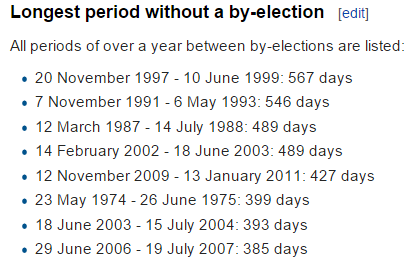
1992, 1998 and 2010 are the only calendar years in history without a single by-election in the House of Commons.
Peter Kellner’s final seat prediction – y-g.co/1byCjZ4 http://t.co/TFmg7vFUf0—
(@YouGov) May 06, 2015
The British Labour governments elected in 1964 and 1974 had small majorities. The majority was three seats after the 1974 election; four seats after the 1964 election. There was an early election in 1966 and two elections in 1974.
The Fixed Term Parliament Act rules out another general election unless a government is voted down on a motion of no confidence and another government is not formed within 14 days.
The Callaghan government fell on a no-confidence vote by one vote in 1979 after seeing its majority eroded by defeats in by-elections.

One of the jobs of the whips in the British House of Commons is to marshal sick and dying MPs for crucial votes. They have a rule that a vote of an MP goes in on the nod as long as his ambulance is parked in the speaker’s courtyard.
At least two ambulances were so parked when the Callaghan government lost its no confidence vote in 1979.
Legend has it that the Tory party whip prodded one of the patients in the back of the ambulance to check if he was still alive. He was so that the Tory whip told the Labour party whip ‘you lose’ and the Callaghan government fell by one vote.
Sir Alfred Broughton, a Labour MP who was on his death bed was not asked to come in despite offering to do so. He died four days after the vote.
Why tomorrow's UK election is looking good for Ed Miliband, via our majority-builder: econ.st/1IhUiBG http://t.co/zg6gFZq2eF—
The Economist (@EconBizFin) May 07, 2015
When asked to honour a gentlemen’s agreement about pairing sick MPs, Tory whip Bernard Weatherill said pairing had never been intended for votes on Matters of Confidence and it would be impossible to find a Conservative MP who would agree to abstain.
After a moment’s reflection, Weatherill offered to abstain because he felt it would be dishonourable to break his word to deputy Chief Whip for the Labour Party, Walter Harrison about pairing conventions, which was a gentlemen’s agreement.
Harrison was so impressed by Weatherill’s offer – which would have ended his political career – that he released Weatherill from his obligation and the Government fell by one vote on the agreement of gentlemen. Weatherill was later elected Speaker of the House of Commons.
 Utopia, you are standing in it!
Recent Comments