The relative importance of the climate crisis in the Third World
02 Apr 2015 Leave a comment
in development economics, environmental economics, global warming, growth disasters, growth miracles, health economics Tags: capitalism and freedom, climate alarmism, global warming, The Great Escape
More evidence of mass kidnappings of activists
01 Apr 2015 Leave a comment
in development economics, entrepreneurship, growth disasters, growth miracles, liberalism Tags: Africa, anticapitalist mentality, capitalism and freedom, do gooders, entrepreneurial alertness, foreign direct investment, Left-wing hypocrisy, ODA
Why aren’t overseas development activists dancing in the streets to celebrate this turnaround in the economic climate of Africa through capitalism and the freedom to invest. The only possible explanation is mass kidnappings.
Both Venezuelan and Singapore were ruled by socialist strongmen
30 Mar 2015 Leave a comment
in development economics, growth disasters, growth miracles Tags: autocracy, capitalism and freedom, Singapore, Venezuela
Bad luck http://t.co/EaIoiqnjbR—
TakingHayekSeriously (@FriedrichHayek) March 28, 2015
Singapore’s Peoples Action Party was expelled from Socialist International in 1976. There is widespread government ownership of businesses in Singapore. So much so, that a new term was invented for it: Government Linked Corporations.
An essay on Lee Kuan Yew, the man who remade Asia on.wsj.com/1BR9YD4 http://t.co/hxG2p7ECpX—
David Crawshaw (@davewsj) March 28, 2015
Camilla Paglia on capitalism and feminism
29 Mar 2015 Leave a comment
in liberalism Tags: capitalism and freedom, feminism, Leftover Left, public intellectuals
Capitalism has almost abolished extreme poverty
22 Mar 2015 Leave a comment
in development economics, growth disasters, growth miracles Tags: capitalism and freedom, extreme poverty, global poverty, The Great Fact


Energy use versus pollution levels
06 Mar 2015 Leave a comment
in development economics, economic history, energy economics, environmental economics, growth miracles Tags: air pollution, capitalism and freedom, The Great Escape

The Great Escape (from mortality inequality).
27 Feb 2015 Leave a comment
in health economics, Sam Peltzman Tags: capitalism and freedom, industrial revolution, infant mortality, The Great Escape, The Great Fact
Sam Peltzman in "Mortality Inequality" used the Lorenz curve to measure mortality inequality. The top figure below is based on data for 1852; the bottom figure on data for 2002. A straight line in the figure below at a 45-degree angle shows perfect equality of mortality: that is, 20% of the population lives 20% of the total life-years at this time; 40% of the population lives 40% of the life-years for this group, and so on.
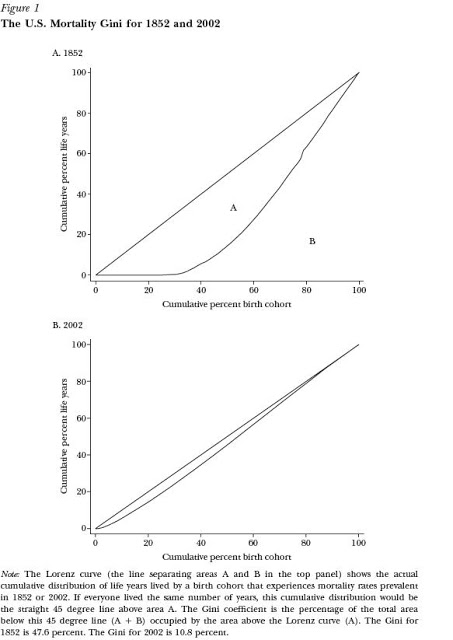
The curved line is the data In 1852 in the USA and in 2002. It shows that with high infant mortality, the bottom 30% of the distribution lived close to 0% of the life years in 1852.
/cdn0.vox-cdn.com/uploads/chorus_asset/file/2443910/slack-imgs.0.png)
Everybody is seriously richer because of post-war capitalism
22 Feb 2015 Leave a comment
in economic growth, economic history, liberalism Tags: capitalism and freedom, The Great Enrichment, The Great Fact
Figure 1: Growth in real average income for the bottom 90%

Source: voxeu.org
By the way, in the countries where growth in real average incomes appears to have flattened out, is it seriously suggested that middle-class families cannot buy a basket of goods of superior quality and quantity than they could 30 or 40 years ago?
The Great Enrichment since 1979 in the USA
22 Feb 2015 Leave a comment
in income redistribution, politics - USA, poverty and inequality, welfare reform Tags: capitalism and freedom, poverty and inequality, The Great Enrichment, top 1%

Over the past one-, two-, and three-decade periods, both middle class and poor households have experienced noticeable gains in living standards. Their gains are slower than those experienced by middle-income families in the earlier post-war era, but the gains are well above zero.

In 1980, in-kind benefits and employer and government spending on health insurance accounted for just 6% of the after-tax incomes of households in the middle one-fifth of the distribution. By 2010 these in-kind income sources represented 17% of middle class households’ after-tax income
…The broadest and most accurate measures of household income are published by the CBO. CBO’s newest estimates confirm the long-term trend toward greater inequality, driven mainly by turbo-charged gains in market income at the very top of the distribution. The market incomes of the top 1% are extraordinarily cyclical, however. They soar in economic expansions and plunge in recessions. Income changes since 2007 fit this pattern.
What many observers miss, however, is the success of the nation’s tax and transfer systems in protecting low- and middle-income Americans against the full effects of a depressed economy.
via Gary Burtless

 Utopia, you are standing in it!
Recent Comments