
More heat than light in the recent inequality debate
26 Jun 2015 1 Comment
The rise in articles about inequality in NZ sure doesn't match the data on inequality.
youtube.com/watch?v=uCT7aE… http://t.co/z2eWKgXJiL—
Eric Crampton (@EricCrampton) June 26, 2015
@MaxRashbrooke The top 1% in New Zealand are lazy and incompetent as a ruling class
24 Jun 2015 1 Comment
in applied price theory, applied welfare economics, economic history, entrepreneurship, health and safety, human capital, industrial organisation, liberalism, Marxist economics, poverty and inequality, Rawls and Nozick, unions Tags: capitalism and freedom, Class war, Joan Robinson, Joseph Schumpeter, social insurance, The Great Enrichment, top 1%, welfare state, withering away in the proletariat
New work by Chris Ball and John Creedy shows substantial *declines* in NZ inequality.
initiativeblog.com/2015/06/24/ine… http://t.co/f94fw4Bhae—
Eric Crampton (@EricCrampton) June 24, 2015
The top 1% in New Zealand really have been dropping the class war ball for at least a generation.
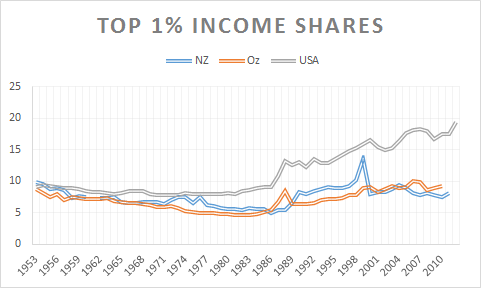
Source: The World Top Incomes Database.
Not only have the New Zealand top 1% been pretty miserable at increasing their share of incomes, hardly any change since 1990 and not much before that, the top 1% allowed inequality in both consumption and disposable income to actually fall since 1990 as shown by Treasury analysis published today.
Joan Robinson was on to this in the 1940s when she said the battle cry of Marxists would have to change from the 1848 version “rise up ye workers, rise up for you have nothing to lose but your chains” to “rise up ye workers, rise up for you have nothing to lose but the prospect of a suburban home and a motorcar”.

Today that battle cry of the Marxist revolution would have to be “rise up ye workers rise up for you have nothing to lose but your iPhone and your air points”. As Joan Robinson observed in the 1940s, that’s not much of a basis for a revolutionary movement.
What Oxfam doesn’t want you to know: global poverty has been declining faster than at any point in human history
23 Jun 2015 Leave a comment
in development economics, economic history, growth miracles Tags: capitalism and freedom, extreme poverty, global poverty, Leftover Left, Oxfam, The Great Enrichment, The Great Escape, The Great Fact
The Great Escape: winning the war on disease
10 Jun 2015 Leave a comment
in development economics, growth disasters, growth miracles, health economics Tags: capitalism and freedom, extreme poverty, global poverty, life expectancy, The Great Escape, The Great Fact

The withering away the proletariat from the rise of the middle-class in underdeveloped countries
05 Jun 2015 Leave a comment
in development economics, growth disasters, growth miracles Tags: capitalism and freedom, The Age of Milton Friedman, The Great Fact
#Dailychart: Workers in poor countries are climbing out of poverty econ.st/1tJXtb4 http://t.co/Z8saGkMa4e—
The Economist (@ECONdailycharts) May 27, 2014
Mises on the Great Fact
29 May 2015 Leave a comment
in Austrian economics, comparative institutional analysis, economic history, Ludwig von Mises Tags: capitalism and freedom, The Great Enrichment, The Great Escape, The Great Fact
The millennium development goals were supposed to be utopian rather than under-promising to over-deliver
25 May 2015 Leave a comment
in development economics, growth disasters, growth miracles Tags: capitalism and freedom, millennium development goals, The Great Escape, The Great Fact
The rise and rise of working billionaires
23 May 2015 Leave a comment


The Great Fact, past and future, in one chart
18 May 2015 Leave a comment
in development economics, growth miracles Tags: capitalism and freedom, The Great Escape, The Great Fact
Some good news for development economists econ.st/1A7xuSu http://t.co/UcDhD1SCXz—
The Economist (@TheEconomist) May 18, 2015
Full-time work on the minimum wage is enough to keep a NZ family out of poverty!
10 May 2015 Leave a comment
in labour economics, minimum wage, politics - Australia, politics - New Zealand, politics - USA, poverty and inequality Tags: capitalism and freedom, child poverty, family poverty, Left-wing hypocrisy, living wage, New Zealand Greens, New Zealand Labour Party, Simon Chapple
Where a 40-hour workweek doesn't lift families from poverty: bloom.bg/1AFOD0q http://t.co/eBoJSz1TkX—
Bloomberg VisualData (@BBGVisualData) May 23, 2015
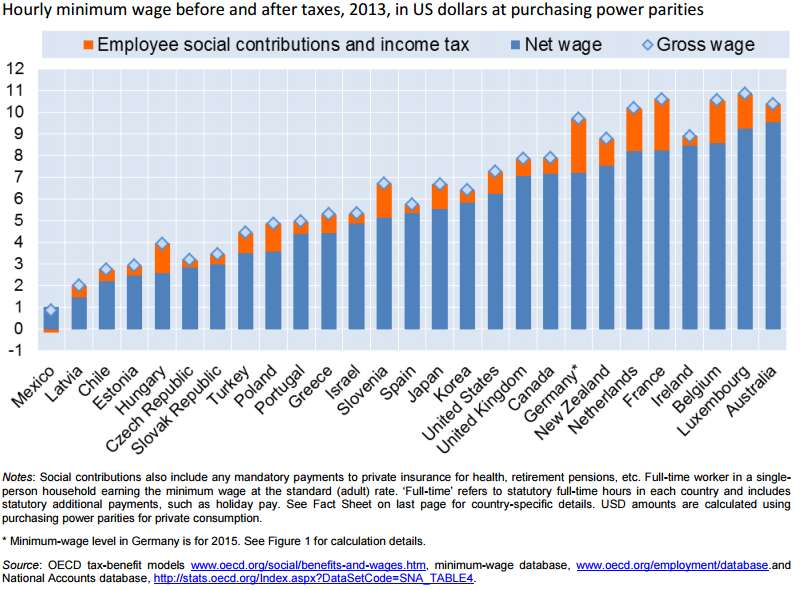
An OECD chart that shows New Zealand parents only need to work a little over 40 hours a week on the minimum wage to lift a family out of poverty in New Zealand.

The figure above shows that a lone parent with two children needs to work about 25 hours a week stay out of poverty in 2013 in New Zealand Once taxes are taken into account as well as additional family benefits such as in-work tax credits. New Zealand is one of the easiest places in the world to get out of poverty by working part-time for a sole mother.
The figure above from the OECD shows that New Zealand couple with two children needs to work about 40 hours a week to stay out of poverty. Of course, what is poverty depends on the definition of the poverty line and in this case by the OECD, it is defined as 50% of the median wage after taxes and family benefits. Another common definition of poverty is earning less than 60% of the median wage
The minimum wage is $14.75 per hour in New Zealand while proposals for a living wage in New Zealand are now $19.25 an hour. The Labour Party wants to increase the minimum wage to $15 per hour.The Greens want to increase the minimum wage to the living wage.
Simon Chapple and Jonathan Boston pointed out in their excellent book last year on child poverty in New Zealand that full-time work by one parent and part-time work by the other in the same household is enough to lift families out of most definitions of poverty:
Sustained full-time employment of sole parents and the fulltime and part-time employment of two parents, even at low wages, are sufficient to pull the majority of children above most poverty lines, given the various existing tax credits and family supports.
The best available analysis, the most credible analysis, the most independent analysis in New Zealand or anywhere else in the world that having a job and marrying the father of your child is the secret to the leaving poverty is recently by the Living Wage movement in New Zealand.
According to the calculations of the Living Wage movement, earning only $19.25 per hour with a second earner working only 20 hours affords their two children, including a teenager, Sky TV, pets, international travel, video games and 10 hours childcare. This analysis of the Living Wage movement shows that finishing school so your job pays something reasonable and marrying the father of your child affords a comfortable family life.
The OECD’s analysis also showed that incentives for New Zealanders to work more and earn more is better than in most countries in terms of what happens if they earn a wage increase.
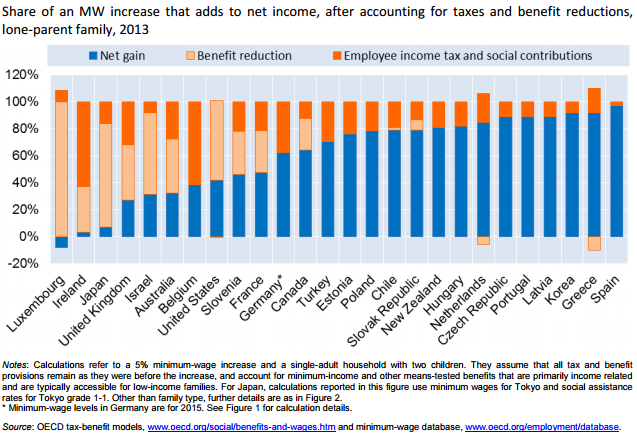
In New Zealand, when there is a 5% minimum wage increase, four percentage points of that wage increase actually stays in the hands of the worker.
In some countries such as Australia, the USA and UK, 60 to 80%of the minimum wage increase is gobbled up in reductions in benefits and taxes. At the same time, the minimum wage increase makes it less profitable for your employer to retain you so your job is more at risk.
The only explanation I have for why the Labour Party, NZ Greens and the living wage movement don’t highlight the success of the existing minimum wage in reducing family poverty in New Zealand is mass kidnappings.
But for these abductions most fowl, I’m sure the Labour Party, NZ Greens and the living wage movement would be dancing in the street celebrating successes of capitalism and freedom in New Zealand in keeping families out of poverty through the minimum wage.
When will capitalism abolish poverty?
06 May 2015 Leave a comment
in development economics, economic history, growth disasters, growth miracles Tags: capitalism and freedom, The Great Escape, The Great Fact
Global poverty is rapidly falling, says @BrookingsInst: buff.ly/1PM4Mdr #progress http://t.co/nGzbnxSHnp—
HumanProgress.org (@humanprogress) April 29, 2015
Why was the Nepalese earthquakes so bad?
04 May 2015 Leave a comment
in development economics, economics of natural disasters, growth disasters, growth miracles Tags: capitalism and freedom, earthquakes, Nepal, richer is safer, The Great Escape, The Great Fact, wealthier is healthier
Prosperity strengthens resilience against disasters. buff.ly/1JORl8y #Nepal #EarthQuakeResponse http://t.co/yx4E98QJn6—
HumanProgress.org (@humanprogress) April 28, 2015
 Utopia, you are standing in it!
Recent Comments