@NZGreens are so polite on Twitter @MaramaDavidson @RusselNorman @greencatherine

One of the first things I noticed when feuding on Twitter with Green MPs was how polite they were. Twitter is not normally known for that characteristic and that is before considering the limitations of 144 characters. People who are good friends and work together will go to war over email without any space limitations for the making an email polite and friendly. Imagine how easy it is to misconstrue the meaning and motivations of tweets that can only be 144 characters.

The New Zealand Green MPs in their replies on Twitter make good points and ask penetrating questions that explain their position well and makes you think more deeply about your own. Knowledge grows through critical discussion, not by consensus and agreement.

Cass Sunstein made some astute observations in Republic.com 2.0 about how the blogosphere forms into information cocoons and echo chambers. People can avoid the news and opinions they don’t want to hear.

Sunstein has argued that there are limitless news and information options and, more significantly, there are limitless options for avoiding what you do not want to hear:

  • Those in search of affirmation will find it in abundance on the Internet in those newspapers, blogs, podcasts and other media that reinforce their views.
  • People can filter out opposing or alternative viewpoints to create a “Daily Me.”
  • The sense of personal empowerment that consumers gain from filtering out news to create their Daily Me creates an echo chamber effect and accelerates political polarisation.

A common risk of debate is group polarisation. Members of the deliberating group move toward a more extreme position relative to their initial tendencies! How many blogs are populated by those that denounce those who disagree? This is the role of the mind guard in group-think.
Sunstein in Infotopia wrote about how people use the Internet to spend too much time talking to those that agree with them and not enough time looking to be challenged:

In an age of information overload, it is easy to fall back on our own prejudices and insulate ourselves with comforting opinions that reaffirm our core beliefs. Crowds quickly become mobs.

The justification for the Iraq war, the collapse of Enron, the explosion of the space shuttle Columbia–all of these resulted from decisions made by leaders and groups trapped in “information cocoons,” shielded from information at odds with their preconceptions. How can leaders and ordinary people challenge insular decision making and gain access to the sum of human knowledge?

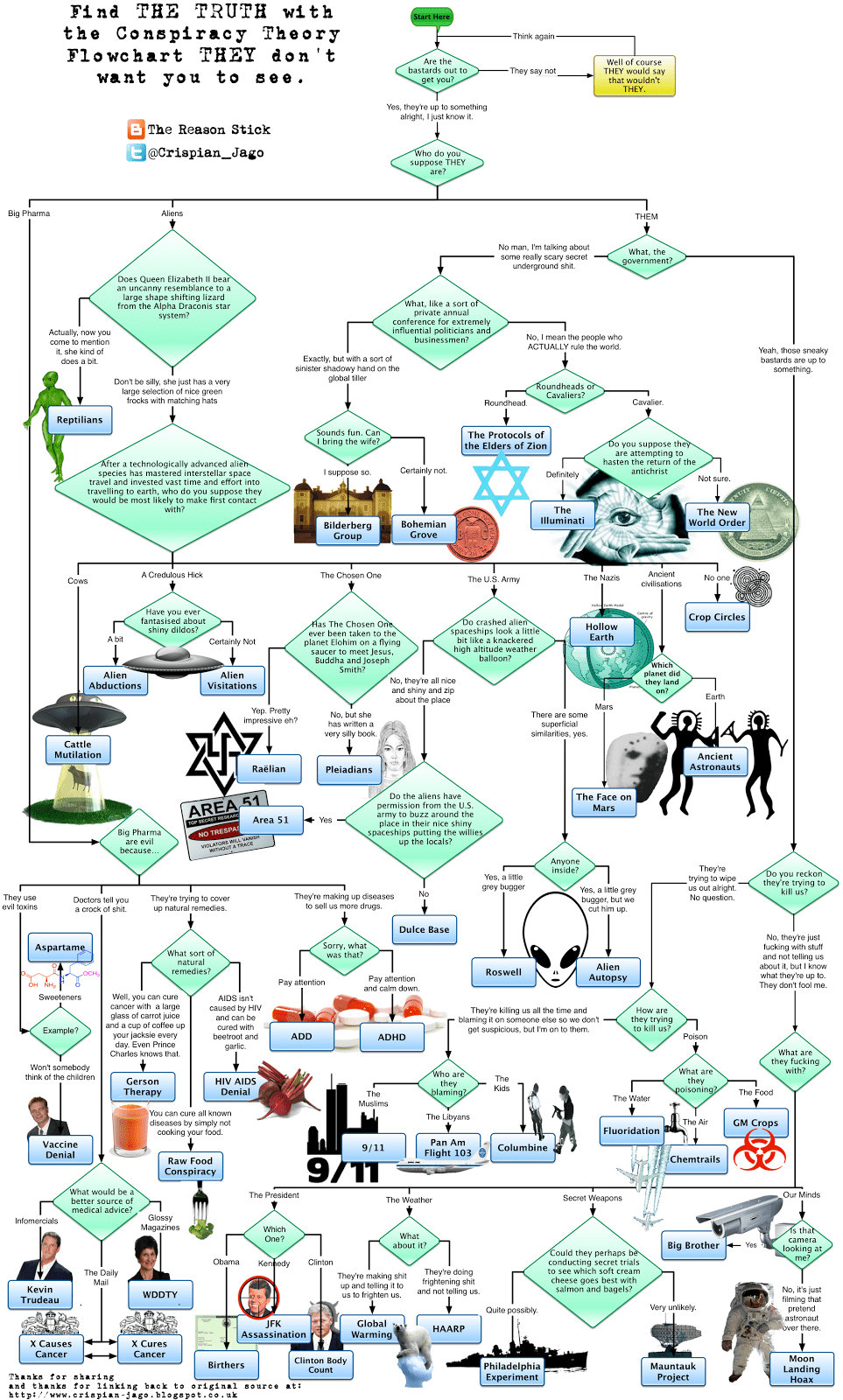
Conspiracy theories had enough momentum of their own before the information cocoons and echo chambers of the blogosphere gained ground.

J.S. Mill pointed out that critics who are totally wrong still add value because they keep you on your toes and sharpened both your argument and the communication of your message. If the righteous majority silences or ignores its opponents, it will never have to defend its belief and over time will forget the arguments for it.

As well as losing its grasp of the arguments for its belief, J.S. Mill adds that the majority will in due course even lose a sense of the real meaning and substance of its belief. What earlier may have been a vital belief will be reduced in time to a series of phrases retained by rote. The belief will be held as a dead dogma rather than as a living truth.

Beliefs held like this are extremely vulnerable to serious opposition when it is eventually encountered. They are more likely to collapse because their supporters do not know how to defend them or even what they really mean.

J.S. Mill’s scenarios involves both parties of opinion, majority and minority, having a portion of the truth but not the whole of it. He regards this as the most common of the three scenarios, and his argument here is very simple. To enlarge its grasp of the truth, the majority must encourage the minority to express its partially truthful view. Three scenarios – the majority is wrong, partly wrong, or totally right – exhaust for Mill the possible permutations on the distribution of truth, and he holds that in each case the search for truth is best served by allowing free discussion.

Mill thinks history repeatedly demonstrates this process at work and offered Christianity as an illustrative example. By suppressing opposition to it over the centuries Christians ironically weakened rather than strengthened Christian belief. Mill thinks this explains the decline of Christianity in the modern world. They forgot why they were Christians.

Cass Sunstein finally admits that regulators are people too, and like the rest of us, they are just as fallible

Image

Conspiracy theories versus unintended consequences

Cass Sunstein defines a conspiracy theory as:

An effort to explain some event or practice by reference to the machinations of powerful people, who have also managed to conceal their role. Of course some conspiracy theories turn out to be true.

He goes on to argue that millions of people hold conspiracy theories: that powerful people work together to withhold the truth about some important practice or terrible event.

Sunstein also argues that many become extremists stem not from irrationality but from having little relevant information and their extremist views are supported by what little they know:

  1. Conspiracy theories generally attribute extraordinary powers to certain agents – to plan, to control others and to maintain secrets.
  2. Conspiracy theories overestimate the competence and discretion of officials and bureaucracies, who are assumed to be able to make and carry out sophisticated secret plans, despite abundant evidence that in open societies that government actions does not usually remain secret for very long.
  3. Conspiracy theories also assume that the nefarious secret plans are easily detected by members of the public such as themselves without the need for special access to the key information or any investigative resources.

Sunstein also argued that a distinctive feature of conspiracy theories is their self-sealing quality. Conspiracy theorists are not likely to be persuaded by an attempt to dispel their theories and look at these attempts as further proof of the conspiracy.

Karl Popper argued that conspiracy theories overlook the pervasive unintended consequences of political and social action. They assume that all consequences must have been intended by someone.

Must everything be the result of a grand plan – a secret conspiracy that ordinary people uncover with little effort? Whatever happened to unintended consequences and stuff-ups?

Basing policy on a scientific consensus is a new development for environmentalists

Previously the precautionary principle was used to introduce doubt when there was no doubt. But when climate science turned in their favour, environmentalists wanted public policy to be based on the latest science.

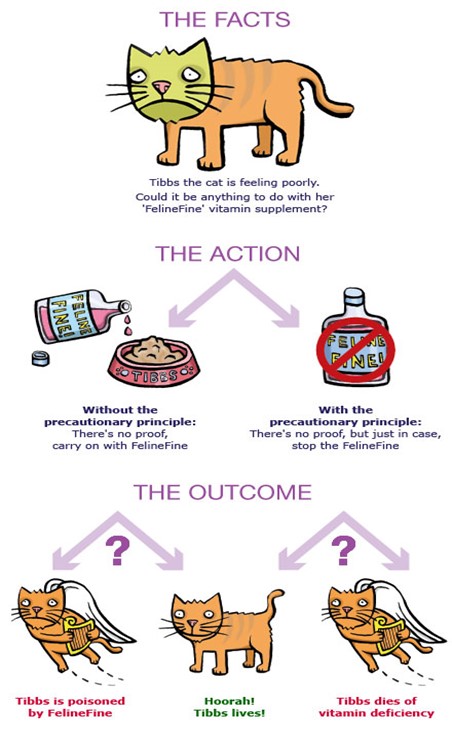
The precautionary principle is deeply incoherent. We should take precautions but there are always risks on both sides of a decision; inaction can bring danger, but so can action. Precautions themselves create risks so the precautionary principle bans what it simultaneously requires.

There is never perfect certainty about the nature and causes of health and environmental threats, so environmental and health regulations are almost always adopted despite some residual uncertainty.

We live in a Schumpeterian world where new risks replace old risks.

The obvious question is it safer or more precautionary to focus on the potential harms of new activities or technologies without reference to the activities or technologies they might displace? Jonathan Alder explains

In any policy decision, policy makers can make two potential errors regarding risk.

On the one hand, policy makers may err by failing to adopt measures to address a health or environmental risk that exists.

On the other hand, policy makers may adopt regulatory measures to control a health or environmental risk that does not exist.

Both types of error can increase risks to public health.


Consider the overwhelming consensus among researchers that biotech crops are safe for humans and the environment

This is a conclusion that is rejected by the very environmentalist organisations that loudly insist on the policy relevance of the scientific consensus on global warming.

In his 2012 Dimbleby lecture, Sir Paul Nurse calls for a re-opening the debate about GM crops based on scientific facts and analysis:

We need to consider what the science has to say about risks and benefits, uncoloured by commercial interests and ideological opinion. It is not acceptable if we deny the world’s poorest access to ways that could help their food security, if that denial is based on fashion and ill-informed opinion rather than good science.

Cass Sunstein wrote that in its strongest and most distinctive forms, the precautionary principle imposes a burden of proof on those who create potential risks, and requires regulation of activities even if it cannot be shown that those activities are likely to produce significant harms:

…apparently sensible questions have culminated in an influential doctrine, known as the precautionary principle.

The central idea is simple: Avoid steps that will create a risk of harm.

Until safety is established, be cautious; do not require unambiguous evidence.

Yet the precautionary principle, for all its rhetorical appeal, is deeply incoherent.

It is of course true that we should take precautions against some speculative dangers.

But there are always risks on both sides of a decision; inaction can bring danger, but so can action.

Precautions, in other words, themselves create risks – and hence the principle bans what it simultaneously requires.

Sunstein is a Democrat whose White House appointment to the head the White House Office of Information and Regulatory Affairs under Obama was opposed by the Left of the Democrat Party because of his views on the precautionary principle and his support of cost-benefit analysis as a primary tool for assessing regulations. Sunstein again:

The simplest problem with the precautionary principle is that regulation might well deprive society of significant benefits, and even produce a large number of deaths that would otherwise not occur.

Genetic modification holds out the promise of producing food that is both cheaper and healthier – resulting, for example, in products that might have large benefits in developing countries.

The point is not that genetic modification will definitely have those benefits, or that the benefits of genetic modification outweigh the risks.

The point is that the precautionary principle provides no guidance

The epitome of anti-science is support for the precautionary principle and opposition to cost-benefit analysis in assessing regulations. Which side of politics is guilty of this?

Environmentalists accept the views of scientists when its suits their anti-progress agenda. In other cases, the precautionary principle is used to delay judgment, reject science such as on GMOs and demand ever more evidence.

Environmentalists are all for the precautionary principle except when applied to natural medicines, organic food and marijuana.

Is the Blogosphere an Infotopia or an Echo Chamber – the Daily Me?

Cass Sunstein made some astute observations in Republic.com 2.0 about how the blogosphere forms into information cocoons and echo chambers. People can avoid the news and opinions they don’t want to hear.

This is not all that surprising. Many do not read the newspaper, or read those newspapers that fuel their initial beliefs. London is famous for its partisan newspapers each pandering to their own slice of the political spectrum.

The standard J.S. Mill view of deliberation is that group discussion is likely to lead to better outcomes, if only because competing views are stated and exchanged.

Sunstein has argued that there are limitless news and information options and, more significantly, there are limitless options for avoiding what you do not want to hear:

  • Those in search of affirmation will find it in abundance on the Internet in those newspapers, blogs, podcasts and other media that reinforce their views.
  • People can filter out opposing or alternative viewpoints to create a "Daily Me."
  • The sense of personal empowerment that consumers gain from filtering out news to create their Daily Me creates an echo chamber effect and accelerates political polarisation.

A common risk of debate is group polarisation. Members of the deliberating group move toward a more extreme position relative to their initial tendencies!

How many blogs are populated by those that denounce those who disagree? This is the role of the mind guard in group-think.

Debate is over-rated as compared to brute experience. Milton Friedman said this in his Nobel price lecture:

Government policy about inflation and unemployment has been at the centre of political controversy. Ideological war has raged over these matters.

Yet the drastic  change that has occurred in economic theory has not been a result of ideological warfare.

It has not resulted from divergent political beliefs or aims.

It has responded almost  entirely to the force of events: brute experience proved far more potent than the  strongest of political or ideological preferences

The market process succeeds because it relies on a bare minimum of knowledge and hardly any deliberation but a lot of learning from experience.

A purpose of voting through secret ballots is both to bring the debate to a close and to clip the wings of those that shout the loudest and longest.

Sunstein in Infotopia wrote about how people use the Internet to spend too much time talking to those that agree with them and not enough time looking to be challenged:

In an age of information overload, it is easy to fall back on our own prejudices and insulate ourselves with comforting opinions that reaffirm our core beliefs. Crowds quickly become mobs.

The justification for the Iraq war, the collapse of Enron, the explosion of the space shuttle Columbia–all of these resulted from decisions made by leaders and groups trapped in "information cocoons," shielded from information at odds with their preconceptions. How can leaders and ordinary people challenge insular decision making and gain access to the sum of human knowledge?

Conspiracy theories had enough momentum of their own before the information cocoons and echo chambers of the blogosphere gained ground.

Must everything be the result of a grand plan? As Karl Popper explains:

…a theory which is widely held but which assumes what I consider the very opposite of the true aim of the social sciences; I call it the "conspiracy theory of society."

It is the view that an explanation of a social phenomenon consists in the discovery of the men or groups who are interested in the occurrence of this phenomenon (sometimes it is a hidden interest which has first to be revealed), and who have planned and conspired to bring it about.

This view of the aims of the social sciences arises, of course, from the mistaken theory that, whatever happens in society – especially happenings such as war, unemployment, poverty, shortages, which people as a rule dislike – is the result of direct design by some powerful individuals and groups.

Cass Sunstein in another book defines a conspiracy theory as:

An effort to explain some event or practice by reference to the machinations of powerful people, who have also managed to conceal their role.

He goes on to argue that millions hold conspiracy theories – that powerful people work together to withhold the truth about some important practice or terrible event.

Conspiracy theories attribute extraordinary powers to political leaders and bureaucracies to plan, to control others, and to maintain secrets. Conspiracy theories overestimate the competence and discretion of these political leaders and bureaucracies, who are assumed to be able to make and carry out sophisticated secret plans, despite ample evidence that most government actions do not remain secret for long.

Conspiracy theories also assume that these nefarious secret plans are easily detected by members of the public without the need for special access to the key information or any investigative resources.

Sunstein also argued that a distinctive feature of conspiracy theories is their self-sealing quality. Conspiracy theorists are not persuaded by an attempt to dispel their theories and look at these attempts as further proof of the conspiracy.

Karl Popper argued that conspiracy theories overlook the pervasive unintended consequences of political and social action; they assume that all consequences must have been intended by someone.

Most people lack direct or personal information about the explanations for terrible events, and they are often tempted to attribute such events to some nefarious actor as a way of coping with an uncertain world. More than a few blogs help them round-up the usual suspects.

The Undercover Historian

Beatrice Cherrier's blog

Matua Kahurangi

Celebrating humanity's flourishing through the spread of capitalism and the rule of law

Temple of Sociology

Celebrating humanity's flourishing through the spread of capitalism and the rule of law

Velvet Glove, Iron Fist

Celebrating humanity's flourishing through the spread of capitalism and the rule of law

CAMERA UK

COMMITTEE FOR ACCURACY IN MIDDLE EAST REPORTING AND ANALYSIS

Why Evolution Is True

Why Evolution is True is a blog written by Jerry Coyne, centered on evolution and biology but also dealing with diverse topics like politics, culture, and cats.

Down to Earth Kiwi

Celebrating humanity's flourishing through the spread of capitalism and the rule of law

NoTricksZone

Celebrating humanity's flourishing through the spread of capitalism and the rule of law

Homepaddock

A rural perspective with a blue tint by Ele Ludemann

Kiwiblog

DPF's Kiwiblog - Fomenting Happy Mischief since 2003

The Dangerous Economist

Celebrating humanity's flourishing through the spread of capitalism and the rule of law

Watts Up With That?

The world's most viewed site on global warming and climate change

The Logical Place

Tim Harding's writings on rationality, informal logic and skepticism

Doc's Books

A window into Doc Freiberger's library

The Risk-Monger

Let's examine hard decisions!

Uneasy Money

Commentary on monetary policy in the spirit of R. G. Hawtrey

Barrie Saunders

Thoughts on public policy and the media

Liberty Scott

Celebrating humanity's flourishing through the spread of capitalism and the rule of law

Point of Order

Politics and the economy

James Bowden's Blog

A blog (primarily) on Canadian and Commonwealth political history and institutions

Science Matters

Reading between the lines, and underneath the hype.

Peter Winsley

Economics, and such stuff as dreams are made on

A Venerable Puzzle

"The British constitution has always been puzzling, and always will be." --Queen Elizabeth II

The Antiplanner

Celebrating humanity's flourishing through the spread of capitalism and the rule of law

Bet On It

Celebrating humanity's flourishing through the spread of capitalism and the rule of law

History of Sorts

WORLD WAR II, MUSIC, HISTORY, HOLOCAUST

Roger Pielke Jr.

Undisciplined scholar, recovering academic

Offsetting Behaviour

Celebrating humanity's flourishing through the spread of capitalism and the rule of law

JONATHAN TURLEY

Res ipsa loquitur - The thing itself speaks

Conversable Economist

Celebrating humanity's flourishing through the spread of capitalism and the rule of law

The Victorian Commons

Researching the House of Commons, 1832-1868

The History of Parliament

Articles and research from the History of Parliament Trust

Books & Boots

Reflections on books and art

Legal History Miscellany

Posts on the History of Law, Crime, and Justice

Sex, Drugs and Economics

Celebrating humanity's flourishing through the spread of capitalism and the rule of law

European Royal History

Exploring the Monarchs of Europe

Tallbloke's Talkshop

Cutting edge science you can dice with

Marginal REVOLUTION

Small Steps Toward A Much Better World

NOT A LOT OF PEOPLE KNOW THAT

“We do not believe any group of men adequate enough or wise enough to operate without scrutiny or without criticism. We know that the only way to avoid error is to detect it, that the only way to detect it is to be free to inquire. We know that in secrecy error undetected will flourish and subvert”. - J Robert Oppenheimer.

STOP THESE THINGS

The truth about the great wind power fraud - we're not here to debate the wind industry, we're here to destroy it.

Lindsay Mitchell

Celebrating humanity's flourishing through the spread of capitalism and the rule of law

Alt-M

Celebrating humanity's flourishing through the spread of capitalism and the rule of law

croaking cassandra

Economics, public policy, monetary policy, financial regulation, with a New Zealand perspective

The Grumpy Economist

Celebrating humanity's flourishing through the spread of capitalism and the rule of law

International Liberty

Restraining Government in America and Around the World

Environmental and Urban Economics

Celebrating humanity's flourishing through the spread of capitalism and the rule of law

Supply and Demand (in that order)

Celebrating humanity's flourishing through the spread of capitalism and the rule of law