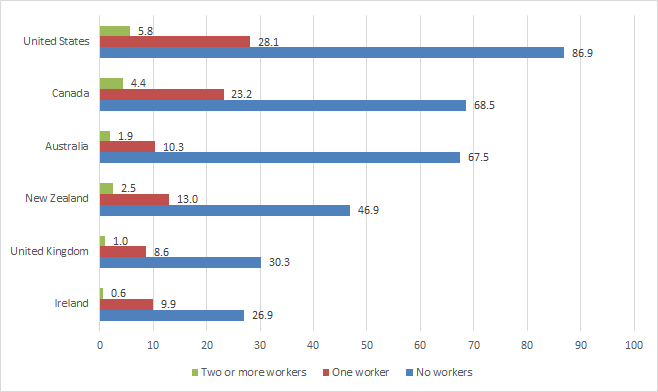
Figure 1: child poverty rates in couple families by employment status, Anglo-Saxon countries, 2010
Source: OECD Family Database; Poverty thresholds are set at 50% of the median income of the entire population.
Celebrating humanity's flourishing through the spread of capitalism and the rule of law
21 Jun 2015 Leave a comment
in economics of love and marriage, labour economics, labour supply, law and economics, politics - Australia, politics - New Zealand, politics - USA, population economics, poverty and inequality, welfare reform Tags: Australia, British economy, Canada, child poverty, economics of families, family poverty, Ireland, labour force participation, single parents
Figure 1: child poverty rates in couple families by employment status, Anglo-Saxon countries, 2010
Source: OECD Family Database; Poverty thresholds are set at 50% of the median income of the entire population.
20 Jun 2015 Leave a comment
in labour economics, politics - Australia, politics - New Zealand, politics - USA, poverty and inequality, welfare reform Tags: Australia, British economy, Canada, child poverty, economics of the family, family poverty, female labour force participation rates, Ireland, maternal labour supply, single mothers, single parents
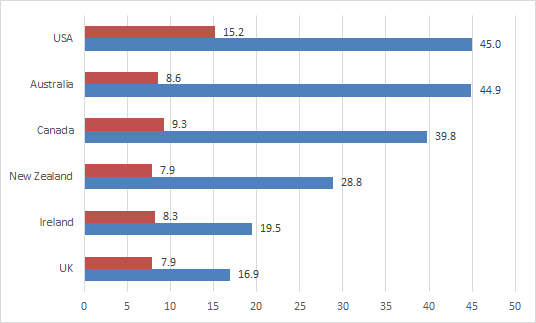
Figure 1: Child poverty rate by employment status of single parent, Anglo-Saxon countries, 2010
Source: OECD Family Database; Poverty thresholds are set at 50% of the median income of the entire population.
11 Jun 2015 Leave a comment
Divorce used to be biggest engine of single parenthood in America. No more. It's nonmarital childbearing cc@davidfrum http://t.co/J5yZtUukNW—
W Bradford Wilcox (@WilcoxNMP) June 10, 2015
09 Jun 2015 Leave a comment
in energy economics, politics - New Zealand Tags: child poverty, consumer price index, CPI inflation, energy prices, family poverty, fuel poverty, power prices
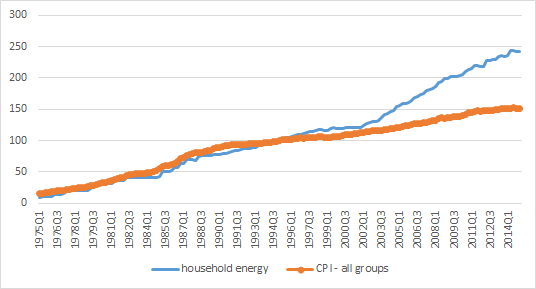
Energy prices seem to have been roaring ahead of consumer prices since the first quarter of 2001. Maybe that is a major contributor to fuel poverty in New Zealand and material deprivation among more poor households in the winter. What gives?
Figure 1: ratio of household energy price index to consumer price index – all groups, March quarter 1995 – March quarter 2015, base = 1995

Source: Statistics New Zealand Infoshare.
Figure 2: Household energy price index and consumer price index – all groups, March quarter 1975 – March quarter 2015, base = 1995
Source: Statistics New Zealand Infoshare.
05 Jun 2015 Leave a comment
in labour economics, minimum wage, poverty and inequality, welfare reform Tags: child poverty, family poverty, living wage, welfare state
Tough times? On #MayDay, compare % of low-paid #workers in yr country bit.ly/1EFrrV7 #LabourDay http://t.co/jNBrmjcom9—
(@OECD) May 01, 2015
Working for minimum wage? See how your country compares, then read oe.cd/mw2015 ( PDF) #wages http://t.co/DJsLYawtfw—
(@OECD) May 06, 2015
25 May 2015 Leave a comment
in economics of crime, economics of love and marriage, law and economics Tags: child abuse, child poverty, domestic violence, economics of the family, marriage and divorce, single parents
Children's likelihood of witnessing domestic violence, by family structure (w/ controls) family-studies.org/children-in-si… http://t.co/V1YGUZTSTh—
Inst. Family Studies (@FamStudies) January 05, 2015
24 May 2015 Leave a comment
in gender, labour economics, labour supply, welfare reform Tags: child poverty, economics of families, female labour force participation, paternal labour force participation, single parents
Figure 1: percentage of sole parents not working with youngest child aged 3-5, OECD, 2011

Source: OECD family database
Figure 2: percentage of sole parents part-time with youngest child aged 3-5, OECD, 2011

Source: OECD family database
23 May 2015 Leave a comment
in gender, labour economics, labour supply, welfare reform Tags: child poverty, economics of families, female labour force participation, paternal labour force participation, single parents
Figure 1: percentage of sole parents working with youngest child aged 6-14, 2011

Source: OECD family database
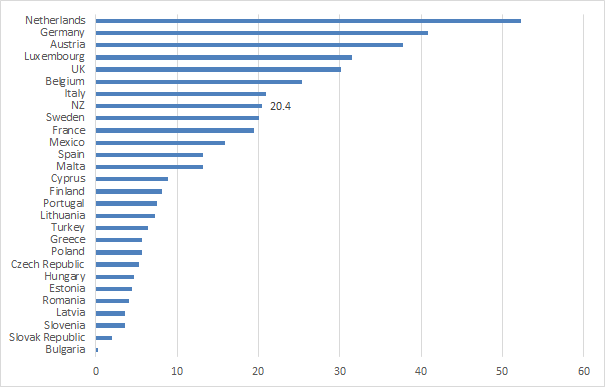
Figure 2: percentage of sole parents working part0time with youngest child aged 6-14, 2011
Source: OECD family database
22 May 2015 Leave a comment
in gender, labour economics, labour supply, welfare reform Tags: child poverty, economics of families, female labour force participation, paternal labour force participation, single parents
Figure 1: percentage of sole parents with youngest child aged under two not working, 2011

Source: OECD family database
Figure 2: percentage of sole parents with youngest child aged under two working part-time, 2011
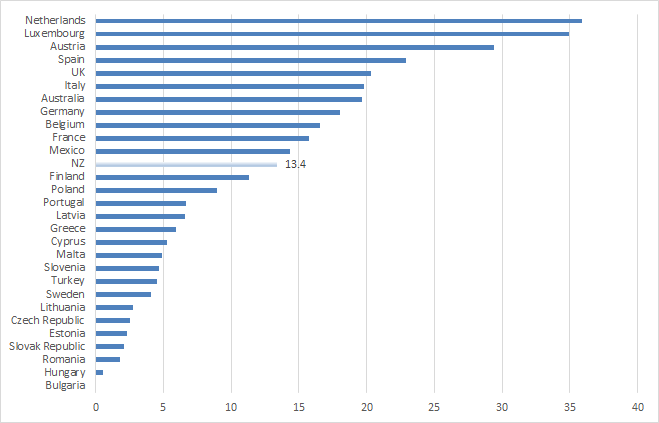
Source: OECD family database
20 May 2015 1 Comment
American families with single mothers face the greatest risk of falling into deep poverty: brook.gs/1IVXiTo http://t.co/dwLcQzvHkh—
Brookings (@BrookingsInst) May 13, 2015
18 May 2015 Leave a comment
in economics of education, gender, human capital, labour economics, labour supply, occupational choice, poverty and inequality, welfare reform Tags: child poverty, economics of marriage, family poverty, female labour force participation, labour force participation, male labour force participation, marriage and divorce, single parents, welfare reform
Helpful distinctions for family thinking: structure, stability & strength (&.. how related) @inclusionist @mboteach http://t.co/zMi92WYUhi—
Richard V. Reeves (@RichardvReeves) January 13, 2015
16 May 2015 Leave a comment
in economic history, labour economics, labour supply, poverty and inequality, welfare reform Tags: 1996 US welfare reforms, child poverty, family poverty, war on poverty

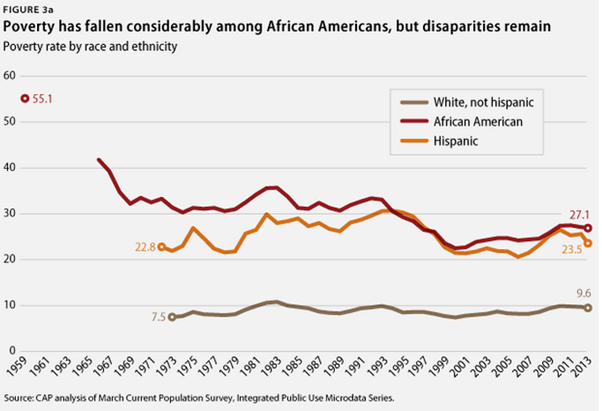
The big drop .in both child poverty and poverty in general was after the 1996 welfare reforms.


via Chart Book: The War on Poverty at 50, Section 1 | Center on Budget and Policy Priorities.
15 May 2015 Leave a comment
in applied welfare economics, economics of love and marriage, gender, labour economics, labour supply, occupational choice, politics - Australia, politics - New Zealand, politics - USA, population economics, welfare reform Tags: child poverty, economics of the family, family poverty, marriage and divorce, single mothers, single parents
CHART: Black Illegitimacy Rate Went from < 20% in 1950 to 75.2% in 2010. Has Obama ever mentioned that? http://t.co/1UBUQ5aLRi—
Mark J. Perry (@Mark_J_Perry) May 12, 2015
Quotation of the Day from Charles Murray http://t.co/Y8W6xGjRPO—
Mark J. Perry (@Mark_J_Perry) May 12, 2015
Celebrating humanity's flourishing through the spread of capitalism and the rule of law
Scholarly commentary on law, economics, and more
Beatrice Cherrier's blog
Celebrating humanity's flourishing through the spread of capitalism and the rule of law
Celebrating humanity's flourishing through the spread of capitalism and the rule of law
Celebrating humanity's flourishing through the spread of capitalism and the rule of law
Why Evolution is True is a blog written by Jerry Coyne, centered on evolution and biology but also dealing with diverse topics like politics, culture, and cats.
Celebrating humanity's flourishing through the spread of capitalism and the rule of law
Celebrating humanity's flourishing through the spread of capitalism and the rule of law
A rural perspective with a blue tint by Ele Ludemann
DPF's Kiwiblog - Fomenting Happy Mischief since 2003
Celebrating humanity's flourishing through the spread of capitalism and the rule of law
The world's most viewed site on global warming and climate change
Tim Harding's writings on rationality, informal logic and skepticism
A window into Doc Freiberger's library
Let's examine hard decisions!
Commentary on monetary policy in the spirit of R. G. Hawtrey
Thoughts on public policy and the media
Celebrating humanity's flourishing through the spread of capitalism and the rule of law
Politics and the economy
A blog (primarily) on Canadian and Commonwealth political history and institutions
Reading between the lines, and underneath the hype.
Economics, and such stuff as dreams are made on
"The British constitution has always been puzzling, and always will be." --Queen Elizabeth II
Celebrating humanity's flourishing through the spread of capitalism and the rule of law
Celebrating humanity's flourishing through the spread of capitalism and the rule of law
WORLD WAR II, MUSIC, HISTORY, HOLOCAUST
Undisciplined scholar, recovering academic
Celebrating humanity's flourishing through the spread of capitalism and the rule of law
Res ipsa loquitur - The thing itself speaks
Celebrating humanity's flourishing through the spread of capitalism and the rule of law
Researching the House of Commons, 1832-1868
Articles and research from the History of Parliament Trust
Reflections on books and art
Posts on the History of Law, Crime, and Justice
Celebrating humanity's flourishing through the spread of capitalism and the rule of law
Exploring the Monarchs of Europe
Cutting edge science you can dice with
Small Steps Toward A Much Better World
“We do not believe any group of men adequate enough or wise enough to operate without scrutiny or without criticism. We know that the only way to avoid error is to detect it, that the only way to detect it is to be free to inquire. We know that in secrecy error undetected will flourish and subvert”. - J Robert Oppenheimer.
The truth about the great wind power fraud - we're not here to debate the wind industry, we're here to destroy it.
Celebrating humanity's flourishing through the spread of capitalism and the rule of law
Celebrating humanity's flourishing through the spread of capitalism and the rule of law
Economics, public policy, monetary policy, financial regulation, with a New Zealand perspective
Celebrating humanity's flourishing through the spread of capitalism and the rule of law
Restraining Government in America and Around the World
 Utopia, you are standing in it!
Recent Comments