What are the payoffs of energy efficiency?
15 Dec 2015 Leave a comment
in economics of regulation, energy economics, environmental economics, global warming Tags: climate alarmism, energy efficiency
Were @jamespeshaw & @DrJamesHansen at the same #COP21
13 Dec 2015 Leave a comment
in economics of regulation, energy economics, environmental economics, global warming, politics - New Zealand Tags: climate aid, climate alarmism, green rent seeking, international climate treaties, New Zealand Greens
Paris was a tremendous defeat for the climate alarmists. Now that they have their treaty – a non-binding treaty – their ability to stir up political momentum to do more is undermined. If the environmental movement already has their agreement to save the world, why is anything more necessary. Especially anything that is costly to the hip-pocket such as a carbon tax.
The Greens, rarely for them, have settled for half measures. That was unwise considering these half measures are nothing at all apart from climate aid. Few like to remember that the Republicans still control the U.S. Congress. Centre-right parties control most governments in Europe.
Are @JulieAnneGenter @BjornLomborg attending the same #COP21
10 Dec 2015 1 Comment
in development economics, econometerics, energy economics, environmental economics, global warming, growth disasters, growth miracles, politics - New Zealand, Public Choice, rentseeking Tags: climate aid, climate alarmism, expressive voting, green rent seeking, New Zealand Greens, ODA, overseas development assistance
@jamespeshaw @BjornLomborg on @COP21
07 Dec 2015 Leave a comment
in energy economics, environmental economics, global warming Tags: climate alarmism
How much of the Netherlands is reclaimed?
05 Dec 2015 Leave a comment
in economic history, environmental economics, global warming Tags: climate alarmism, climate change adaptation, reclamation, The Netherlands
Is Paris the end of fossil fuel era?
04 Dec 2015 Leave a comment
in economic history, energy economics, environmental economics, global warming Tags: climate alarmism, Fossil Fuels, global warming, nuclear power, renewable energy, solar energy, wind power
Are Republican voters becoming climate alarmists?
03 Dec 2015 Leave a comment
in energy economics, environmental economics, global warming, politics - USA Tags: climate alarmism, expressive voting, rational ignorance, rational rationality, voter demographics
Is global warming our biggest problem?
02 Dec 2015 Leave a comment
in applied price theory, applied welfare economics, energy economics, environmental economics, global warming Tags: climate alarmism, Little ice age, younger dryas

The incentive effects of the living wage and a carbon tax @BernieSanders
25 Nov 2015 Leave a comment
in applied price theory, energy economics, labour economics, minimum wage, politics - USA Tags: 2016 presidential election, carbon tax, climate alarmism, expressive voting, Leftover Left, living wage, rational irrationality, Twitter left
The inconvenient truths of @AlGore
20 Nov 2015 Leave a comment
in environmental economics, global warming Tags: climate alarmism, expressive voting, political propaganda, rational ignorance, rational irrationality
Richard Tol on The road from Paris: whither climate policy?
03 Nov 2015 Leave a comment
in environmental economics, global warming Tags: climate alarmism, Richard Tol
@GreenpeaceNZ @jamespeshaw The Futility and Farce of Global Climate Negotiations @RichardTol
18 Oct 2015 Leave a comment
in constitutional political economy, development economics, economics of bureaucracy, environmental economics, environmentalism, global warming, growth disasters, growth miracles, international economics, politics - Australia, politics - New Zealand, politics - USA, Public Choice, rentseeking Tags: bootleggers and baptists, climate alarmism, expressive voting, free-riders, global warming, green tariffs, international public goods, Leftover Left, New Zealand Greens, Twitter left
It is time for the environmental movement to face up to the fact that there never will be an international treaty to restrain carbon emissions. The practical way to respond to global warming is healthier is wealthier, richer is safer. Faster economic growth creates more resources for resilience and adaptation to a changing environment.
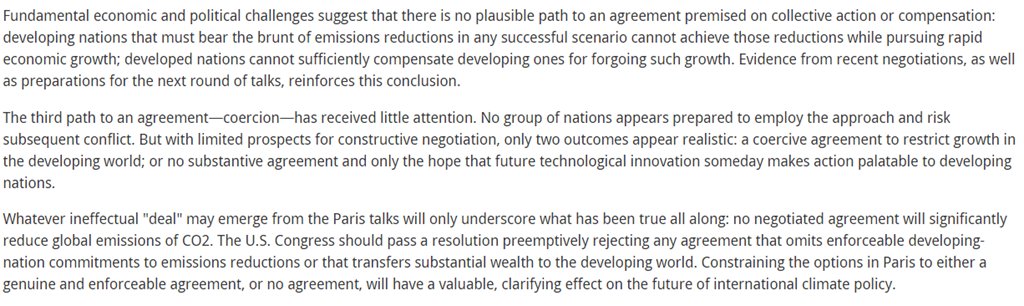
NEW REPORT: The Futility and Farce of Global Climate Negotiations bit.ly/1LvFFv3 http://t.co/TwbFUwaPlm—
Manhattan Institute (@ManhattanInst) October 17, 2015
India's target compared to its recent history http://t.co/pIvwhoSTpL—
Richard Tol (@RichardTol) October 02, 2015


 Utopia, you are standing in it!

Recent Comments