The second IPCC installment showed that the temperature rise that we are expected to see sometime around 2055-2080 will create a net cost of 0.2-2% of GDP – the equivalent of less than one year of recession…
Again, not surprisingly, politicians tried to have this finding deleted. British officials found the peer-reviewed estimate “completely meaningless,” and, along with Belgium, Norway, Japan, and the US, wanted it rewritten or stricken. One academic speculated that governments possibly felt “a little embarrassed” that their previous exaggerated claims would be undercut by the UN.
The third installment of the IPCC report showed that strong climate policies would be more expensive than claimed as well – costing upwards of 4% of GDP in 2030, 6% in 2050, and 11% by 2100.
And the real cost will likely be much higher, because these numbers assume smart policies, instantly enacted, with key technologies magically available.
Bjørn Lomborg says that the UN climate panel’s latest report tells a story that politicians prefer to ignore
09 Nov 2014 Leave a comment
in climate change, energy economics, environmental economics, global warming Tags: Bjørn Lomborg, climate alarmism, global warming, green rent seeking, IPCC
Yet another IPCC back down on the climate crisis
03 Nov 2014 Leave a comment
in environmental economics, global warming Tags: climate alarmism, global warming
How urgent is ‘urgent’?
03 Nov 2014 Leave a comment
in economics of climate change, energy economics, environmental economics, environmentalism Tags: climate alarmism, global warming

by Judith Curry
I think we have a very brief window of opportunity to deal with climate change . . . no longer than a decade at most. – James Hansen 2006
We have only four more years to act on climate change. – James Hansen 2009
View original post 980 more words
UN Grants The Planet A Century Long Reprieve
03 Nov 2014 Leave a comment
in climate change, economics of climate change, energy economics, environmental economics Tags: climate alarmism, global warming

Celebrate! The UN has granted Earth a 100 year reprieve from global warming.
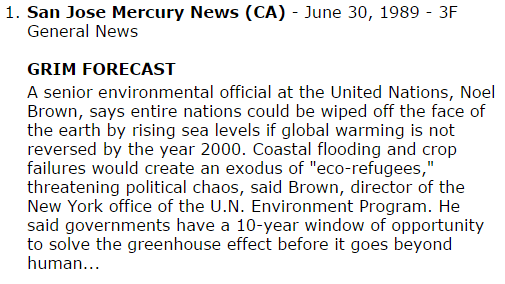
In 1989, the UN said we had until the end of the 20th century to save the planet from global warming – but now they say we have until the end of the 21st century.
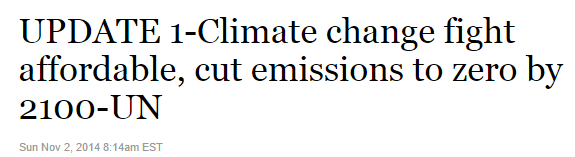
UPDATE 1-Climate change fight affordable, cut emissions to zero by 2100-UN

IPCC report shows Stern inflated climate change costs by Richard Tol
16 Oct 2014 12 Comments
in environmental economics, global warming Tags: climate alarmism, global warming, Nicolas Stern, Richard Tol

How much does climate change cost? What will be the impact on our wallets?
The latest report from the Intergovernmental Panel on Climate Change’s (IPCC) Working Group II has concluded that global warming of 2.5˚C would cost the equivalent to losing between 0.2-2.0% of annual income.
This seems in sharp contrast to the Stern Review of the Economics of Climate Change, which found it would cost 5-20%. How can that be?
The Stern Review was prepared by a team of civil servants and never reviewed (before publication) by independent experts. Some argue that the Stern Review served to bolster Gordon Brown’s credentials with the environmental wing of the Labour Party in preparation for his transition to party leader and prime minister. And in fact next week IPCC Working Group III will conclude that the Stern Review grossly underestimated the costs of bringing down greenhouse gas emissions.
While interested parties can self-publish whatever they want, such informally published grey literature has no place in the IPCC’s work. Although the Stern Review’s findings were not included in the IPCC’s current, Fifth Assessment Report (AR5), the Stern Review draws heavily on the climate change impact estimates of Chris Hope of Cambridge University, whose numbers are peer-reviewed, and were included in the IPCC’s work. Hope calculated a economic loss of 0.9%, slightly lower than the IPCC’s central estimate of 1.1%. So the Stern Review and IPCC AR5 do not contradict one another. If anything, the Stern Review is slightly more optimistic.
Playing with numbers
So how did the Stern Review reach its figure of 5%-20% of income, when in fact its calculations started with an estimate of less than 1%? The reason is an arcane bit of welfare economics. Dr Hope’s 0.9% is a conventional impact estimate. If the world warmed by 2.5˚C, the average person would feel as if they had lost 0.9% of her income. If the world warmed by more, the impact would be higher; if warming is less, the impact is lower.
The Stern Review’s 5% is generated like an annuity, taking a stream of payments that vary over time (in this case the predicted impact of climate change) and converting it into fixed annual payments. The Stern Review thus replaces the impact of more than 200 years of climate change – effects that start low and end high – with a number that is the same for each year. Most people find it confusing to replace numbers that vary over time with a single fixed number.
In order to calculate an annuity economists apply a discount rate, effectively representing the change in value of money over time. The Stern Review (as it was originally published in 2006) uses a discount rate of about 1.4% – far below what most people use, and indeed far lower than the official discount rate of Her Majesty’s Treasury of 3.5% (and falling further to 1% for those effects more than three centuries into the future). Using such a low discount rate inflates the annuity, and so the reported costs of climate change.
Stern’s argument for a low discount rate is a paternalistic one. People’s value judgements are wrong, according to the Stern Review, and the government has the right to overrule them. Stern puts himself in the position of a colonial ruler, governing the savages against their will – but in their own interest, of course.
The costs of uncertainty
Stern’s 5% figure also reflects the uncertainties about future climate change and its impact on our welfare. Combined with the low discount rate, this means that the headline number of the Stern Review is dominated by unlikely events in 200 years’ time. It does not reflect climate changes’ impact in the near term, or even the best estimate over a century. It is, by and large, a prediction based on the worst case scenario of two centuries from now.
Unfortunately, this worst case is internally inconsistent. It assumes both high greenhouse gas emissions and high vulnerability to the effects of climate change. That does not make sense. Essentially, it assumes that, for example, Africans will be rich enough to drive highly emitting SUVs, but too poor to buy mosquito nets to protect their children against malaria spread by increased numbers of insects that the warmer, wetter climate global warming would bring.
So while Stern reports a range of 5-20%, those figures do not truly represent upper and lower bounds. The 5% is their best estimate, reflecting all uncertainties. The 20% is an arbitrary number – it is based on assumptions on greenhouse gas emissions, climate change and climate impacts that the authors themselves find less credible.
Both studies agree that the economic impact of climate change is small – half a century of climate change at this rate would do perhaps as much damage as losing one year of economic growth. Unfortunately, the Stern Review hides this reasonably optimistic conclusion behind accounting tricks and dubious assumptions, creating a sense of disagreement that is not there.
via theconversation.com under Creative Commons Licence

Leo vs. science: vanishing evidence for climate change | New York Post
21 Sep 2014 Leave a comment
in climate change, environmental economics, global warming Tags: climate alarmism, global warming

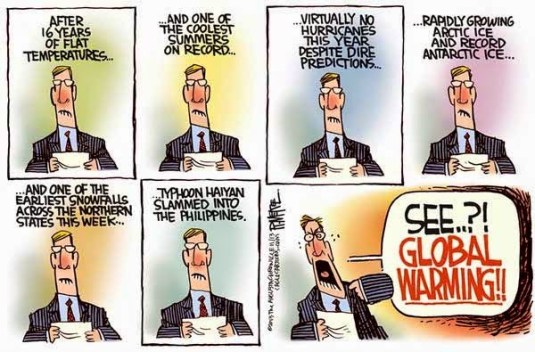
According to NASA satellites and all ground-based temperature measurements, global warming ceased in the late 1990s. This when CO2 levels have risen almost 10 percent since 1997. The post-1997 CO2 emissions represent an astonishing 30 percent of all human-related emissions since the Industrial Revolution began. That we’ve seen no warming contradicts all CO2-based climate models upon which global-warming concerns are founded.
Rates of sea-level rise remain small and are even slowing, over recent decades averaging about 1 millimeter per year as measured by tide gauges and 2 to 3 mm/year as inferred from “adjusted” satellite data. Again, this is far less than what the alarmists suggested.
Satellites also show that a greater area of Antarctic sea ice exists now than any time since space-based measurements began in 1979. In other words, the ice caps aren’t melting.
A 2012 IPCC report concluded that there has been no significant increase in either the frequency or intensity of extreme weather events in the modern era. The NIPCC 2013 report concluded the same. Yes, Hurricane Sandy was devastating — but it’s not part of any new trend.
via Leo vs. science: vanishing evidence for climate change | New York Post.
Climate Consensus: Do Little for Now
16 Sep 2014 1 Comment
in applied price theory, applied welfare economics, economics of natural disasters, environmental economics, global warming, health economics, liberalism, technological progress Tags: climate alarmism, cost benefit analysis, global warming, moral panic, richer is safer, wealthier is healthier

 Utopia, you are standing in it!
Recent Comments