Why China is at the heart of global climate-change deal. (Hint: red line) http://t.co/oQVRfDq90k by @willmauldin pic.twitter.com/EcuuCErPQy
— Amy Harder (@AmyAHarder) December 15, 2014
6 charts that show why UN climate talks keep breaking down – Vox
15 Dec 2014 Leave a comment
in economics of climate change, environmental economics, environmentalism, global warming Tags: climate alarmism, expressive voting, global warming
/assets.sbnation.com/uploads/chorus_asset/file/1374708/failing_at_two-degree_goal.0.png)
/assets.sbnation.com/uploads/chorus_asset/file/1374424/cumulative_historical_emissions.0.png)
/assets.sbnation.com/uploads/chorus_asset/file/1374568/China_s_per_capita_emissions.0.png)
/assets.sbnation.com/uploads/chorus_asset/file/1395414/outsourcing_emissions_2.0.png)
/assets.sbnation.com/uploads/chorus_asset/file/1374984/divvying_up_to_meet_the_budget.0.png)
/assets.sbnation.com/uploads/chorus_asset/file/1374504/Annex_B_vs_non_Annex_B.0.png)
Lima climate deal: Every single country now plans to tackle emissions. Sort of. – Vox
15 Dec 2014 Leave a comment
in climate change, energy economics, environmental economics, global warming Tags: climate alarmism, expressive voting, global warming
Global warming – where there is and is not a consensus to deny | Ordinary Times
14 Dec 2014 Leave a comment
in applied welfare economics, climate change, environmental economics, environmentalism, global warming, Karl Popper, politics - Australia, politics - New Zealand, politics - USA, Public Choice Tags: climate alarmism, expressive voting, global warming

The motte for climate change activists are the following:
- Global temperatures are rising.
- Greenhouse gases lead to increased temperatures.
- Greenhouse gases emitted by humans have led to measurable increases in temperature beyond what would have occurred without any humans.
The above points are highly defensible because Science. I believe they are true (though I do so only via trust in others rather than having evaluated any of the research involved personally).
Activists, however, do not sit in this motte for long. They often go on to make a lot of other claims in the bailey:
- Long-term projections of the Earth’s climate are accurate.
- Catastrophe will result in a few decades due to human carbon emissions.
- Nuclear energy is not a viable alternative to fossil fuels.
- Carbon capture is not viable.
- Geoengineering is not viable.
- Unilateral subsidization of renewables by Western industrialized nations is an effective way to reduce global emissions of greenhouse gases.
- Subsidies of energy-efficient products are a better use of resources rather than research and development.
- Subsidizing vehicles that pollute less than other vehicles will provide a net reduction in greenhouse emissions.
- LEED-certified buildings are more energy-efficient than old buildings.
- Building new LEED-certified buildings reduces net greenhouse emissions relative to not building them.
- Sending oil by railcar will result in less net emissions than sending oil through a pipeline (e.g. the Keystone pipeline).
Not all activists make all of these claims, but I think most make at least some claims that are less defensible than those in the motte.
The end result is that anyone who opposes any of the views, even questionable ones sitting in the bailey, can be branded an anti-science denialist. Strictly speaking, this is unfair since there certainly isn’t a scientific consensus on questions like whether it makes sense to spend thousands of dollars subsidizing Chevy Volts while taxing bicycles and safety helmets at 8%.
via An Example of the Motte and Bailey Doctrine | Ordinary Times.
Empirical / Tests Myths – CO2 and Climate Change
14 Dec 2014 Leave a comment
in environmental economics, global warming Tags: climate alarmism, global warming


EU’s rate of decarbonisation is identical before and after the ETS was introduced in 2000
13 Dec 2014 Leave a comment
in climate change, economics of climate change, environmental economics, global warming Tags: carbon tax, carbon trading, climate alarmism, European Union, expressive voting, global warming
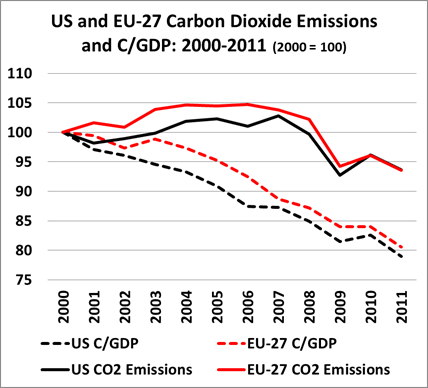 Whatever impact the EU ETS has had, the US achieved similar results with no carbon market (and some might argue, with no climate policy at all. Both the US and EU reduced aggregate emissions by 6.4 percent from 2000.
Climate Prediction Models That Can’t Predict Climate
13 Dec 2014 Leave a comment
in environmental economics, global warming Tags: climate alarmism, forecasting errors, global warming

HT: Bryan Caplan

This Greenpeace Stunt May Have Irreparably Damaged Peru’s Nazca Site
12 Dec 2014 Leave a comment
in economics of crime, environmental economics, global warming Tags: climate alarmism, eco-vandals, ecotourism, Greenpeace, vandalism


no one, not even presidents and cabinet ministers, was allowed where the activists had gone without authorisation and anyone who received permission must wear special shoes.
The Nazca lines are huge figures depicting living creatures, stylised plants and imaginary figures scratched on the surface of the ground between 1,500 and 2,000 years ago. They are believed to have had ritual functions related to astronomy.
via This Greenpeace Stunt May Have Irreparably Damaged Peru’s Nazca Site
What would you spend $200 million on?
11 Dec 2014 Leave a comment
in development economics, environmental economics, global warming Tags: climate alarmism, green rent seeking, overseas development assistance
Anti-science Left alert: Biotech and global warming
09 Dec 2014 Leave a comment
in environmental economics, global warming, health economics Tags: Anti-Science left, biotechnology, climate alarmism, GMOs, Quacks
Climate Change Denial Bingo!
06 Dec 2014 Leave a comment
in environmental economics, global warming Tags: climate alarmism, global warming


Recent Comments