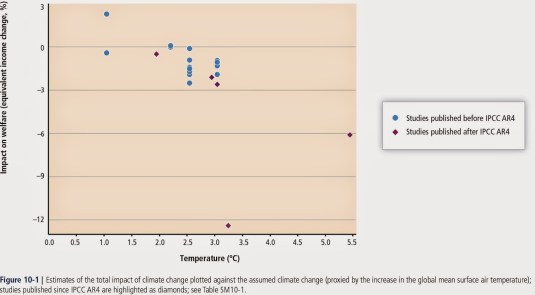
The above figure is as it appears in the final, published version of Chapter 10 of the Contribution of Working Group II to the Fifth Assessment Report of the Intergovernmental Panel on Climate Change.
via Richard Tol.
Celebrating humanity's flourishing through the spread of capitalism and the rule of law
05 Dec 2014 Leave a comment
The above figure is as it appears in the final, published version of Chapter 10 of the Contribution of Working Group II to the Fifth Assessment Report of the Intergovernmental Panel on Climate Change.
via Richard Tol.
04 Dec 2014 Leave a comment
01 Dec 2014 Leave a comment
in environmental economics, global warming, politics - Australia Tags: climate alarmism, global warming, green rent seeking
30 Nov 2014 Leave a comment
in economics of information, economics of media and culture, environmental economics, global warming Tags: climate alarmism, economics of advertising, global warming

But it apparently does not occur to them that, for someone not persuaded of their policies, the same argument applies to them, that, from the standpoint of the people they want to convince, the cartoon is a reason to be more skeptical of their views, not less.
via Ideas.
28 Nov 2014 Leave a comment
in applied price theory, applied welfare economics, environmental economics, global warming Tags: climate alarmism, cost benefit analysis, evidence-based policy, global warming

1. Physicians may not agree on the medical condition causing the symptoms the patient presents.
2. Even if physicians agree on their diagnoses, they often do not agree on the efficacy of alternative responses — for example, surgery or medical management for lower-back pain.
3. The reason patients seek advice and treatment is that they expect physicians to have vastly superior knowledge about the proper diagnosis and efficacy of treatment.
4. Medicine proceeds on the basis of double blind trials and other small field experiments. Control and treatment groups are used before any treatment is applied widely.
5. Medicine is not perfect as was the case with the misdiagnosis of the causes of stomach ulcers.
6. The lag between cause and effect are short as would be the case if you rejected emergency treatment after a car accident or cancer treatment.
7. Medicine tests the efficacy of invasive treatments, weighs side-effects and encourages adaptation and prevention.
8. The staying power of self-interest in medicine is well-known: much higher rates of surgery when there is fee for service and much lower rates of surgery if the patient is a doctor or his partner. The efforts of the medical profession to suppress competition is well-known.

28 Nov 2014 2 Comments
in energy economics, environmental economics, global warming Tags: climate alarmism, electric cars, expressive voting, global warming

The intrepid adventurer from the BBC drove the 778 kilometers from London to Edinburgh in an electric Mini, and had to stop eight times to recharge – often waiting six hours or more.
In total, he spent 80 hours waiting or driving, averaging just ten kilometers per hour – an unenviable pace even before the advent of the steam engine.
via BBC News – Mini adventure: how far can an electric car go?.
28 Nov 2014 Leave a comment
in energy economics, environmental economics, global warming Tags: climate alarmism, expressive voting, global warming
27 Nov 2014 Leave a comment
in environmental economics, global warming Tags: climate alarmism, global warming
20 Nov 2014 Leave a comment

.@cgiarclimate Debate on climate change always neglect crucial role of CO2 in agriculture @ifadnews @careemergencies http://t.co/Y3Du5YnF56—
Golden Rice Now (@paulevans18) July 17, 2015
20 Nov 2014 Leave a comment
in climate change, environmental economics, environmentalism, politics - USA Tags: climate alarmism, global warming
19 Nov 2014 Leave a comment
in climate change, environmental economics, global warming Tags: climate alarmism, global warming
17 Nov 2014 Leave a comment
in environmental economics, global warming Tags: climate alarmism, global warming
Celebrating humanity's flourishing through the spread of capitalism and the rule of law
Celebrating humanity's flourishing through the spread of capitalism and the rule of law
Celebrating humanity's flourishing through the spread of capitalism and the rule of law
Celebrating humanity's flourishing through the spread of capitalism and the rule of law
Celebrating humanity's flourishing through the spread of capitalism and the rule of law
Celebrating humanity's flourishing through the spread of capitalism and the rule of law
Celebrating humanity's flourishing through the spread of capitalism and the rule of law
Celebrating humanity's flourishing through the spread of capitalism and the rule of law
A History of the Alt-Right
Econ Prof at George Mason University, Economic Historian, Québécois
Celebrating humanity's flourishing through the spread of capitalism and the rule of law
Scholarly commentary on law, economics, and more
Beatrice Cherrier's blog
Celebrating humanity's flourishing through the spread of capitalism and the rule of law
Celebrating humanity's flourishing through the spread of capitalism and the rule of law
Celebrating humanity's flourishing through the spread of capitalism and the rule of law
Why Evolution is True is a blog written by Jerry Coyne, centered on evolution and biology but also dealing with diverse topics like politics, culture, and cats.
Celebrating humanity's flourishing through the spread of capitalism and the rule of law
A rural perspective with a blue tint by Ele Ludemann
DPF's Kiwiblog - Fomenting Happy Mischief since 2003
Celebrating humanity's flourishing through the spread of capitalism and the rule of law
The world's most viewed site on global warming and climate change
Tim Harding's writings on rationality, informal logic and skepticism
A window into Doc Freiberger's library
Let's examine hard decisions!
Commentary on monetary policy in the spirit of R. G. Hawtrey
Thoughts on public policy and the media
Celebrating humanity's flourishing through the spread of capitalism and the rule of law
Politics and the economy
A blog (primarily) on Canadian and Commonwealth political history and institutions
Reading between the lines, and underneath the hype.
Economics, and such stuff as dreams are made on
"The British constitution has always been puzzling, and always will be." --Queen Elizabeth II
Celebrating humanity's flourishing through the spread of capitalism and the rule of law
Celebrating humanity's flourishing through the spread of capitalism and the rule of law
WORLD WAR II, MUSIC, HISTORY, HOLOCAUST
Undisciplined scholar, recovering academic
Celebrating humanity's flourishing through the spread of capitalism and the rule of law
Res ipsa loquitur - The thing itself speaks
In Hume’s spirit, I will attempt to serve as an ambassador from my world of economics, and help in “finding topics of conversation fit for the entertainment of rational creatures.”
Researching the House of Commons, 1832-1868
Articles and research from the History of Parliament Trust
Reflections on books and art
Posts on the History of Law, Crime, and Justice
Celebrating humanity's flourishing through the spread of capitalism and the rule of law
Exploring the Monarchs of Europe


Recent Comments