Shaming Someone Doesn’t Change Their Mind
07 Feb 2017 Leave a comment
in economics of information, economics of media and culture Tags: cognitive psychology, moral psychology, political psychology

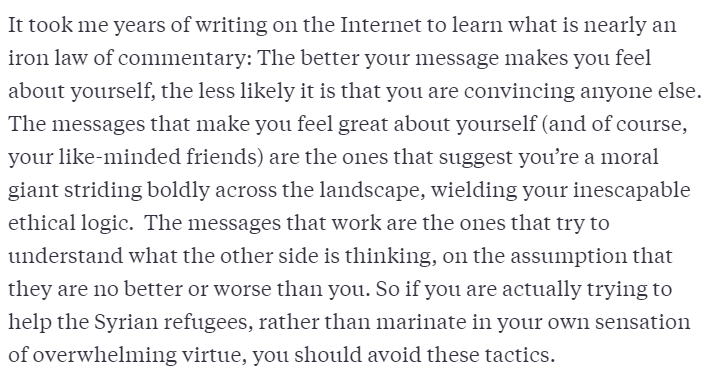
Megan McArdle’s iron law of commentary on refugee policy @GreenCatherine
24 Feb 2016 Leave a comment
in Economics of international refugee law, politics - Australia, politics - New Zealand, politics - USA Tags: asylum seekers, cognitive psychology, psychology of persuasion, refugee policy
Some intellectual traits
30 Dec 2015 Leave a comment
in liberalism Tags: cognitive psychology, conjecture and refutation, economics personality traits, personality psychology
A further explanation of the Dunning-Kruger effect
16 Nov 2015 Leave a comment
in economics of education, economics of media and culture Tags: cognitive psychology, Dunning-Kruger affect
A handy guide to irrational nonsense
28 Sep 2015 Leave a comment
in applied price theory, liberalism Tags: cognitive psychology, logical fallacies, philosophy of science, quackery, rational rationality

Robert Hare on treating psychopaths @EricCrampton @ATabarrok @ryanhmurphy
17 Sep 2015 Leave a comment
in applied price theory, economics of crime Tags: cognitive psychology, crime and punishment, criminal deterrence, economics of personality traits, psychiatry, psychopaths, Robert Hare, social psychology

There is a peak stupid
17 Sep 2015 Leave a comment
in managerial economics, organisational economics Tags: cognitive psychology, conjecture and refutation, Dunning-Kruger effect
Avoid Mount Stupid http://t.co/PrtPoRX3xJ—
Steve Case (@SteveCase) September 15, 2015
Is there a gender gap in the Dunning-Kruger effect?
10 Aug 2015 Leave a comment
in applied price theory, economics of education, economics of media and culture, gender, human capital, labour economics, personnel economics Tags: cognitive psychology, Dunning-Kruger effect, economics of personality traits, reversing gender gap
Great scientists know what they don't know. 1st step to learning. Female economists winning. blogs.lse.ac.uk/impactofsocial… http://t.co/xcfCvMNU3U—
S Dynarski (@dynarski) July 03, 2015
Low performers in maths by gender, USA, UK, Japan, Canada, Australia and New Zealand
17 Jul 2015 Leave a comment
in discrimination, economics of education, gender, human capital, labour economics Tags: cognitive psychology, educational psychology, lost boys, PISA, Psychology, reversing gender gap
Figure 1: % of students achieving a proficiency level below 2 in maths by gender, USA, UK, New Zealand, Japan, Canada and Australia, 2012
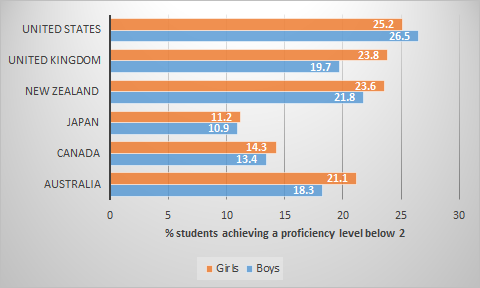
Source: OECD StatExtract.
Low performers in science by gender, USA, UK, Japan, Canada, Australia and New Zealand
16 Jul 2015 Leave a comment
in discrimination, economics of education, gender, labour economics, labour supply Tags: cognitive psychology, educational psychology, lost boys, PISA, Psychology, reversing gender gap
Figure 1: % of students achieving a proficiency level below 2 in science by gender, USA, UK, New Zealand, Japan, Canada and Australia, 2012

Source: OECD StatExtract.
Low performers in reading by gender, USA, UK, Japan, Canada, Australia and New Zealand
15 Jul 2015 1 Comment
in discrimination, economics of education, gender, human capital, labour economics Tags: cognitive psychology, education, lost boys, PISA, Psychology, reversing gender gap
Figure 1: % of students achieving a proficiency level below 2 in reading by gender, USA, UK, New Zealand, Japan, Canada and Australia, 2012

Source: OECD StatExtract.
A perspective on the overweening conceit of youth
14 Jul 2015 Leave a comment
in applied welfare economics, behavioural economics, economics of crime, economics of education, labour economics, law and economics Tags: child development, cognitive psychology, economics of personality traits, political psychology
 Utopia, you are standing in it!
Recent Comments