On 22 June 1990, 'Checkpoint Charlie', the famous crossing between East-West Berlin, was dismantled. #OTD http://t.co/XGLZiilBxr—
History Facts 247 (@historyfacts247) June 22, 2015
Checkpoint Charlie was dismantled today 1990
22 Jun 2015 Leave a comment
in economic history, Marxist economics Tags: Berlin wall, collapse of communism
Mr Gorbachev, Tear Down this Wall
13 Jun 2015 Leave a comment
in war and peace Tags: Berlin wall, collapse of communism, Ronald Reagan
Today in 1987 President Ronald Reagan publicly challenges Mikhail Gorbachev to tear down the Berlin Wall. http://t.co/oCiigdHoWW—
ClassicPics (@History_Pics) June 12, 2015
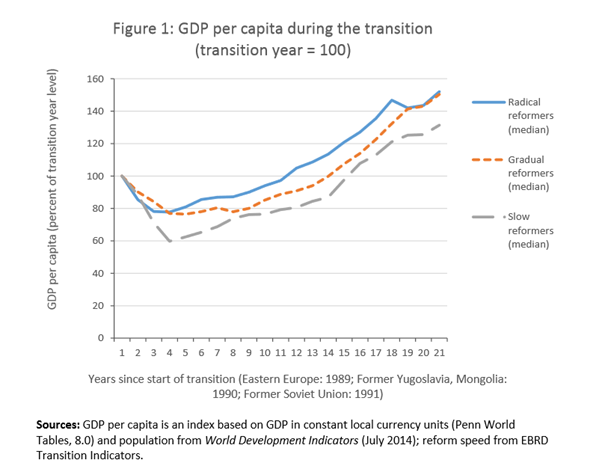
Should economic reform have been slower in the transitional economies?
03 Jun 2015 1 Comment
in comparative institutional analysis, constitutional political economy, development economics, economics of bureaucracy, growth disasters, growth miracles, Marxist economics, Public Choice, rentseeking Tags: collapse of communism, economics of socialism, economics of transition, former USSR, Russia

25 years later Berlin recreates the Wall with 8000 glowing balloons
08 Nov 2014 Leave a comment
in liberalism Tags: collapse of communism, fall of the Berlin wall
Berlin is just cool. 8,000 glowing balloons recreate the Berlin Wall, 25 yrs after its fall: wired.com/2014/11/8000-g… http://t.co/qWQZ4TyhLz—
Tabatha Southey (@TabathaSouthey) November 08, 2014
25 years ago today in East Berlin
05 Nov 2014 Leave a comment
in Marxist economics, politics, Public Choice Tags: collapse of communism, Fall the Berlin war
The Berlin Wall: 1989 and now
29 Oct 2014 Leave a comment
in liberalism Tags: Berlin wall, collapse of communism
 |
 |
 |
 |
 |
 |
 |
 |
 |
 |
After the Berlin wall fell, the local German club in Canberra purchased a piece of the Berlin wall and mounted it o the wall over its entrance. There are markets and everything, including historical icons of liberty.
Within hours of the fall of the Berlin wall, a buddy German entrepreneur or two noticed that a lot of people will want to buy a piece of the Berlin wall, including expatriate Germans. One way these entrepreneurs would have noticed would have been local Berliners sticking pieces of the wall in the boots of their cars to take home as souvenirs.

There were 184 kilometres (114 miles) of concrete, or 45,000 individual segments, and its commercial value was recognised early.

Showing a notable nascent capitalist instinct, ministers of the provisional GDR government passed a resolution to take commercial advantage of the Berlin Wall on December 29, 1989, before official demolition even began.

An East German foreign trade company, Limex-Bau, received the job of marketing the individual segments, which it apparently did with some success. Three-hundred-sixty segments were taken for their artistic value and sold all over the world for prices as high as 40,000 marks.

There are segments in Las Vegas casinos, South Korean parks and on Caribbean islands. The city of Berlin has also kept a few dozen segments to give away as ceremonial state gifts.
HT: spiegel.de
What Have We Learned from the Collapse of Communism? by Peter Boettke
13 Apr 2014 Leave a comment
in Austrian economics, constitutional political economy, development economics, entrepreneurship, law and economics, liberalism, Public Choice Tags: collapse of communism
the collapse of Communism has taught political economists several things:
first, that economic policy is always nested within a set of institutions—that there are economic/financial, political/legal, and social/cultural issues, which all must be taken into account;
second, that leadership matters throughout the transition process;
and third, that historical contingency can either work in your favour or cut against the successful transition.
And I would add a fourth one: that political power corrupts even the most informed and idealistic of individuals, such that you cannot count on ideological alignment to win the day. You have instead a small window of opportunity in which ideological alignment can be utilized to establish institutions that make it difficult for even bad men to do much harm.
In other words, the goal of our political/legal institutions should not be to ensure that the best and the brightest can govern, but instead that if the worst get in power, they can do little damage. This is the idea of a “robust political economy”.
 Utopia, you are standing in it!
Recent Comments