The gender commuting gap between mothers and fathers
28 Aug 2016 Leave a comment
in discrimination, economics of love and marriage, gender, human capital, labour economics, labour supply, occupational choice, poverty and inequality, transport economics Tags: asymmetric marriage premium, commuting times, compensating differentials, female labour force participation, gender gap, gender wage gap
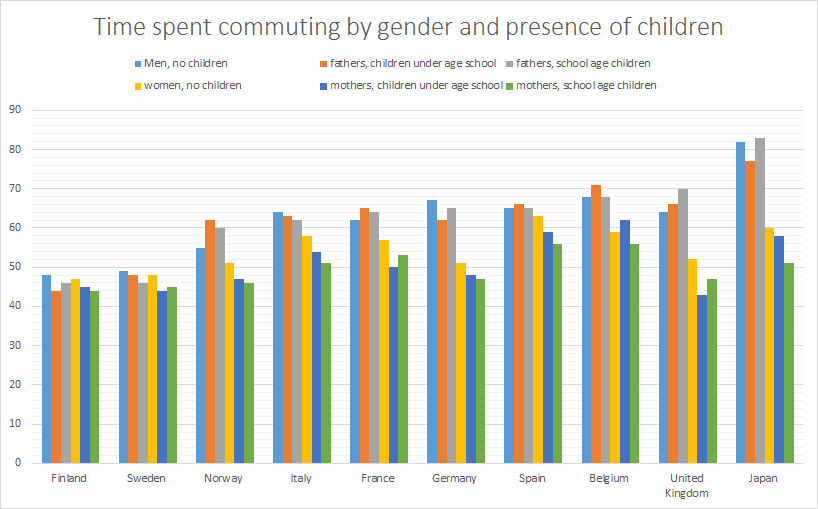
The first three bars in each cluster of bars are for men. in almost all countries mothers with dependent children spend less time commuting than childless women. This might suggest that working mothers have found workplaces closer to home than women without children. The gender gap in commuting where it is present in the country is larger than the gap between mothers and other women in their commuting time.
Source: OECD Family Database – OECD, Table LMF2.6.A.
Which occupations have the longest commutes?
05 Apr 2016 Leave a comment
in human capital, labour economics, occupational choice, transport economics, urban economics Tags: commuting times, compensating differentials

Gender commuting gap for workers who travel to and from home to work
04 Feb 2016 Leave a comment
in discrimination, gender, labour economics, labour supply, occupational choice, transport economics, urban economics Tags: commuting times, reverse gender gap
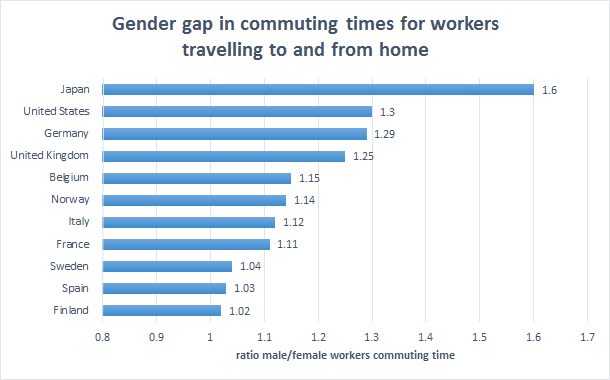
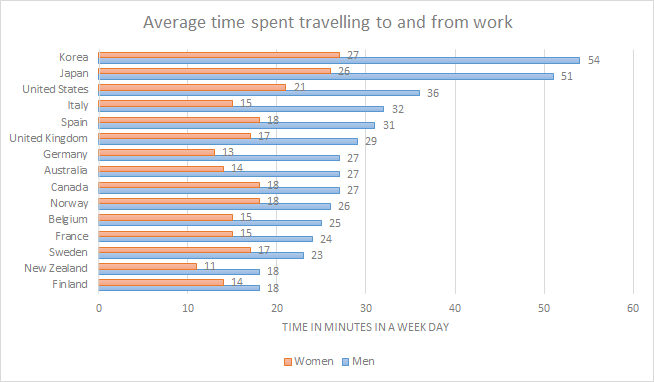
I lived in Japan so that 60% extra time the Japanese men spend travelling to and from work in those cramped trains is not to be underrated.
Source: OECD Family Database – OECD.
No asymmetric marriage premium in commuting: the family commuting gap for mothers and fathers travelling to and from work by school age of child in the UK, Germany, France and Italy
04 Feb 2016 Leave a comment
in discrimination, economics of love and marriage, gender, human capital, labour economics, labour supply, occupational choice, transport economics, urban economics Tags: asymmetric marriage premium, commuting times, gender wage gap, reversing gender gap
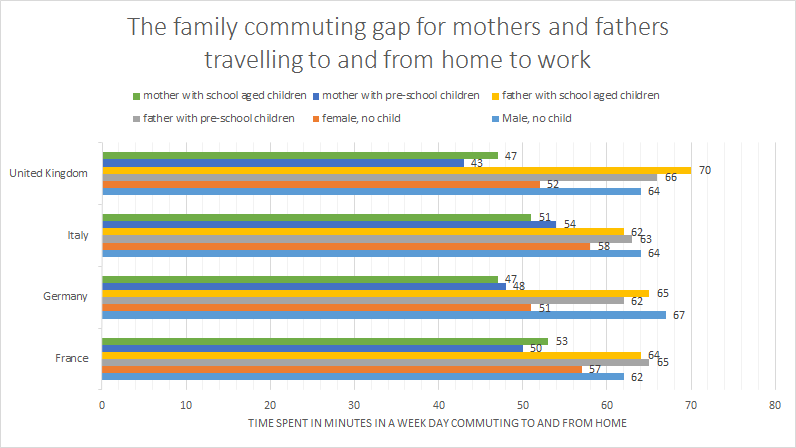
Few labour market statistics have any meaning unless broken down by gender. The compensating differentials that explain much of the family pay gap extend strongly to commuting times.
Source: OECD Family Database – OECD, Table LMF2.6.A.
Mothers commute a good 15 to 20 minutes less than fathers in the UK, Italy, Germany and France. Single women commute 5 to 10 minutes further than mothers. Single men and fathers commute much the same distance.
The reverse gender gap in commuting times across the OECD @JulieAnneGenter
31 Jan 2016 2 Comments
in discrimination, gender, labour economics, labour supply, occupational choice, transport economics, urban economics Tags: commuting times, compensating differentials, gender wage gap, reversing gender gap
Commuting times need to be incorporated into calculations of the gender wage gap because they do represent a serious fixed cost of working that is higher for men than for women.
Source: OECD Family Database.
Not only is the commuting time for female workers less, there is much less variation across the OECD member countries than for men.
The figures for New Zealand are so low that they are suspicious.
@NZGreens @TransportBlog cars rule in Auckland! Auckland commuting times by transport mode
21 Aug 2015 1 Comment
in job search and matching, labour economics, occupational choice, politics - New Zealand, transport economics, urban economics Tags: Auckland, bicycles, commuting times, compensating differentials, expressive voting, green rent seeking, Inner-city Left, New Zealand Greens, public transport, rational irrationality, search and matching, The fatal conceit, The pretense to knowledge
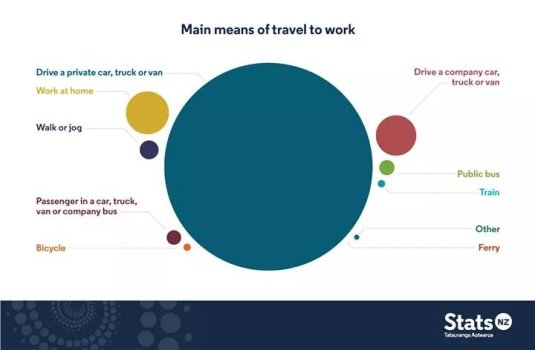
I am not surprised only 7% of Auckland’s take public transport to work considering it takes much longer than any other form of commuting.
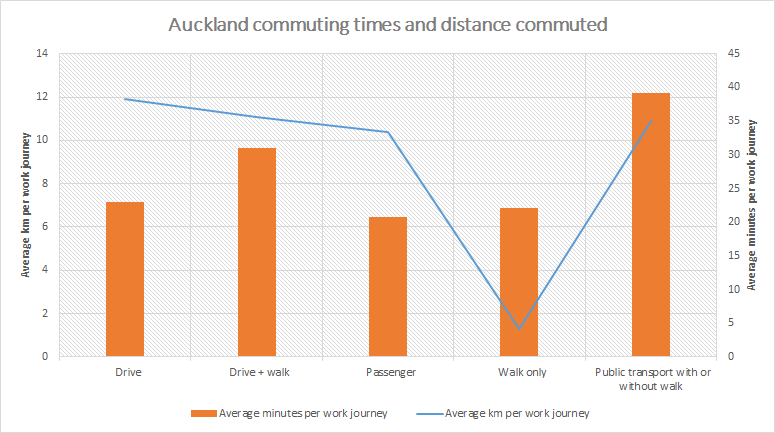
The average commute by public transport is 40 minutes as compared to less than 25 in a car. 74% of Aucklanders drive to work and another 9% are a passenger in a car.
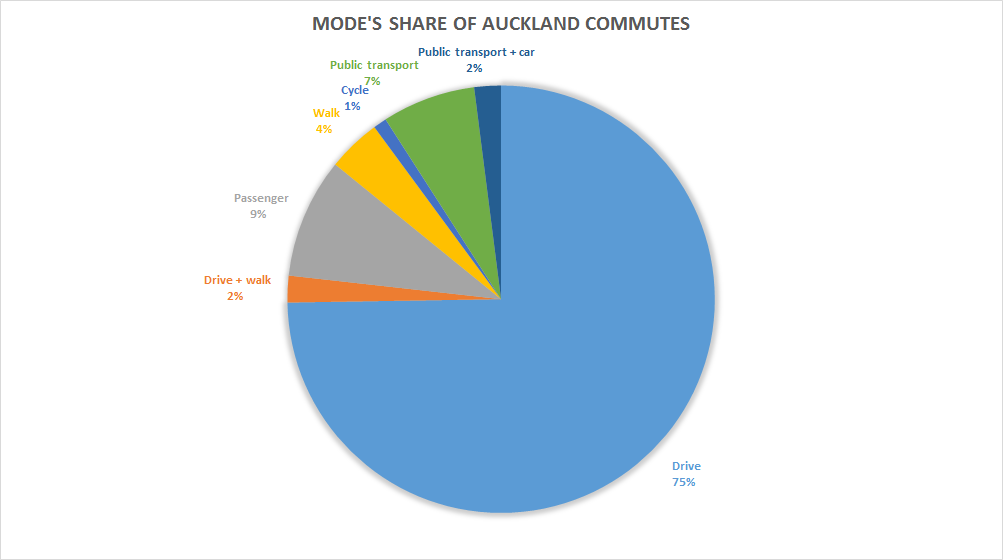
No information was available on those who bike to work because only 1% of Aucklanders bike to work. Only 2% of all New Zealanders take a bike to work. The sample size was therefore too small. Yet another reason to ban bikes at night. Few commute on this mode of transport in Auckland.
The near identical commuting distances irrespective of the mode of transport except walking is further evidence that people are quite discerning in balancing commuting times and job selection as per the theory of compensating differentials. Indeed, average commuting times in Auckland are much the same as the average commuting time in America.

The Auckland transport data showing people commute much the same distance by any mode of transport bar walking also validates Anthony Downs’ theory of triple convergence.

Improving the commuting times in one mode of transport will mean people simply take the mode of peak hour transport that is suddenly become less congested while others who were not going to commute at peak times or start commuting at peak times as Anthony Downs explains:
If that expressway’s capacity were doubled overnight, the next day’s traffic would flow rapidly because the same number of drivers would have twice as much road space.
But soon word would spread that this particular highway was no longer congested. Drivers who had once used that road before and after the peak hour to avoid congestion would shift back into the peak period. Other drivers who had been using alternative routes would shift onto this more convenient expressway. Even some commuters who had been using the subway or trains would start driving on this road during peak periods.
Within a short time, this triple convergence onto the expanded road during peak hours would make the road as congested as it was before its expansion.
 Utopia, you are standing in it!
Recent Comments