How did Germany and Japan achieve record economic growth following World War II?
08 Nov 2016 Leave a comment
in applied price theory, development economics, economic growth, economics of natural disasters, growth miracles, macroeconomics Tags: convergence, Germany, Japan
Who will be the 20 largest economies in 2030?
10 Jun 2015 Leave a comment
in development economics, economic growth, growth miracles, macroeconomics Tags: China, convergence, India, Japan
These will be the world’s 20 largest economies in 2030 bloom.bg/1IzgMhl http://t.co/KADxgakbEj—
Bloomberg VisualData (@BBGVisualData) May 20, 2015
US and Canadian real GDP per capita as a percentage of British GDP per capita, 1800–2010
19 May 2015 Leave a comment
in economic growth, economic history, macroeconomics, politics - USA Tags: British economy, Canada, convergence
Figure 1: US and Canadian real GDP per capita are as percentage of British GDP per capita (1990 Int. GK$PPP), 1800 – 2010
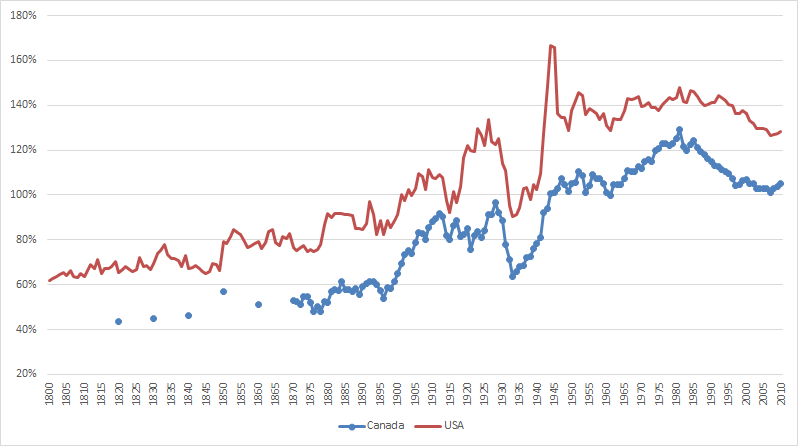
Source: The Maddison-Project, http://www.ggdc.net/maddison/maddison-project/home.htm 2013 version.
Colonial upstarts! British, American and Canadian real GDP per capita, 1775–2010
18 May 2015 Leave a comment
in economic growth, economic history, macroeconomics Tags: British economy, Canada, convergence, industrial revolution
The USA only overtook Britain in per capita GDP per capita in purchasing power parity terms early in the 20th century. Canada overtook the mother country in the post-war period.
Figure 1: British, American and Canadian GDP per capita (1990 Int. GK$PPP), 1775 – 2010

Source: The Maddison-Project, http://www.ggdc.net/maddison/maddison-project/home.htm 2013 version.
Figure 2: British, American and Canadian GDP per capita (1990 Int. GK$PPP), 1775 – 1870
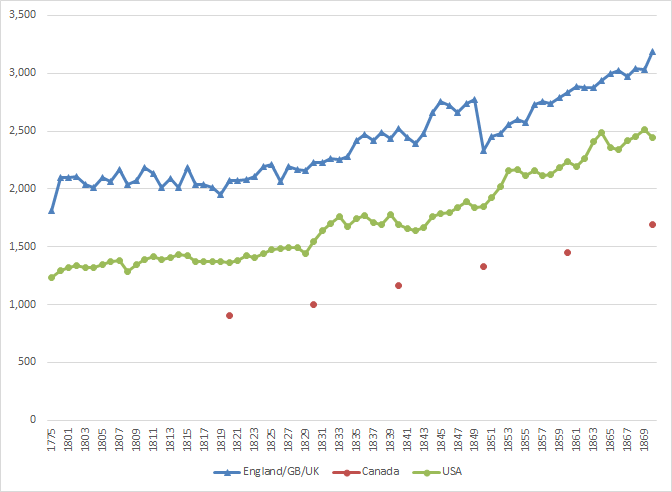
Source: The Maddison-Project, http://www.ggdc.net/maddison/maddison-project/home.htm 2013 version.
Figure 3: British, American and Canadian GDP per capita (1990 Int. GK$PPP), 1870 – 2010
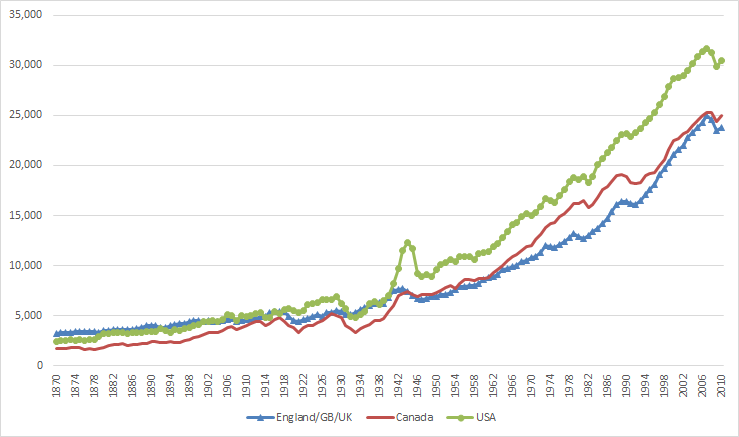
Source: The Maddison-Project, http://www.ggdc.net/maddison/maddison-project/home.htm 2013 version.
When did Down Under overtake the Mother Country? Real GDP Britain, Australia and New Zealand 1820–2010
17 May 2015 Leave a comment
in development economics, economic growth, economic history, growth disasters, growth miracles, macroeconomics Tags: Australia, British economy, convergence, lost decades, Maddison database, New Zealand
Pretty quickly according to figure 1. Britain, Australia and New Zealand quickly had similar standards of living in the middle of the 19th century until about 1880. Australia was richer for about 20 years until the great Federation drought took the wind out of its sails.
Figure 1: British, Australian and New Zealand GDP per capita (1990 Int. GK$PPP), 1820 – 2010
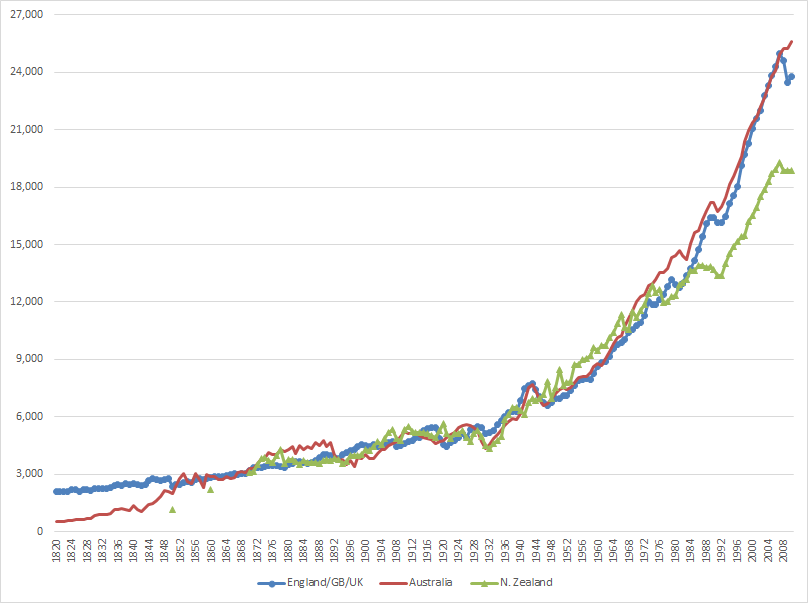
Source: The Maddison-Project, http://www.ggdc.net/maddison/maddison-project/home.htm 2013 version.
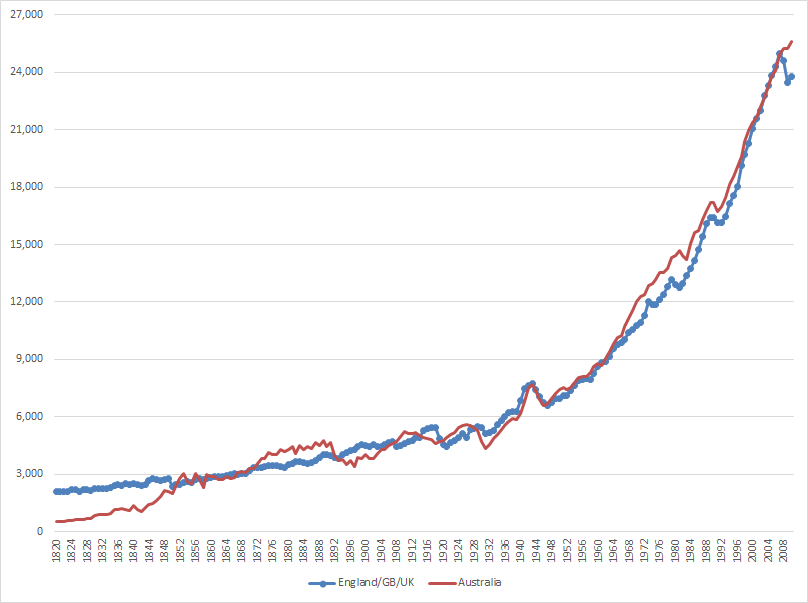
New Zealand then broke away at the end of the Second World War from both Australia and UK. In the mid-1960s circumstances changed with Australia drifting ahead of the UK and New Zealand drifting away to a lower standard of living.
Figure 2: British and Australian GDP per capita (1990 Int. GK$PPP), 1820 – 2010
Source: The Maddison-Project, http://www.ggdc.net/maddison/maddison-project/home.htm 2013 version.
Figure 2 shows that from about 1960 until 1990 Australia was richer than the UK. After that, the growth dividend of Thatchernomics allowed the British to catch up again to the Australians.
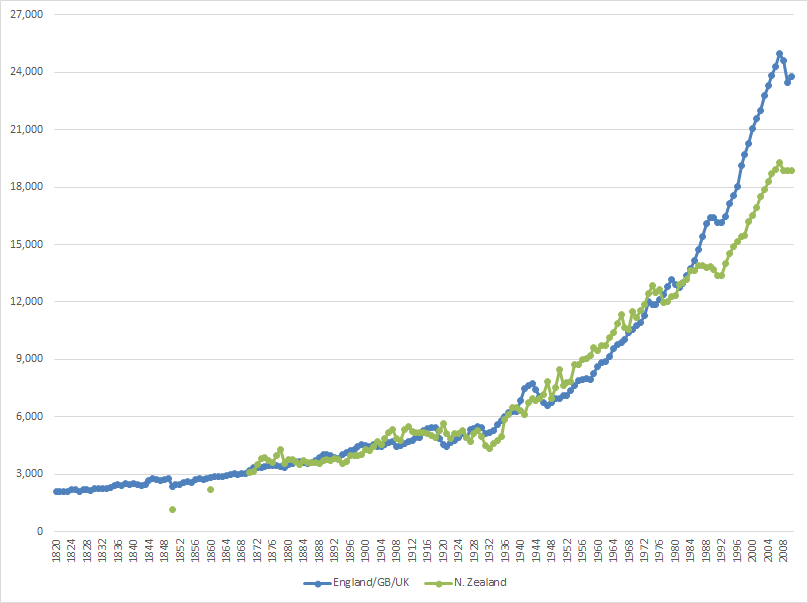
Figure 3: British and New Zealand GDP per capita (1990 Int. GK$PPP), 1820 – 2010
Source: The Maddison-Project, http://www.ggdc.net/maddison/maddison-project/home.htm 2013 version.
Figure 3 shows that New Zealand was richer than the UK in the mid-20th century. The lost decades in New Zealand from 1974 to 1992 let the sick man of Europe overtake New Zealand before Thatchernomics caused a growth spurt in the UK to take the British well ahead.
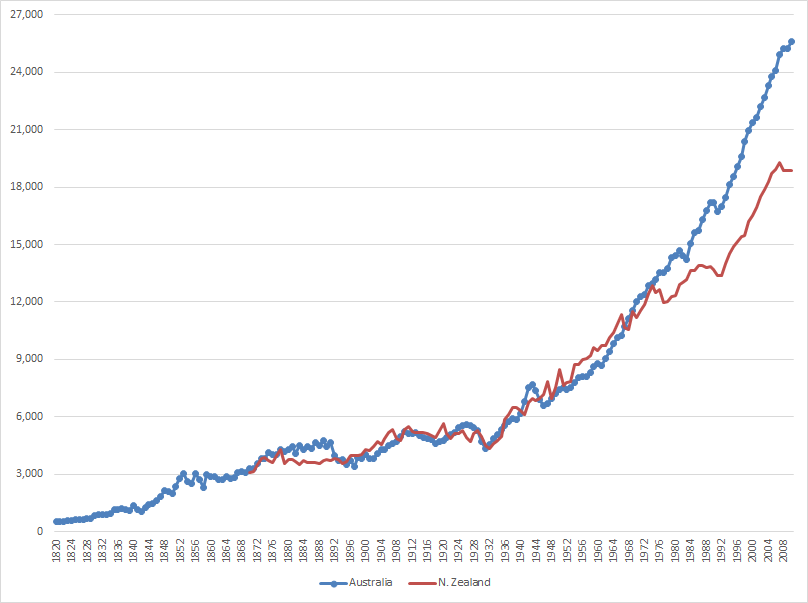
Figure 4: Australian and New Zealand GDP per capita (1990 Int. GK$PPP), 1820 – 2010
Source: The Maddison-Project, http://www.ggdc.net/maddison/maddison-project/home.htm 2013 version.
Figure 4 shows that New Zealand was richer than Australian in the first part of the post-war period. The divergence started with the onset of the lost decades in New Zealand in the early 1970s.
 Utopia, you are standing in it!
Recent Comments