Desperately seeking to agree with @JulieAnneGenter on transport investment quality

I just wrote an op-ed for National Business Review online (pay-walled) agreeing with an op-ed last week by Green MP Julie Anne Genter on transport investment. My op-ed started

The Taxpayers’ Union welcomes the commitment of the Green Party yesterday to evaluating transport investments without any bias or favouritism to one transport mode over another.

The Taxpayers’ Union could not agree more with Julie Anne Genter when she said that the question ministers should always ask is “what is the best investment we can make?”

This op-ed was my rejoinder to her reply to my op-ed criticising a recent Green Party on national freight policy. That policy called for 25% of all freight by kilometres travelled to each go by rail and road. That would near double their freight market share from 30% currently to 50% when measured by kilometre.

For my troubles I got nothing but criticism and accusations in the comments section in National Business Review Online. A tweet by Genter was far more gracious.

There was no praise in the comment section at the National Business Review online for agreeing with the Green policy. In the first comment I was told I did not understand economics and that

When the policy default is “cut taxes and spending and let me selfishly keep my money” they miss out on the much larger benefit to everyone, including themselves, by nudging or economy to spend more on intrinsically more efficient transport – like rail – and less on alternatives.

No thanks at all for agreeing that transport investments should be the best we can make. After saying that in their recent freight policy, the Greens set targets were specific transport technologies they favour, which are rail and sea freight. 

You cannot argue that transport investments should be the best we can make then declare a preference for a particular technology or mode of transport. But let us not quibble over that glaring contradiction.

The broader principle was agreed which is transport investments should be driven by cost benefit analysis and value for money. It should be technology neutral and transport mode neutral. That, of course, means the Greens cannot declare targets for the market shares of particular modes of freight shipment if they want to follow their own policy about value for money.
Does invested $1 in retrofitting saves $6 in health expenditure? @PhilTwyford @PeterDunneMP @AndrewLittleMP

Various bold claims have been made about the payoff from investing more in retrofitting insulation into housing. The government recently spent $600 million on such retrofitting of insulation.

https://twitter.com/PhilTwyford/status/728137160113557505

There is a private member’s bill before Parliament to introduce minimum standards for rental properties with regard to insulation and other matters. Little is by the Leader of the Opposition Andrew Little said for the consequences for rents of this additional expense to landlords.

Ian Harrison of Tail Risk Economics initially estimated that the $600 million invested in retrofitting of insulation will save barely half of that:

After correcting for this major error and taking a more realistic view of the benefit estimates in other studies, the net benefits of $630 million disappear.

The $600 million insulation investment will probably generate benefits of closer to $170 million, for an economic loss of $430 million.

After meeting with Ian, I read through the rather dull background documents behind a cost benefit analysis relied upon by the government to spend the $600 million dollars.

The most interesting part of the cost benefit analysis is most of the benefits come from fewer cardiovascular related hospitalisation of the elderly and not from respiratory diseases among children.

I found the error was far more fundamental than a incorrect transfer of a calculation between tables discussed in the first publication by Harrison. I had to read the background documents several times to understand what had been done wrong.

The cost benefit analysis for the Warm Up New Zealand Heat Smart Programme assumes that the number of elderly occupants of the newly insulated house increases by one each year and after 5 years, one of these dies but is replaced by a new elderly occupant.

We have modelled the probability of a vulnerable person avoiding mortality as a result of the intervention. The probability of this is (112.7/1000)*0.27= 0.03 (3%). We treat avoidance of mortality by treatment in each year as independent events.

The multi-year benefit calculated above would accrue based on the life years gained as a result of deaths avoided in year one.

However, we would expect these benefits to accrue in year two for different vulnerable individuals (aged 65 and over with a cardiovascular related hospitalisation in previous 18 months), and for different individuals again in every subsequent year that the treatment continues to have an effect, i.e. an on-going stream of benefits of $1,050.74 per year. This assumes a constant proportion of people aged 65+ who have recently been hospitalised with circulatory problems….( p.38).

In the first year of the new insulation, the first occupant benefits and the net present value is included in the benefit cost analysis calculation – the erroneous benefit cost analysis calculations which its authors still defend.

In the 2nd year, another elderly person moves into that same house and the same calculation is done for them. In the following year, yet another elderly person moves into the same house and the net present value calculation is repeated.

By the end of 5 years, there are 5 occupants in this house all benefiting from the same insulation investment. In the 6th year, the first elderly occupant dies to be replaced by a new elderly occupant who then gains from the insulation upgrade.

There was double counting of the number of people who benefited from the insulation as Iain Harrison explains

The analysis assumed that there was not one, but five occupants who had been hospitalised with a cardiovascular illness in the previous 18 months in each of the relevant insulated houses. There should have been only one such occupant.

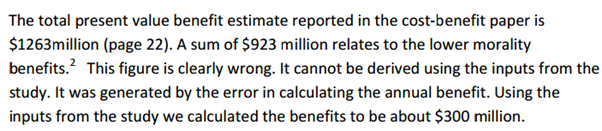
The retrofitting of insulation was estimated to cost $600 million. Iain Harrison estimated the benefits to be $300 million, not $1.2 billion. That is a benefit cost ratio of 0.5.

image

Source: Iain Harrison, The mortality reduction benefits of insulation: the error identified.

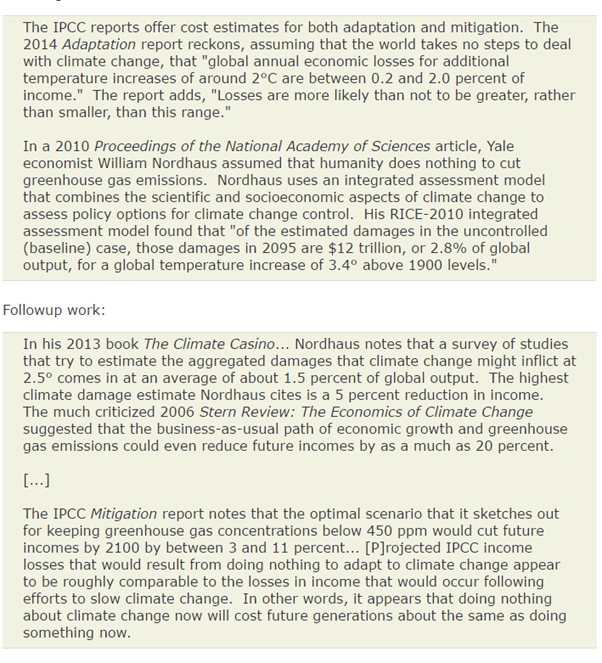
Oops, I overestimated the cost of doing nothing about global warming

image

Source: Global Warming, Cost-Benefit Analysis, and The End of Doom, Bryan Caplan | EconLog | Library of Economics and Liberty from Ron Bailey (2016) The End of Doom: Environmental Renewal in the Twenty-first Century.

FA Hayek on piecemeal analysis such as cost benefit analysis and evidence-based policy

The merits of different options to combat global warming

Is fighting global warming a good investment?

The selective nature of cost benefit analysis in health and safety policy

Image

A Cost-Benefit Approach to Public Policy – Jeff Miron

Video

Treat scientific advice on global warming like advice from your doctor


1. Physicians may not agree on the medical condition causing the symptoms the patient presents.

2. Even if physicians agree on their diagnoses, they often do not agree on the efficacy of alternative responses — for example, surgery or medical management for lower-back pain.

3. The reason patients seek advice and treatment is that they expect physicians to have vastly superior knowledge about the proper diagnosis and efficacy of treatment.

4. Medicine proceeds on the basis of double blind trials and other small field experiments. Control and treatment groups are used before any treatment is applied widely.

5. Medicine is not perfect as was the case with the misdiagnosis of the causes of stomach ulcers.

6. The lag between cause and effect are short as would be the case if you rejected emergency treatment after a car accident or cancer treatment.

7. Medicine tests the efficacy of invasive treatments, weighs side-effects and encourages adaptation and prevention.

8. The staying power of self-interest in medicine is well-known: much higher rates of surgery when there is fee for service and much lower rates of surgery if the patient is a doctor or his partner. The efforts of the medical profession to suppress competition is well-known.

caption

David Friedman on the costs and benefits of prevention and adaptation to global warming

Image

Hayek on the futility of cost benefit analysis of regulation

Image

Climate Consensus: Do Little for Now

via Climate Consensus: Do Little for Now : The Freeman : Foundation for Economic Education.

The Munger test is far better than cost benefit analysis

HT: Mike Munger (2014) Unicorn Governance

Image

Bassett, Brash & Hide

Celebrating humanity's flourishing through the spread of capitalism and the rule of law

Truth on the Market

Scholarly commentary on law, economics, and more

The Undercover Historian

Beatrice Cherrier's blog

Matua Kahurangi

Celebrating humanity's flourishing through the spread of capitalism and the rule of law

Temple of Sociology

Celebrating humanity's flourishing through the spread of capitalism and the rule of law

Velvet Glove, Iron Fist

Celebrating humanity's flourishing through the spread of capitalism and the rule of law

Why Evolution Is True

Why Evolution is True is a blog written by Jerry Coyne, centered on evolution and biology but also dealing with diverse topics like politics, culture, and cats.

Down to Earth Kiwi

Celebrating humanity's flourishing through the spread of capitalism and the rule of law

NoTricksZone

Celebrating humanity's flourishing through the spread of capitalism and the rule of law

Homepaddock

A rural perspective with a blue tint by Ele Ludemann

Kiwiblog

DPF's Kiwiblog - Fomenting Happy Mischief since 2003

The Dangerous Economist

Celebrating humanity's flourishing through the spread of capitalism and the rule of law

Watts Up With That?

The world's most viewed site on global warming and climate change

The Logical Place

Tim Harding's writings on rationality, informal logic and skepticism

Doc's Books

A window into Doc Freiberger's library

The Risk-Monger

Let's examine hard decisions!

Uneasy Money

Commentary on monetary policy in the spirit of R. G. Hawtrey

Barrie Saunders

Thoughts on public policy and the media

Liberty Scott

Celebrating humanity's flourishing through the spread of capitalism and the rule of law

Point of Order

Politics and the economy

James Bowden's Blog

A blog (primarily) on Canadian and Commonwealth political history and institutions

Science Matters

Reading between the lines, and underneath the hype.

Peter Winsley

Economics, and such stuff as dreams are made on

A Venerable Puzzle

"The British constitution has always been puzzling, and always will be." --Queen Elizabeth II

The Antiplanner

Celebrating humanity's flourishing through the spread of capitalism and the rule of law

Bet On It

Celebrating humanity's flourishing through the spread of capitalism and the rule of law

History of Sorts

WORLD WAR II, MUSIC, HISTORY, HOLOCAUST

Roger Pielke Jr.

Undisciplined scholar, recovering academic

Offsetting Behaviour

Celebrating humanity's flourishing through the spread of capitalism and the rule of law

JONATHAN TURLEY

Res ipsa loquitur - The thing itself speaks

Conversable Economist

Celebrating humanity's flourishing through the spread of capitalism and the rule of law

The Victorian Commons

Researching the House of Commons, 1832-1868

The History of Parliament

Articles and research from the History of Parliament Trust

Books & Boots

Reflections on books and art

Legal History Miscellany

Posts on the History of Law, Crime, and Justice

Sex, Drugs and Economics

Celebrating humanity's flourishing through the spread of capitalism and the rule of law

European Royal History

Exploring the Monarchs of Europe

Tallbloke's Talkshop

Cutting edge science you can dice with

Marginal REVOLUTION

Small Steps Toward A Much Better World

NOT A LOT OF PEOPLE KNOW THAT

“We do not believe any group of men adequate enough or wise enough to operate without scrutiny or without criticism. We know that the only way to avoid error is to detect it, that the only way to detect it is to be free to inquire. We know that in secrecy error undetected will flourish and subvert”. - J Robert Oppenheimer.

STOP THESE THINGS

The truth about the great wind power fraud - we're not here to debate the wind industry, we're here to destroy it.

Lindsay Mitchell

Celebrating humanity's flourishing through the spread of capitalism and the rule of law

Alt-M

Celebrating humanity's flourishing through the spread of capitalism and the rule of law

croaking cassandra

Economics, public policy, monetary policy, financial regulation, with a New Zealand perspective

The Grumpy Economist

Celebrating humanity's flourishing through the spread of capitalism and the rule of law

International Liberty

Restraining Government in America and Around the World