The trivial role of conservation in forestry conservation
13 May 2015 Leave a comment
in environmental economics, environmentalism, resource economics Tags: conservation, creative destruction, innovation, profit and loss
Creative destruction in magazines
13 May 2015 Leave a comment
in economic history, economics of media and culture, entrepreneurship, industrial organisation, survivor principle Tags: creative destruction, entrepreneurial alertness, Internet, legacy media, magazines, market selection
The Death of the One-Hit Wonder
13 May 2015 Leave a comment
in economic history, economics of media and culture, entrepreneurship, Music Tags: consumer sovereignty, creative destruction, entrepreneurial alertness, market selection, one-hit wonders, superstar wages, superstars, The meaning of competition

In a recent article, The Atlantic argues that while record labels used to be able to determine which songs would become radio hits, stations now rely more heavily on consumer preferences.
In short, iHeartMedia, the conglomerate that owns 850 radio stations, doesn’t care about the desire of the music industry for a quicker hit cycle so they can sell more units. They just don’t want you to change the channel — and the best way to keep you tuned in is to keep playing the same songs.
Another factor is that 1% of artists earn 77% of all revenues from recorded music. Modern music is dominated by superstars. Some of these are quite old superstars from many decades ago when they first had their first hit. The industry circling its wagons:
Just as the movie industry seems to be relying more heavily on sequels, the music industry is putting more emphasis on promoting established artists.
In a turbulent marketplace, record companies are liable to be more risk averse. Developing new artists who might hit it big is less appealing when the prize is projected to get smaller.
Creative destruction in occupations
12 May 2015 Leave a comment
in labour economics, labour supply, occupational choice, personnel economics Tags: creative destruction, innovation, skill biased technological change
"The Changing Nature of Middle-Class Jobs" – via @nytimes nyti.ms/17Jzp1N http://t.co/2vRL6idiXt—
PewResearch FactTank (@FactTank) February 22, 2015
The robots are coming, the robots are coming – been there, done that in Japan
12 May 2015 1 Comment
in applied price theory, development economics, economic history, entrepreneurship, growth miracles, industrial organisation, labour economics, labour supply, survivor principle, unemployment Tags: creative destruction, entrepreneurial alertness, innovation, Japan, technological unemployment
When I was a kid, I used to like reading the Encyclopaedia Britannica. I read them from cover to cover.
One of the things I recalled from the Encyclopaedia Britannica was that in 1961 nearly half of the Japanese workforce worked in the agricultural sector.
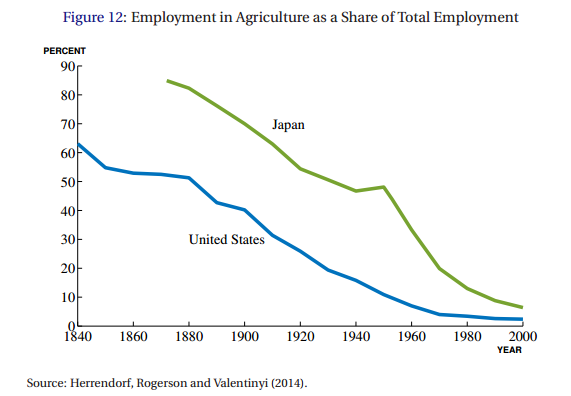
I notice that anomaly when I was reading the Encyclopaedia Britannica entry on Japan in the 1970s. Japan had undergoing an economic transformation since my Encyclopaedia Britannica’s were written in 1961. It was very much out of date.
Australian manufacturing was being outcompeted in every direction from automobiles to clothing and footwear by the Japanese manufacturing sector back when I was a teenager.
The Japanese economic miracle absorbed the Japanese agricultural labour force without anybody having time to shout "the robots are coming, the robots are coming".

There is a lesson in there somewhere for the current breathless journalism, with far too many academic fellow travellers about "the robots are coming, the robots are coming".
When I was a student at graduate school in Japan, I visited a Japanese factory in 1996 that was completely automated bar one function. Only once did a human hand actually touch the electrical goods they were making. Naturally, at the Q&A session at the end of our visit, I asked when was his job going to be automated.

Creative destruction in newsrooms
11 May 2015 Leave a comment
in economics of media and culture, entrepreneurship Tags: creative destruction, entrepreneurial alertness
U.S. Newsroom employment is down to a 30-year low, as the #newspaper crisis continues statista.com/topics/994/new… http://t.co/teMPPAkAEd—
Statista (@StatistaCharts) September 18, 2013
No signs of a newspaper crisis in Asia and Latin America (as of yet) statista.com/topics/994/new… http://t.co/701eDUPVOy—
Statista (@StatistaCharts) June 05, 2013
Creative destruction in browsers
10 May 2015 Leave a comment
in economics of media and culture, entrepreneurship Tags: creative destruction, entrepreneurial alertness, Firefox, Google
• Chart: 5 Years After Launch, #Chrome is on Top of the Browser World statista.com/topics/1001/go… http://t.co/JukAKTj7DB—
Statista (@StatistaCharts) September 06, 2013
• Chart: Google #Chrome is Winning the Browser Wars statista.com/markets/21/int… http://t.co/FOWFywpUn2—
Statista (@StatistaCharts) August 15, 2013
The U.S. #newspaper industry is in bad shape according to this alarming chart. #publishing statista.com/topics/994/new… http://t.co/zWLU3PNme6—
Statista (@StatistaCharts) April 16, 2013
Delivering a computer – 1957 and now
09 May 2015 Leave a comment
1957: 13 men delivering a computer.
2017: a person may wear 13 computing devices http://t.co/ORE45mw5x0—
Vala Afshar (@ValaAfshar) January 11, 2015
How does the consumer price index cope with the Great Enrichment?
08 May 2015 1 Comment
in entrepreneurship, technological progress Tags: creative destruction, entrepreneurial alertness, living standards, mismeasurement of prosperity, Moore's law, The Great Enrichment, The Great Fact


Creative destruction in media consumption
08 May 2015 Leave a comment
#Dailychart: In 2015 consumers will spend more time online than watching TV econ.st/1EU7g5Q http://t.co/pqKNum7CU5—
The Economist (@EconBizFin) May 05, 2015
Creative destruction in US Brewery Count since 1874
07 May 2015 Leave a comment
in industrial organisation, survivor principle Tags: beer, creative destruction
The prizes for guessing that a lot of US breweries closed during the prohibition era. Numbers were falling rapidly before prohibition because of the ready availability of reliable pure drinking water and electricity.
CHART: US Brewery Count 1874 to 2014 http://t.co/B4nlJTRA18—
Mark J. Perry (@Mark_J_Perry) April 12, 2015
Up until the early 20th century, people did not drink beer that wasn’t bought from an area nearby because of the difficulties of preserving beer through refrigeration. Once electricity was readily available to refrigerate beer, the economies of scale kicked in.
Initially, beer was for the masses and there was may be one or two beers on tap at any part in Australia or New Zealand. Very few bottled beers were available behind the bar.
CHART: Americans sure love macro-brewed swill. Top 4 selling US beers: Bud Light, Coors Light, Bud, Miller Lite. http://t.co/W1Sh9LvPYh—
Mark J. Perry (@Mark_J_Perry) March 31, 2015
In recent decades, there has been the rise of boutique beers as incomes have risen. A number of tasty boutique beers emerged emerged on the market. I’d like a particular Belgian beer because it has cinnamon in it.
Creative destruction in PCs – how powerful was the first PC in 1980?
06 May 2015 Leave a comment
in economics of media and culture, entrepreneurship, industrial organisation, survivor principle, technological progress Tags: creative destruction, entrepreneurial alertness, PCs
"The march of technology"-Abrash
1980 4MHz computer: $6000
2015 TitanX: $1000
30 years & 1,000,000,000X more powerful http://t.co/zTexe8d259—
Darshan Shankar (@DShankar) March 26, 2015
Abrash demonstrating how quickly tech has evolved over time #f8 #VR http://t.co/TymEpfyHwv—
Mashable (@mashable) March 26, 2015
Twitter is growing faster than Facebook, relatively speaking
05 May 2015 Leave a comment
in economics of media and culture, entrepreneurship, financial economics, industrial organisation, survivor principle Tags: creative destruction, Facebook, Twitter
The robots are coming, the robots are coming – creative destruction in time telling
04 May 2015 Leave a comment
in entrepreneurship, industrial organisation, survivor principle Tags: creative destruction, entrepreneurial alertness, technological unemployment
Before alarm clocks were affordable, 'knocker-ups' were used to wake people early in the morning. UK, around 1900 http://t.co/wD24qR85Jg—
History Pics (@HistoryPixs) January 20, 2014
Creative destruction in advertising revenue
04 May 2015 Leave a comment
in economics of information, economics of media and culture, environmental economics, industrial organisation, survivor principle Tags: creative destruction, economics of advertising, entrepreneurial alertness, Google, legacy media, markets selection, The meaning of competition


Recent Comments