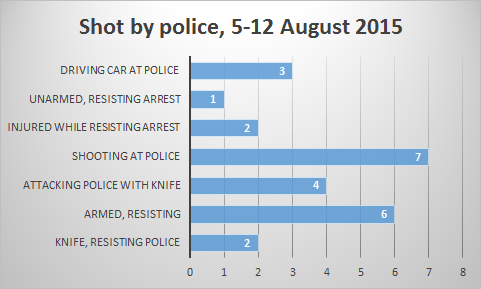
@radleybalko @thecounted 25 killed by police 5-12 August. How did they die? @PoliticalLine
12 Aug 2015 Leave a comment
in economics of crime, law and economics, politics - USA Tags: common law, crime and punishment, criminal deterrence, law enforcement, police
Using Enron to explain Bedford’s law of forensics statistics
02 Aug 2015 Leave a comment
in applied price theory, economics of crime, law and economics Tags: Benford's law, crime and punishment, forensics statistics
Some frauds are sometimes easier to uncover. For example, in a recent Iranian presidential election, the governing candidate led by 2 to 1 votes all night. Next to no variation despite returns coming in from the more liberal cities and the rather conservative country ballot boxes.
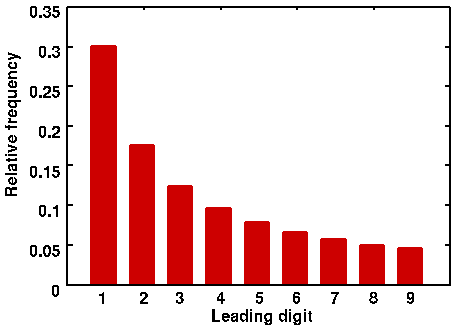
Bedford’s law is used to uncover fraud through peculiarity in the occurrence of numbers. The law states that in many naturally occurring collections of numbers, the small digits occur disproportionately often as leading significant digits such as the number one.
In the finest traditions of Stephen Stigler’s law of scientific epiphany, Benford was the second person to discover it and he got credit for it rather than the first (Simon Newcomb) by undertaking a proper analysis:
Newcomb didn’t provide any sort of explanation for his finding. He noted it as a curiosity, and in the face of a general lack of interest it was quickly forgotten.
That was until 1938, when Frank Benford, a physicist at the general electric company, noticed the same pattern. Fascinated by this discovery, Benford set out to see exactly how well numbers from the real world corresponded to the law. He collected an enormous set of data including baseball statistics, areas of river catchments, and the addresses of the first 342 people listed in the book American Men of Science.
Benford observed that even using such a menagerie of data, the numbers were a good approximation to the law that Newcomb had discovered half a century before.
About 30% began with 1, 18% with 2 and so on. His analysis was evidence for the existence of the law, but Benford, also, was unable to explain quite why this should be so.
If someone tries to falsify numbers, they will have to invent some data. They use too many numbers starting with digits in the mid range, 5,6,7 and not enough numbers starting with 1. This violation of Bedford’s Law, suggesting the possibility such as at Enron.
Death rates for homicide, black and white males aged 15 to 19, USA, 1950-2013
01 Aug 2015 Leave a comment
in economic history, economics of crime, law and economics, politics - USA Tags: crime and punishment, life expectancies
Figure 1: Death rates for homicide, black and white males aged 15 to 19: United States, selected years 1950-2013
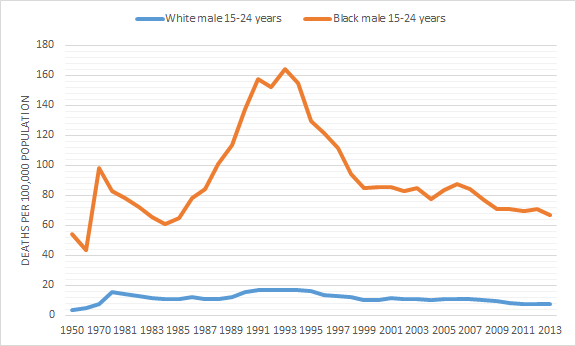
Source: Centres for Disease Control and Prevention.
The death toll in high-speed police chases
30 Jul 2015 1 Comment
in economics of crime, law and economics, transport economics Tags: crime and punishment, law and order, law enforcement, police, trade-offs, unintended consequences
High-speed police chases kill 330 people per year, one-third of whom are innocent bystanders: priceonomics.com/the-case-for-b… http://t.co/uFmzxgcplk—
Zachary Crockett (@zzcrockett) July 22, 2015
Crimes by age and offence category
27 Jul 2015 Leave a comment
in economics of crime, human capital, labour economics, labour supply, law and economics, occupational choice, politics - USA Tags: crime and punishment, criminal deterrence
How to make the case for arming British police when attacking American police shootings
26 Jul 2015 Leave a comment
in economics of crime, health and safety, labour economics, law and economics, politics - USA Tags: common law, crime and punishment, law enforcement, occupational health and safety, police, rule of law
More British English, Scottish and Welsh police (68) have been murdered by gunfire than British police have shot people dead (52) in over a century.
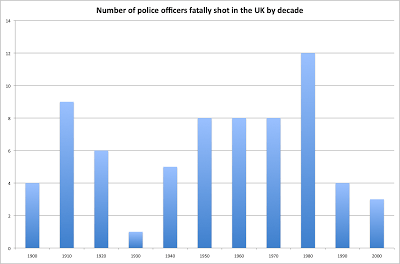
Source: Number of police officers shot dead in the UK by decade | John Graham-Cumming.
This suggests to me that the ledger is in the wrong direction. This list does not include British police stabbed or beaten to death nor are Northern Ireland deaths.
According to the FBI, from 1980–2014, an average of 55 law enforcement officers are feloniously killed per year in the USA. Those killed in accidents in the line of duty are not included in this number.
More law enforcement officers are murdered every year in the USA than ever murdered by gunfire in Britain. Police have the same common law right as any other to defend their own lives and the lives of others.
/cdn0.vox-cdn.com/uploads/chorus_asset/file/2849636/Screen_Shot_2014-12-21_at_1.42.15_PM.0.png)
Entrepreneurial alertness in filming police brutality
25 Jul 2015 1 Comment
in economics of crime, entrepreneurship, law and economics, managerial economics, market efficiency, organisational economics, personnel economics Tags: crime and punishment, criminal deterrence, entrepreneurial alertness, law enforcement, police, police brutality
Cumulative probability of a parent in prison by the age of 14
24 Jul 2015 Leave a comment
in economics of crime, law and economics, politics - USA Tags: crime and punishment, criminal deterrence, incarceration rates, single parents
What are some economic & social costs of crime & incarceration in the U.S? See 10 facts: bit.ly/1xvWAo2 http://t.co/6YNKYi6f43—
The Hamilton Project (@hamiltonproj) April 13, 2015
America’s Peculiar Bail System
20 Jul 2015 Leave a comment
in economics of crime, law and economics Tags: bail, crime and punishment, criminal deterrence
America's Peculiar Bail System: priceonomics.com/americas-pecul… http://t.co/QxN4do58Uy—
Priceonomics (@priceonomics) May 26, 2015
Personal cameras as evidence that criminal deterrence works and works well
16 Jul 2015 1 Comment
in economics of crime, law and economics, managerial economics, organisational economics, personnel economics, politics - New Zealand, politics - USA Tags: body cameras, crime and punishment, criminal deterrence, police, prisons
Hutt City Council parking wardens are the latest in a long line of frontline staff to wear lapel cameras to deter assaults and verbal abuse. These lapel cameras are another illustration about how criminals and miscreants respond to incentives and are deterred by a greater prospect of being caught, convicted and punished. In the case of lapel cameras, there is a greater prospect of been identified and recorded for later proceedings.

The introduction of personal cameras in New Zealand prisons in high risk areas lead to a large reduction in the number of incidents of violence and abuse towards prison staff. Chief custodial officer Neil Beales said:
The use of on body cameras has led to a 15 to 20 per cent reduction in disruptive incidents (which can range from very minor to more serious) in units where cameras were used, compared with units where they were not used.
Even hardened prison inmates respond to incentives and a greater prospect of being caught and punished.

The introduction of personal cameras is not a priority for the New Zealand police. Mention was made of a six year long budget freeze as one of the reasons.
The first randomized controlled trial of police body cameras in the USA showed that cameras sharply reduce the use of force by police and the number of citizen complaints.

In Seattle, where a dozen officers started wearing body cameras in a pilot program in December, the police department has set up its own YouTube channel, broadcasting a stream of blurred images to protect privacy.
Gun related homicides compared
09 Jul 2015 Leave a comment
in economics of crime, law and economics Tags: crime and punishment, gun control
Gun related homicides http://t.co/BUZ4XIwTWY—
Charts and Maps (@ChartsandMaps) April 12, 2015
What is the most common use of a gun at crime scenes?
03 Jul 2015 Leave a comment
in economic history, politics - USA Tags: crime and punishment, gun control
1st 999 number introduced today 1937
30 Jun 2015 Leave a comment
in economic history, economics of crime, economics of media and culture, entrepreneurship, law and economics Tags: British economy, crime and punishment, London
999 – World's first emergency telephone number – was introduced in London #OnThisDay 30 June 1937 #emergencyservices http://t.co/I4gbrwJ2Vp—
BT Archives (@BTArchives) June 30, 2014
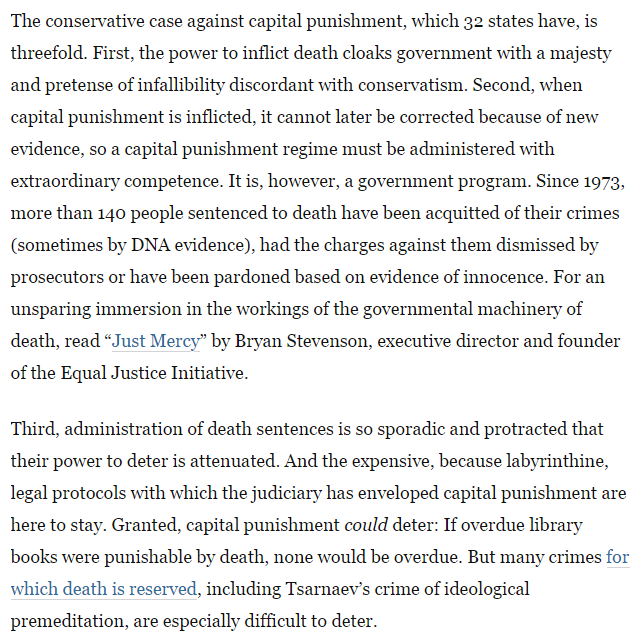
The conservative case against capital punishment – George Will
15 Jun 2015 Leave a comment
in economics of bureaucracy, economics of crime, law and economics, politics - USA, Public Choice Tags: capital punishment, crime and punishment, criminal deterrence, The fatal conceit, The pretence to knowledge, unintended consequences
Hostage Uses Pizza Hut App to Order a Police Rescue
13 Jun 2015 Leave a comment
in economics of crime, law and economics, politics - USA Tags: crime and punishment, entrepreneurial alertness
Hostage Uses Pizza Hut App to Order a Police Rescue popularmechanics.com/default/a15405… http://t.co/gxFq0zqBCn—
Popular Mechanics (@PopMech) June 10, 2015
 Utopia, you are standing in it!
Recent Comments