Crimes by age and offence category
27 Jul 2015 Leave a comment
in economics of crime, human capital, labour economics, labour supply, law and economics, occupational choice, politics - USA Tags: crime and punishment, criminal deterrence
Entrepreneurial alertness in filming police brutality
25 Jul 2015 1 Comment
in economics of crime, entrepreneurship, law and economics, managerial economics, market efficiency, organisational economics, personnel economics Tags: crime and punishment, criminal deterrence, entrepreneurial alertness, law enforcement, police, police brutality
Cumulative probability of a parent in prison by the age of 14
24 Jul 2015 Leave a comment
in economics of crime, law and economics, politics - USA Tags: crime and punishment, criminal deterrence, incarceration rates, single parents
What are some economic & social costs of crime & incarceration in the U.S? See 10 facts: bit.ly/1xvWAo2 http://t.co/6YNKYi6f43—
The Hamilton Project (@hamiltonproj) April 13, 2015
America’s Peculiar Bail System
20 Jul 2015 Leave a comment
in economics of crime, law and economics Tags: bail, crime and punishment, criminal deterrence
America's Peculiar Bail System: priceonomics.com/americas-pecul… http://t.co/QxN4do58Uy—
Priceonomics (@priceonomics) May 26, 2015
Personal cameras as evidence that criminal deterrence works and works well
16 Jul 2015 1 Comment
in economics of crime, law and economics, managerial economics, organisational economics, personnel economics, politics - New Zealand, politics - USA Tags: body cameras, crime and punishment, criminal deterrence, police, prisons
Hutt City Council parking wardens are the latest in a long line of frontline staff to wear lapel cameras to deter assaults and verbal abuse. These lapel cameras are another illustration about how criminals and miscreants respond to incentives and are deterred by a greater prospect of being caught, convicted and punished. In the case of lapel cameras, there is a greater prospect of been identified and recorded for later proceedings.

The introduction of personal cameras in New Zealand prisons in high risk areas lead to a large reduction in the number of incidents of violence and abuse towards prison staff. Chief custodial officer Neil Beales said:
The use of on body cameras has led to a 15 to 20 per cent reduction in disruptive incidents (which can range from very minor to more serious) in units where cameras were used, compared with units where they were not used.
Even hardened prison inmates respond to incentives and a greater prospect of being caught and punished.

The introduction of personal cameras is not a priority for the New Zealand police. Mention was made of a six year long budget freeze as one of the reasons.
The first randomized controlled trial of police body cameras in the USA showed that cameras sharply reduce the use of force by police and the number of citizen complaints.

In Seattle, where a dozen officers started wearing body cameras in a pilot program in December, the police department has set up its own YouTube channel, broadcasting a stream of blurred images to protect privacy.
The conservative case against capital punishment – George Will
15 Jun 2015 Leave a comment
in economics of bureaucracy, economics of crime, law and economics, politics - USA, Public Choice Tags: capital punishment, crime and punishment, criminal deterrence, The fatal conceit, The pretence to knowledge, unintended consequences
Prison incarceration rates by race and education
12 Jun 2015 1 Comment
in discrimination, economics of crime, economics of education, human capital, labour economics, labour supply, law and economics, occupational choice, politics - USA Tags: compensating differentials, crime and punishment, criminal deterrence, law and order, racial discrimination, racism
Male African American high school dropouts facing a nearly 70% cumulative risk of imprisonment by their early 30s. However, the increase in incarceration rates among high school graduates appeared to be much the same for both blacks and whites.
This hints that racism is not as good explanatory of high rates of African-American male incarceration. Police do not know whether the people they arrest have high school diplomas or not but most of the people they arrest are high school dropouts. This suggests that the opportunity cost and rewards of crime over lawful occupational pursuits is a driver of the supply of crime.
There was only 1 crime for which sentences went up a lot in the USA
12 Jun 2015 Leave a comment
in economics of crime, law and economics, politics - USA Tags: crime and punishment, criminal deterrence
Striking that there was only 1 crime for which sentences went up a lot: Murder. A bad thing? vox.com/2015/5/7/85653… http://t.co/yTOXPJFT3O—
Kay Hymowitz (@KayHymowitz) May 07, 2015
1/3rd of mass shootings ended when members of the public subdued or shot the perpetrator
28 May 2015 Leave a comment
in economic history, economics of regulation Tags: crime and punishment, criminal deterrence, gun control
US imprisonment rates by race and education
18 May 2015 Leave a comment
in economics of crime, labour economics, law and economics, occupational choice Tags: crime and punishment, criminal deterrence, imprisonment rates
The crime rate is certainly down in America
28 Apr 2015 Leave a comment
in economics of crime, law and economics Tags: crime and punishment, criminal deterrence
England riots culprits jailed for 1,800 years, which deterred crime
26 Mar 2015 Leave a comment
in economics of crime, labour economics, law and economics, occupational choice Tags: crime and punishment, criminal deterrence, London riots


The level of lawlessness was shocking and wholly inexcusable. The imposition of severe sentences, intended to provide both punishment and deterrence, must follow…
The context hugely aggravates the seriousness of each individual offence … the sheer numbers involved may have led some of the offenders to believe that they were untouchable and would escape detection…
When there is wanton and vicious violence of gross degree the court is not concerned with whether it originates from gang rivalry or from political motives. It is the degree of mob violence that matters and the extent to which the public peace is broken.”
The Lord Chief Justice Judge
The response of the criminal fraternity in London to the sentences handed out during the London riots was very business like. Offending for those particular sentences dropped. Criminals substituted to other forms of crime to pursue their chosen occupation as a criminal in light of the changed incentives:
…a significant drop in riot crimes across London in the six months after the riots, consistent with a deterrence effect from the tougher sentencing. More evidence of general deterrence comes from the observation that crime also fell in the post‐riot aftermath in areas where rioting did not take place.
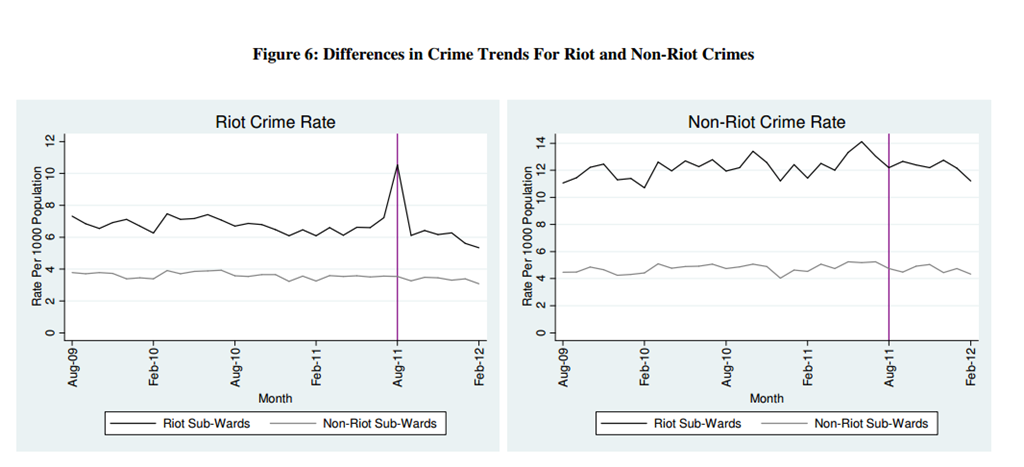
The deterrent effect of the sentences handed down in the immediate aftermath of the London riots 2011
05 Aug 2014 Leave a comment
in economics of crime, law and economics Tags: crime and punishment, criminal deterrence, London riots 2011
Savage criminal sentences were handed down by the courts in the days after the London riots in 2011.
- Nicholas Robinson (aged 23) was sentenced to 6 months imprisonment for stealing bottles of water (worth £3.50) from a looted shop in Brixton. His previous good character and early plea of guilty to a non-dwelling burglary, as well as the low value of goods stolen, the fact he was in education, and his remorse, were in his favour. These meant the magistrate decided to not send him up to the Crown Court where he would face a possible higher sentence.
- Danielle Corns (19) was sentenced to 10 months for stealing two left-footed trainers in Wolverhampton and leaving them outside the shop.
- Two 20-year olds were sentenced to 4 years imprisonment for creating a Facebook riot event in Northwich (which didn’t occur and to which no one attended).
7 out of 10 of sentences issued in the aftermath of the London riots were upheld in full in the Court of Appeal. Any reductions were modest. The longer sentence handed out was 23 years for conspiracy to murder to the leader of a gang who planned to drive to the riots carrying guns to attack the police.

Brian Bell, Laura Jaitman and Stephen Machin (2014) used this sudden change in the judicial wind to measure the impact of tough sentences on crime.
Across London, they found a significant drop in “riot crimes” – burglary, criminal damage and violence against the person – over the six months following the riots.
Other crimes showed a tendency to increase, as though criminals were substituting away from these “expensive” crimes and towards the “cheaper” ones.
Crime is occupation choice: criminals commit crime because they find that profitable to do so. When criminals anticipate that crime will be less profitable and more likely to be accompanied by the prison experience, less crimes are committed.
HT: timharford.com
The rationality postulate is under attack from the other people are stupid fallacy-updated
14 Apr 2014 Leave a comment
in applied price theory, behavioural economics, economics of crime, entrepreneurship, experimental economics, industrial organisation, market efficiency, survivor principle Tags: behavioural economics, crime and punishment, criminal deterrence, experimental economics, Gordon Tullock, token economies, Vernon Smith
The rationality postulate is under attack from the other people are stupid fallacy: not you, not me, not present company, of course, but the nameless them over there; the perpetually baffled, every man jack of them.
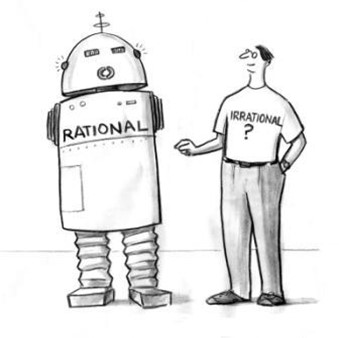
These no-hopers are deemed competent to vote and DRIVE CARS, but they cannot get their head around a credit card. How the them over there find their way to work every morning must be a mystery to behavioural economists. One summary of behavioural labour economics is this:
The key empirical findings from field research in behavioural economics imply that individuals can make systematic errors or be put off by complexity, that they procrastinate, and that they hold non-standard preferences and non-standard beliefs
I found the chapter in Tullock and McKenzie’s book on token economies in mental hospitals to be most enlightening.
The tokens were for spending money at the hospital canteen and trips to town and other privileges. They were earned by keeping you and your area clean and helping out with chores.
The first token economies were for chronic, treatment-resistant psychotic inpatients.
In 1977, a major study, still considered a landmark, successfully showed the superiority of a token economy compared to the standard treatments. Despite this success, token economies disappeared from the 1980s on.
Experiments which would now be unethical showed that the occupational choices and labour supply of certified lunatics responded to incentives in the normal, predictable way.
For example, tokens were withdrawn for helping clean halls and common areas. The changes in occupational choice and reductions in labour supply was immediate and as predicted by standard economics.
Some patients would steal the tokens for other patients, so the token individually marked, and the thefts almost stopped. Crime must pay even for criminally insane inpatients.
Kagel reported that:
The results have not varied with any identifiable trait or characteristic of the subjects of the token economy – age, IQ, educational level, length of hospitalization, or type of diagnosis.

Behavioural economics is an excellent example of how engaging in John S. Mill’s truth that engaging with people who are partly or totally wrong sharpens your arguments, improves their presentation and deepens your analysis.
People have a better understanding of rationality such as through the work of Vernon Smith on ecological and constructivist rationality and of how people deal with human frailties and correct error through specialisation, exchange and learning.
- George Stigler in his Existence of X-inefficiency paper opposed attributing behaviour to errors because error can explain everything so it explains nothing until we have a theory of error.
- Kirzner in “X–Inefficiency, Error and the Scope for Entrepreneurship” wrote that error is pervasive in economic processes. Rational Misesian human actors are human enough to err.
What is inefficient about the world, said Kirzner, is at each instant, an opportunity for improvements, in one way or another and is yet simply not yet noticed. The lure of pure entrepreneurial profits harnesses the systematic elimination of errors and points the way to the market generated institutions necessary for steady social improvements to emerge. Brand names are an obvious example of an institution to overcome doubts about product quality. Middle-men and brokers specialise in performing much of the calculation burdens in their markets.
Many still compare real-world marketplaces to idealised regulation overseen by bureaucrats free of the very biases they are nudging us along to overcome. There are real constraints that limit the options available to fix what are seen as problems to be solved.
Vernon Smith when asked about behavioural economics, wondered how so cognitively flawed a creature made it out of the caves. Vernon Smith argued that the answer had a lot to do with the institutions that emerged to overcome human limitations:
Markets are about recognizing that information is dispersed in all social systems and that the problem of society is to find, devise, and discover institutions that incentivize and enable people to make the right decisions without anyone having to tell them what to do.
Smith and Hayek both posit that market institutions rather than individuals bear the primary cognitive burden in coordinating economic activity. To quote Vernon Smith:
What we learn from experiments is that any group of people can walk into a room, be incentivized with a well-defined private economic environment, have the rules of the oral double auction explained to them for the first time, and they can make a market that usually converges to a competitive equilibrium, and is 100 per cent efficient—they maximize the gains from exchange—within two or three repetitions of a trading period.
Yet knowledge is dispersed, with no participant informed of market supply and demand, or even understanding what that means.
This strikingly demonstrates what Adam Smith called ”a certain propensity in human nature . . . to truck, barter, and exchange one thing for another”
These double oral auctions converged to the competitive price even with as few as three or four sellers with neither the buyers nor sellers knowing anything of the values or costs of others in the market. Price-taking behaviour was not necessary to reach these competitive outcomes.
Behavioural economics is a clumsy way of discussing the pervasiveness of errors because insufficient attention is paid to decentralised, emergent market processes that correct them, often long ago.
 Utopia, you are standing in it!
Recent Comments